
Sesklo
Before the pyramids, before Stonehenge, before bronze was ever poured into a mold, people were already firing fine red-on-white pottery on a low hill above a Thessalian stream. The oldest layers at Sesklo reach back to around 7500 BC. When the first villagers here were planting wheat and shaping clay, the entire span of recorded Greek history still lay thousands of years in the future. This quiet village near Volos holds the deepest human roots in Europe.
The First European Town
Sesklo gives its name to the earliest known Neolithic culture of Europe, a way of life that spread across Thessaly and into Macedonia. The Greek archaeologist Christos Tsountas first put a spade into the mound in the early 20th century, and what he and later excavators found reset the clock on European civilization. At its peak around 5000 BC, the settlement sprawled across roughly twenty hectares. Somewhere between 500 and 800 houses crowded the slopes, home to a population that may have approached five thousand people. That is not a scattering of huts. That is a town, built on a hillside above fertile valleys, generations before anywhere else in Europe could claim the same.
Mud, Stone, and Two Storeys
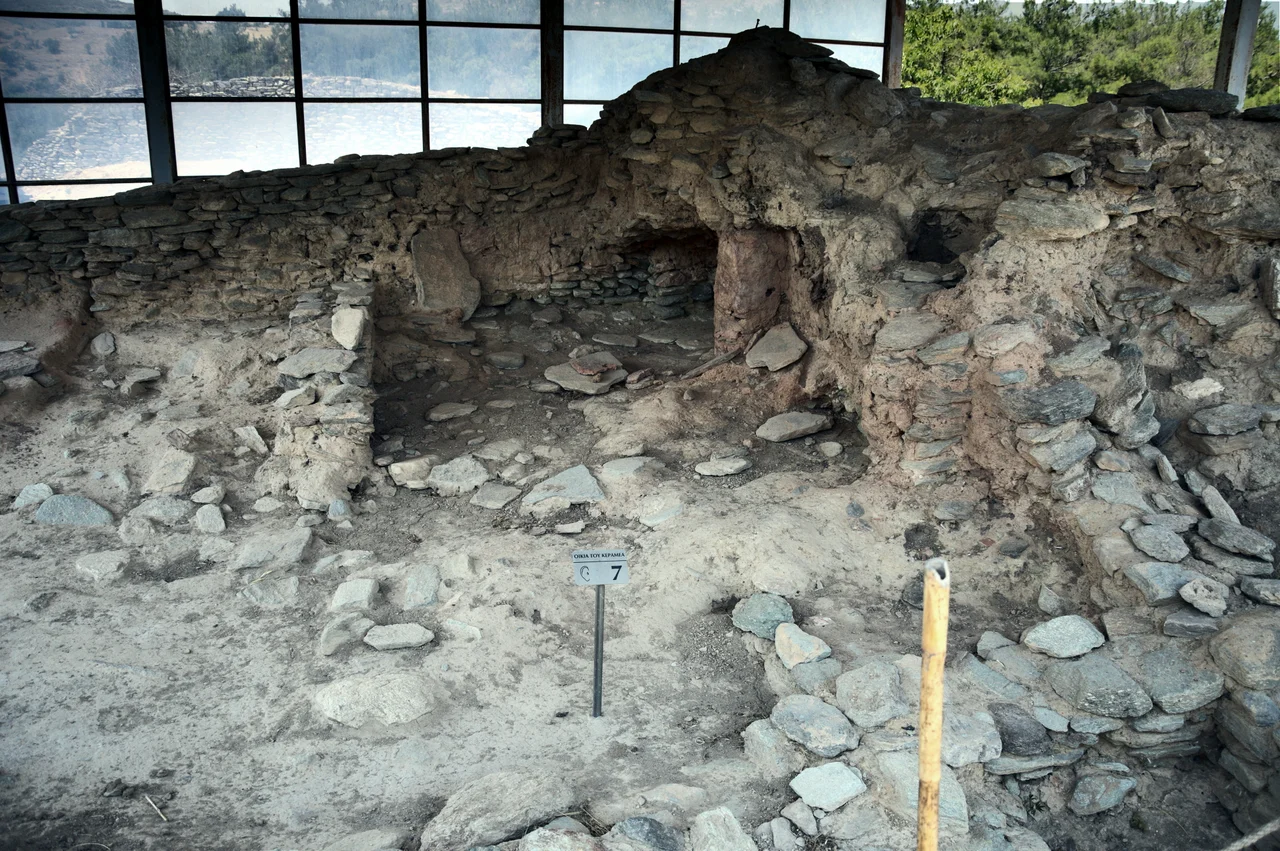
The people of Sesklo grew wheat and barley and kept herds of sheep and goats, along with cattle, pigs, and dogs. Their earliest homes were modest, one or two rooms framed in wood or raised in mudbrick. But something remarkable happened over the centuries. Building grew standardized: adobe walls rose on solid stone foundations, laid out with a deliberate, almost urban order. Archaeologists found the first two-storey houses here. Walk the excavated foundations today and you are reading the blueprint of the first deliberately planned community on the continent, where someone, nine thousand years ago, decided exactly where the next house should stand.
Red on White
The hallmark of Sesklo is its pottery, and it is genuinely beautiful. The villagers developed a fine glazed earthenware and painted it with crisp geometric designs in red on a pale ground, work that rivals in age the earliest ceramics of the Near East. Toward the culture's end the patterns loosen into flame-like motifs. Alongside the pots came figurines, above all statuettes of women, many of them pregnant, almost certainly tied to fertility beliefs that echo across the prehistoric Balkans. The pioneering archaeologist Marija Gimbutas even saw in one Sesklo mask the ancestor of the gorgon face that would haunt Greek art for millennia afterward.
An Ending in Dispute
How the Sesklo culture ended is still argued. An older "invasion theory" held that around 5000 BC the settlement was violently overrun by the people of the neighboring Dimini culture. A competing view, advanced by Professor Ioannis Lyritzis using thermoluminescence dating of ceramics from both sites, tells a quieter story. By his reading the Dimini people first appeared among the "Seskloans" around 4800 BC, four centuries before the culture faded near 4400 BC, meaning the two communities coexisted rather than one simply destroying the other. Either way, the influence radiated outward. Researchers trace lines from Sesklo to the Karanovo and Körös cultures, and through them to the great Danube civilization. Europe's farming future grew, in part, from this hill.
Standing on the Mound
Today Sesklo is a small village, and the archaeological site sits open to the sky a short drive from Volos. The mound is unassuming, low and grassy, the kind of rise you might walk past without a second look. That is exactly the wonder of it. The finds, the painted pottery and the little clay women, are mostly in the Archaeological Museum of Volos, donated and housed in a building that itself dates to 1909. Stand on the excavated foundations and the scale of time bends. The people who lived here were not a footnote to Greek history. They were its first chapter, written in mudbrick and red paint long before anyone thought to write at all.
From the Air
Sesklo lies at 39.36°N, 22.84°E, on low hills roughly 15 km west of Volos in Thessaly. The nearest airport is Nea Anchialos National (LGBL), about 25 km to the south. From the air, look for the broad fertile plain of Thessaly opening west of the Pagasetic Gulf, with the mound itself a subtle rise above a stream valley. Best viewed at low altitude in clear daylight; the surrounding farmland is most legible in spring green or summer gold.
Nearby Stories
- Greece 13 km away
- Larissa Cremaste 16 km away
- Monastery of Saint David the Elder 21 km away
- Karditsa 21 km away
- Skiathos Castle 24 km away
- Tempi Train Crash 36 km away
- Meteora: The Monasteries Built on Impossible Pillars 48 km away
- Battle of Potidaea 73 km away