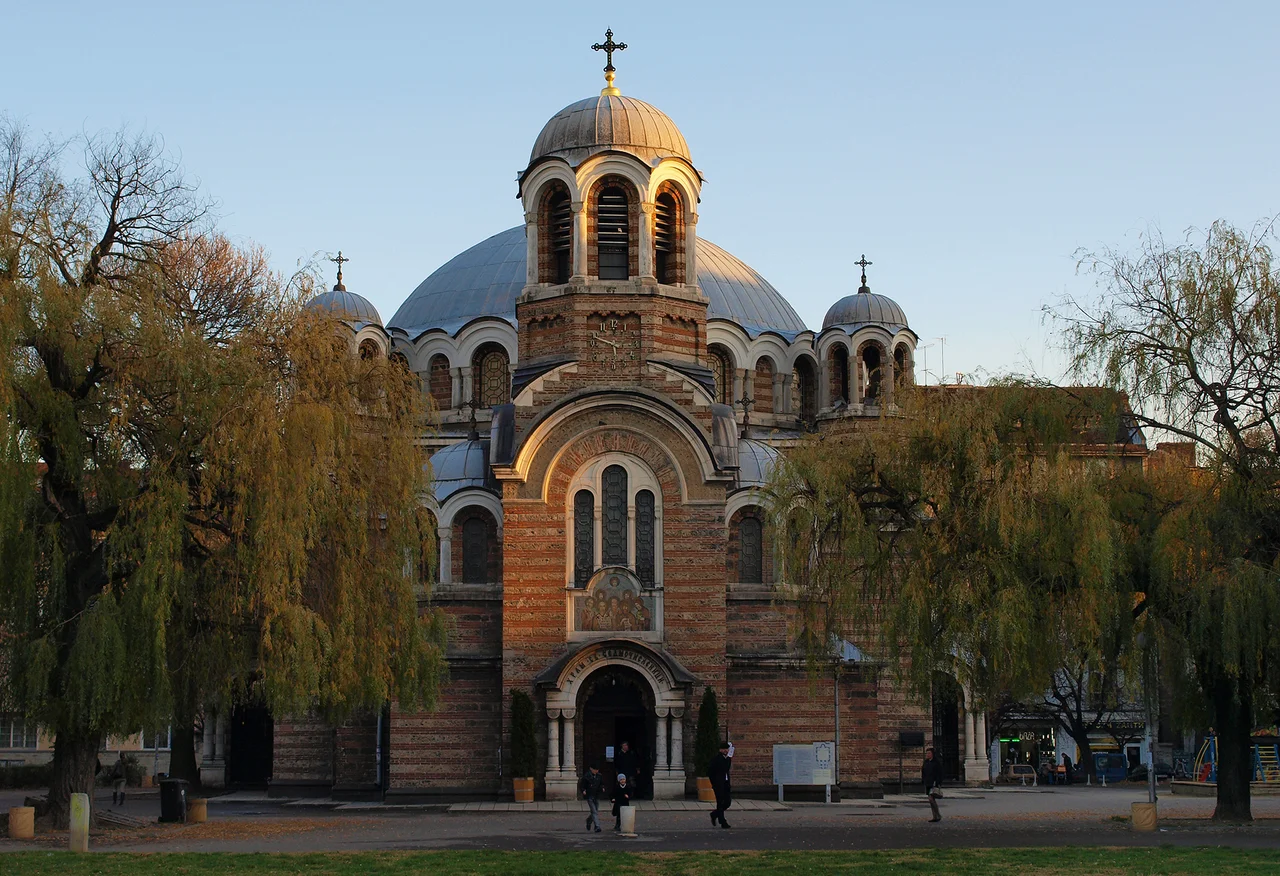

Seven Saints Church, Sofia
The dedication is unusual. Most churches honor a single patron, occasionally a pair. This one honors seven, and the names are worth saying because they explain why this dome stands where it does. Cyril and Methodius are the famous two, the brothers from Thessalonica who in the ninth century created an alphabet capable of writing Slavic speech. Their five disciples were Clement, Naum, Sava, Gorazd, and Angelarius. Together the seven shaped Bulgarian and broader Slavic culture in ways that still echo every time anyone reads Cyrillic.
Layers Beneath the Floor
When workers were preparing the site at the turn of the twentieth century, they kept finding older buildings beneath their feet. There was an early Christian temple from the fourth or fifth century, excavated in 1901. Beneath that was a pagan temple of Asclepius, the Greek god of healing, dating to Roman Serdica when this neighborhood housed shrines for the sick who came seeking the god's intervention. There were also remnants of a former nunnery associated with the Rila Monastery, the great Bulgarian religious house tucked into the mountains south of the city. The building that stands today rises on a thousand years of earlier devotion, each generation worshipping different powers in essentially the same square of ground. This pattern repeats across Sofia, where the city has been continuously inhabited since at least 7000 BC, but here you can almost feel the layers.
Sinan's Hand
The current structure began as the Black Mosque, completed around 1547. It was commissioned by Sofu Mehmed Pasha, a former governor-general of Rumelia who would rise to become a vizier under Suleiman the Magnificent. The architect was Mimar Sinan, the same Mimar Sinan whose Selimiye Mosque in Edirne would later be called his masterpiece. Sinan worked across the entire Ottoman Empire, leaving mosques and bridges in cities most of his contemporaries never saw, and Sofia got one of his designs. The mosque was 25 meters square with a single great lead-covered dome over its central hall. Its minaret was made of dark granite, which is what gave the building the name that stuck: the Black Mosque. The minaret collapsed during a 19th-century earthquake. After Bulgaria gained independence from the Ottoman Empire in 1878, the abandoned mosque drifted through profane uses, serving as a military warehouse and then as a prison.
Becoming a Church
The Russian architect Alexander Pomerantsev, who had designed the Upper Trade Rows on Moscow's Red Square, suggested that the abandoned mosque be converted into a Christian church. Two Bulgarian architects, Yordan Milanov and Petko Momchilov, took on the design work. They preserved Sinan's central hall and his great dome and added a narthex, four oval bays, an altar section, and a bell tower in the Neo-Byzantine style favored by Bulgaria's young national architecture. Construction took a year, from May 1901 to May 1902, though the interior decoration would not be completed until 1996. Tsar Ferdinand was recognized in 1905 as the primary donor. The statesman Petko Karavelov, who had served four times as Prime Minister of Bulgaria, also contributed significantly to the rebuilding. He died in January 1903, just months before the church was inaugurated, and was buried in its grounds along with his wife. The church opened on 27 July 1903.
Small Material Stories
Two details say something about how Bulgaria approached the work. The large candlesticks standing in front of the altar were cast in 1903 from obsolete police badges collected from Eastern Rumelia and the Principality of Bulgaria, the two political units that had been merged in 1885 to form modern Bulgaria. The metal of an outdated state was reforged into objects of worship. An electric clock fitted to the western facade in the 1930s was made by Georgi Hadzhinikolov, a noted Bulgarian watchmaker, and is still running. The mosque was originally part of a larger complex. There had been an imaret, a kitchen for the poor, and a madrasa that was later turned into a prison after the Liberation. There had been a caravanserai for traveling merchants and a hammam for washing. Most of these are gone, traced now only by foundations turned up during construction work.
Why the Dedication Matters
The Seven Saints to whom the church is dedicated were not chosen arbitrarily. Cyril and Methodius were Greek brothers who in 863 set out from the Byzantine Empire to evangelize the Slavs of Great Moravia. To translate the Bible and the liturgy into a language that had no written form, they invented an alphabet. Their first script, called Glagolitic, was eventually replaced by the simpler Cyrillic developed by their disciples after Cyril's death. The five disciples were the ones who carried the alphabet south after a hostile reception in Moravia, eventually finding refuge and royal patronage in Bulgaria. Without them, there would be no Cyrillic script, which today is used by hundreds of millions of people from Bulgaria to Mongolia. Dedicating Sofia's most prominent post-liberation church to all seven was a statement about national identity rooted in language. Bulgaria, freshly free from five centuries of Ottoman rule, was claiming its place as the cradle of Slavic letters.
From the Air
The Seven Saints Church sits in central Sofia at 42.69N, 23.33E, near the Count Ignatiev School and within the historic core of the Bulgarian capital. Sofia lies in a valley at 550 meters elevation, surrounded by mountains: Vitosha rises south to 2,290 meters, Lyulin sits west, and the Balkan range runs to the north. From altitude the city is a clear oval against the dark Vitosha massif. Recommended viewing altitude is 5,000-7,000 feet for the church and city center. Vasil Levski Sofia Airport (LBSF) lies just east of the city, the country's main international gateway. Plovdiv (LBPD) is 90 nautical miles southeast. Air pollution can affect visibility in winter due to temperature inversions; spring and autumn afternoons are typically clearest. Vitosha mountain often holds cloud while the valley below stays clear.
Nearby Stories
- Battle of the Gates of Trajan 1.3 km away
- Battle of Kresna Gorge 65 km away
- Battle of Plovdiv (1878) 70 km away
- Battle of Kosturino 114 km away
- New Europe Bridge 129 km away
- Old Bazaar, Skopje 136 km away
- Trapezitsa Fortress 142 km away
- Trajan's Bridge 193 km away