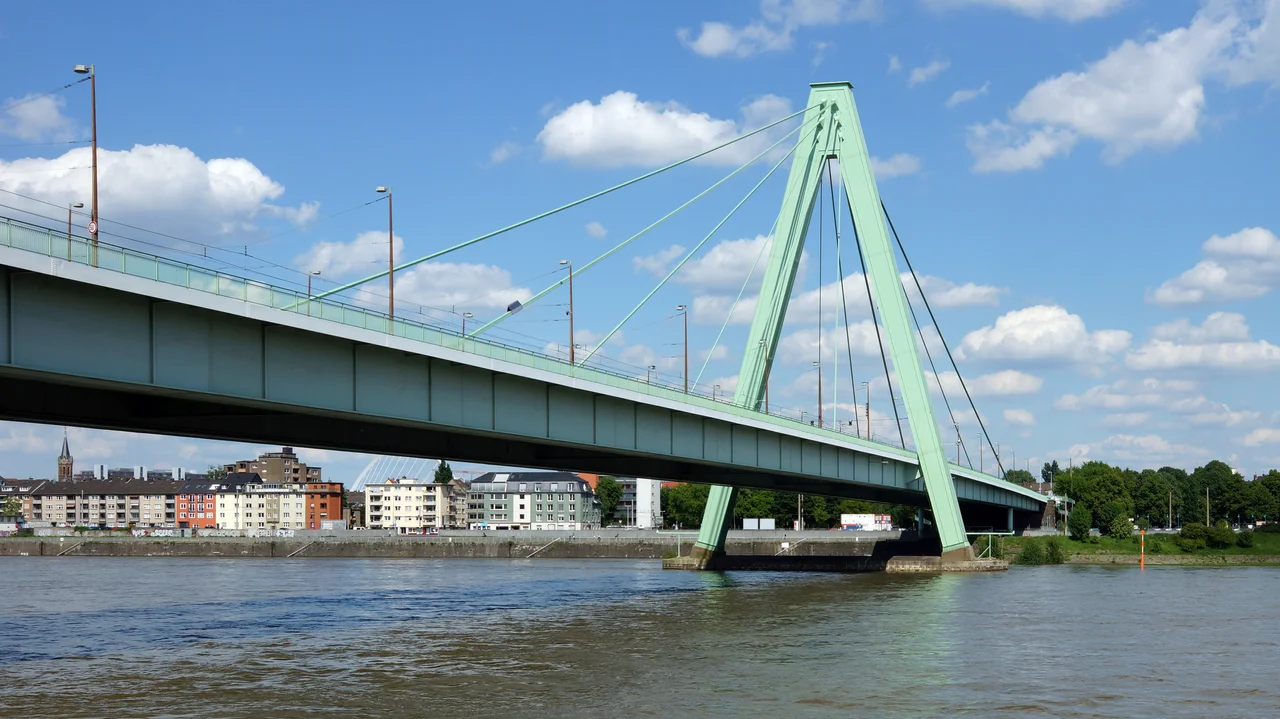

Severins Bridge
Look upstream from Cologne Cathedral and the river opens out, the spires of the Altstadt reflecting in the water, nothing breaking the line of the old town. That uncluttered view is not an accident. When engineers were asked to span the Rhine here in the late 1950s, they were given a strict constraint: don't put anything in front of the cathedral. The answer was a single A-shaped pylon, planted hard against the right bank, holding the entire bridge deck on steel cables that fan out across 691 metres of water. Cologne calls it the Severinsbrücke. When it opened in 1959, no cable-stayed bridge in the world spanned further.
After the War
By 1956 every one of Cologne's Rhine bridges had been destroyed or rebuilt. The city's general traffic plan that year called for two new crossings to complete the postwar reconstruction, and the Severinsbrücke would be the first entirely new bridge location, not a rebuild. Construction did not begin gently. On 21 September 1956, during preparations for the foundations, a counterweight for the bridge pillar lost its balance. At least five workers were killed. The project went on, the bridge was opened on 7 November 1959 by Federal Chancellor Konrad Adenauer and Cardinal Josef Frings, the cathedral's archbishop, and Mayor Theo Burauen cut the ribbon. The dead workers are not commemorated on the bridge itself, but they belong to its history.
One Pylon, Not Two
The design problem was real. A conventional cable-stayed bridge needs two pylons, one on each bank, but two pylons here would have framed the cathedral and the Altstadt in steel, ruining the most photographed silhouette in Germany. Architect Gerd Lohmer worked with the great German bridge engineer Fritz Leonhardt to find another way: a single A-shaped pylon, anchored on the Deutz side, with the deck cantilevered out toward the Altstadt and held up by long steel cables splayed from the pylon's head. The pylon rises 77.2 metres above the bridge's foundations and the main span between it and the far abutment is 302 metres. At its opening it was the longest cable-stayed main span in the world and the first to use an A-shape. The construction used 8,300 tonnes of steel and cost 25.3 million Deutschmarks.
Painted Cologne Green
Every road bridge in Cologne is painted the same shade, a deep mossy colour the city calls Brückengrün, and the Severinsbrücke is part of that family. It carries four lanes of road traffic, two tracks of the Stadtbahn (lines 3 and 4 stop at Severinstraße and Suevenstraße), cycle paths, and pavements wide enough to lean on the rail and watch barges work their way upstream toward Basel. The bridge connects the Severinsviertel on the left bank to Deutz on the right, and is fundamental to the inner ring road that loops around the old town. Because of the deck's unusual rigidity, trams could run across it even on its original road-shared track; in 1979 they were given their own dedicated track body. In 1989 the bridge was added to the German monuments list.
A Globe and a Long Argument
On a March day in 1997, the Cologne action artist HA Schult had a helicopter lower a four-metre globe onto the top of the Severinsbrücke's pylon. The globe was a wire grid the size of a small house, with neon outlines of the continents and a single red neon figure, mid-leap, jutting from it in a euphoric pose. It was supposed to stay a few months. The mayor of Cologne, Norbert Burger, hated it. The public was divided. The globe stayed for three and a half years. On 15 October 2000 another helicopter lifted it back off, by then structurally rebuilt, and flew it to its current home on the roof of the DEVK insurance headquarters near the Zoobrücke further up the river, where it still glows at night. The pylon went back to being just a pylon.
Still Holding
Sixty-six years after opening, the Severinsbrücke is still Cologne's most architecturally ambitious crossing. The engineering reputation was confirmed early; in 1967 it won the Cologne architecture prize. In 2014 engineers added internal hot-dip galvanised U-profile reinforcements inside the main beam boxes and the pylon to deal with the punishment of decades of heavy tram and truck traffic. The reinforcements are invisible from outside. The bridge looks today exactly as it did on a November afternoon in 1959 when Adenauer and Frings walked across it for the first time, and the cathedral, two kilometres upstream, still stands silhouetted against an uninterrupted sky.
From the Air
50.9308 N, 6.9679 E. The single asymmetric A-pylon makes the Severinsbrücke instantly identifiable from the air; look for the lone tower on the right (Deutz) bank with cables fanning west across the Rhine. The bridge sits about 1.6 km south of Cologne Cathedral. Cologne/Bonn (EDDK) is 13 km southeast. Düsseldorf (EDDL) 35 km north. The painted green deck is distinctive against the brown river.
Nearby Stories
- Diamond Interchange: How a Simple Idea Reshapes Towns Like Julich 2.8 km away
- Dusseldorf-Unterbach 6.1 km away
- Baumwollspinnerei Ermen & Engels 11 km away
- RAF Bruggen 15 km away
- Hagen Open-air Museum 21 km away
- Belgium 130 km away
- Marcinelle Mining Disaster 173 km away
- Zwingenberg Castle 178 km away