
Shaigiya tribe
The 1707 French map labels them "les Chaighie" and draws pyramids in their country - pyramids that are real, the tombs of the Kushite kings at Jebel Barkal and Nuri. Centuries before a European cartographer put them on paper, the Shaigiya already held the stretch of Nile between Korti and the fourth cataract, and they still do. To understand Sudan - its arguments with Egypt, its memory of the Mahdi, its twentieth-century politics - you have to understand this tribe. Their story is a 500-year continuity interrupted by invasions they sometimes resisted and sometimes joined.
A Language That Went Underground
The Shaigiya tell their own origin story in Arab terms: a Hejazi named Shaig, descended from an uncle of the Prophet, settled among the Nubians after the Arab conquest of Egypt in the seventh century. Historians tell a different one. Dar Shaigiya sat inside the Christian kingdom of Makuria during the medieval period; the tribe as a distinct group probably coalesced in the fifteenth century from hybrid Nubian and Arab lineages. What is certain is the language. As late as the nineteenth century, Shaigiya people were bilingual in Arabic and a Nubian tongue - Dongolawi, according to travelers, or Nobiin, according to the modern historian Jay Spaulding, who found grammatical fingerprints of Nobiin still embedded in mid-1800s Shaigiya documents. Even at the turn of the twentieth century, Shaigiya elders told Nicholls that they were not Arabs at all - they were indigenous to this stretch of Nile, and had always been. The Arabization of Sudan swept the language away in public, but it left traces the grammarians could still read.
The Horse-Riders of the Fourth Cataract
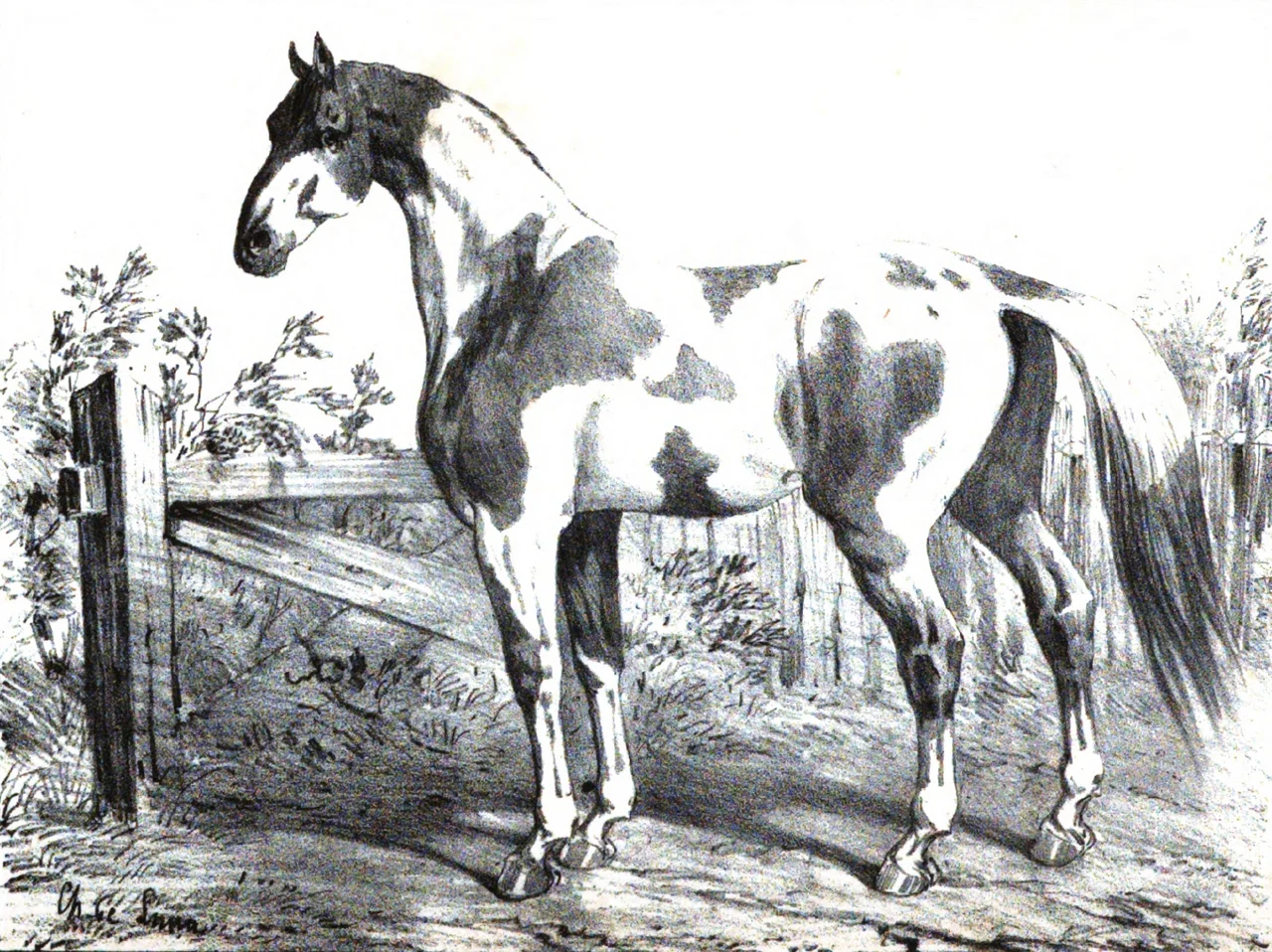
For roughly a century and a half, the Shaigiya were the dominant power on this part of the Nile. Around 1690 they broke from the Funj Sultanate and carved out an independent zone. Their warriors rode Dongola horses - a breed so famous in the eastern Sudan it gave the tribe its military signature. They wore chain mail coats and carried shields of hippopotamus or crocodile hide, armed with lance, sword, or javelin. Their young men, trained from early childhood, could throw a spear from horseback with what the traveler John Lewis Burckhardt called astonishing precision when he lived among them in 1807. The Scottish explorer James Bruce, writing in 1790, noted that the tribe had migrated to its present homeland around 1772. Burckhardt's guide, by contrast, would not light a fire at night for fear of Shaigiya raiders. The tribe had schools that taught Islamic sciences to students from across Sudan. It was not a simple community. The same society that produced scholars also produced the cavalry that terrorized the caravans as far north as Wadi Halfa and as far south as Shendi.
The Year the Muskets Came
In 1820, Muhammad Ali of Egypt launched his conquest of Sudan. The Shaigiya refused to submit. A woman of the tribe named Mihera Bint Abboud rode with the warriors and roused them to resist. At the Battle of Korti the cavalry met firearms and cannon. The result was decisive: the Shaigiya were broken not by lack of courage but by the gap in technology. Mac Jaweesh, one of the tribal chiefs, fled south to Shendi and asked the Ja'Alin leader Mac Nimr to join a coalition. Mac Nimr refused. The Shaigiya were surrendered to the Turks, who offered them terms: take service in the invader's army and keep your lands. They took the deal. When the Ja'Alin rose in revolt in 1822, the Shaigiya helped crush it - and received Ja'Alin territory between Shendi and Khartoum as reward. The alliance would come back to cost them sixty years later.
Between Gordon and the Mahdi
When the Mahdist War erupted in 1881, the Shaigiya's long service with Turco-Egyptian forces put them in an impossible position. Some continued fighting for the invader. Gordon's first operation after reaching Khartoum in 1884 was to rescue a detachment of Shaigiya troops besieged in the fort at Al Halfaya, just north of the city. Major Ahmed Hussein Pasha, from the tribe's Suarab section, held out at Al-Ubayyid against the Mahdi's forces until the fort fell in 1883 - Hussein escaped to Egypt and returned during the reconquest in 1898, and his descendants live today in Omdurman and beyond. In April 1884 another tribal chief, Saleh Wad el Mek, surrendered to the Mahdi with 1,400 men. But the Shaigiya who had stayed with Gordon sealed the tribe's fate: the Mahdi proscribed them. When Khartoum fell in January 1885, Saleh's sons were hunted down and executed by Dervish troops. By the Anglo-Egyptian reconquest of 1898, the tribe had been reduced to a few hundred families.
Rebuilding
They came back. The Shaigiya rebuilt their numbers and their influence through the Egyptian Army and later the Sudan Defence Force, and when Sudan became independent in 1956, Shaigiya officers were prominent in the new military. General Ibrahim Abboud - decorated with the MBE for his bravery at the Battle of Keren in 1941 - was a Shaigi from the Onia section, and in 1958 he led the coup that made him the first military president of the Sudan. Today the tribe's homeland along the Nile between Korti and the fourth cataract remains the core of Dar Shaigiya, though the Merowe Dam, completed in 2009, flooded villages and displaced communities here - another round of accommodation to a state decision made far away. Shaigiya musicians still play the tanbura, the old lyre. The cheek scarifications that once marked children of the tribe are now mostly gone. The horses are still around, though you have to look for them.
From the Air
Dar Shaigiya stretches along a roughly 200km arc of the Nile between Korti (about 18.10°N, 31.80°E) and the fourth cataract (about 18.87°N, 32.10°E) in northern Sudan. The Merowe Dam lies at the fourth cataract and forms a large reservoir visible from cruising altitude. The reference coordinates here (15.63°N, 32.53°E) point toward Khartoum, where many Shaigiya live today. Nearest airports: Khartoum International (HSSS) to the south; Merowe Airport (HSMR) serves the tribal heartland. In clear weather the Nile's gorge through Nubian sandstone makes the region easy to identify.
Nearby Stories
- Esh Shaheinab 27 km away
- Naqa 56 km away
- Mahdist War 65 km away
- Musawwarat es-Sufra 100 km away
- Gezira State 101 km away
- Northern Sudan 215 km away