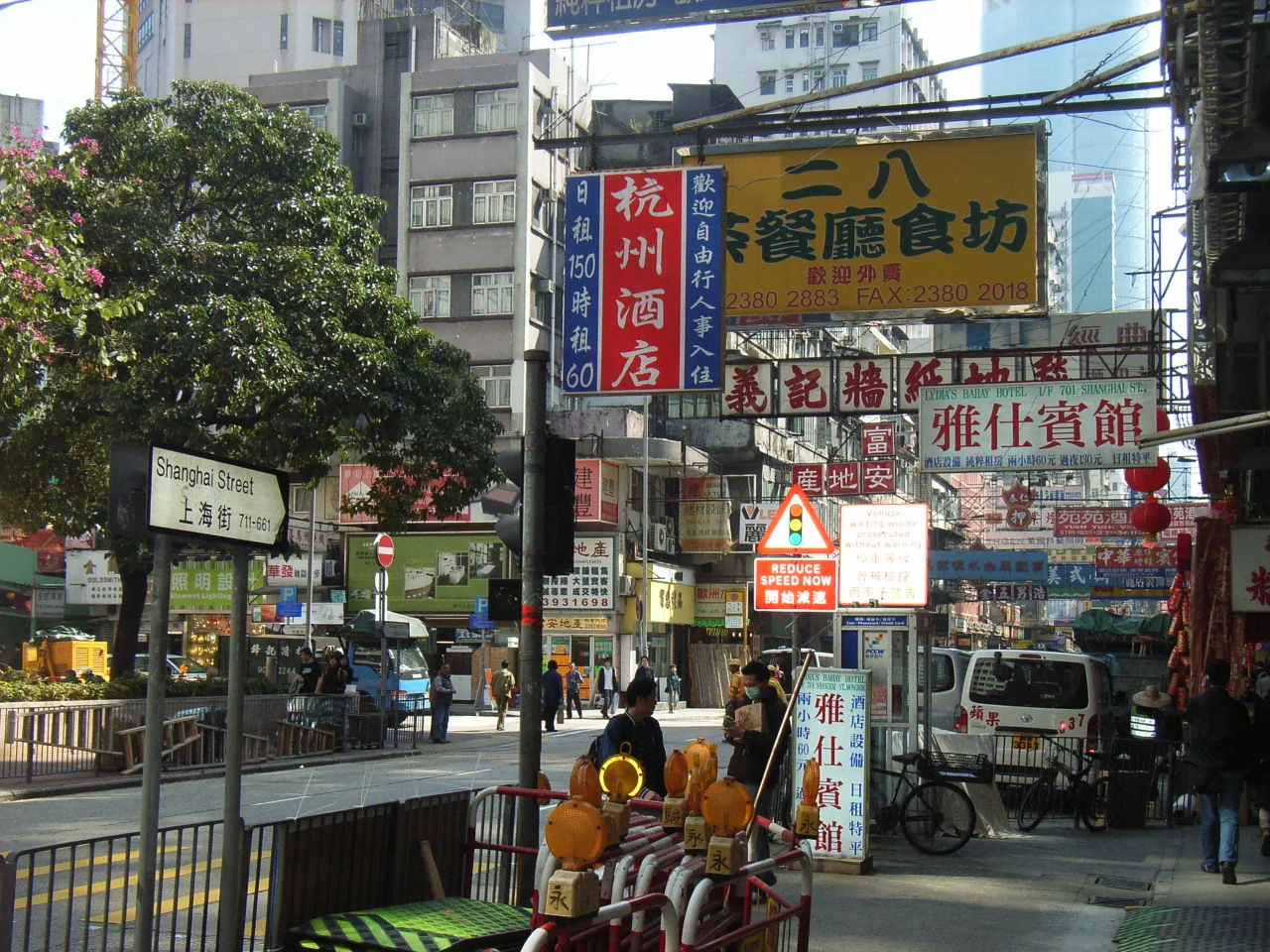

Shanghai Street
The street that became the main commercial artery of Kowloon was not called Shanghai Street when it opened. It was Station Street — 差館街 — named for the Magistrate's Court that anchored its middle section. The rename to Shanghai Street came in 1909, partly to resolve confusion with an Upper Station Street across the harbour in Sheung Wan. But the name "Shanghai" brought its own weight: a reference to the city that epitomized Chinese commercial ambition, chosen for a street that, in the decades before Nathan Road was built up, epitomized the same thing in Hong Kong.
The Street Before Nathan Road
By 1880, the street already had 150 taxed units — including a brothel, the type of business that generated more formal property records than most. Around 9,000 people lived in the Yau Ma Tei district, making it the most densely populated area on the Kowloon peninsula. Shanghai Street sat at its center.
In those decades, the shops were organized around traditional Chinese trades: sellers of wedding dresses and red ceremony goods, fung shui tools, books, pawnshops. The street supplied the social infrastructure of a migrant Chinese population in a British colonial city. Magistrate's Courts stood between Public Square Street and Market Street until one was demolished in 1957. The court that replaced it moved to Gascoigne Road, and the area around the old courthouse was gradually commercialized.
Nathan Road existed from the early 20th century, but its commercial dominance came later. From the 1970s to the 1990s, as Nathan Road boomed with tourists and chain retailers, the Mong Kok section of Shanghai Street developed a different character — hostess clubs and venues related to the sex trade operating alongside the traditional wedding goods and kitchen supply shops. Both forms of commerce still exist there today, alongside residential units, in the layered coexistence that distinguishes Hong Kong's older neighborhoods.
The Red Brick House
At No. 344 Shanghai Street stands a building that looks conspicuously out of place: a red-brick Victorian structure, the last remaining piece of a water pumping station built in 1895. The station operated until 1911. In the years that followed, its three buildings were repurposed: one became a post office in the 1910s and 1920s; another became a hazardous goods store; the third — the surviving red brick building — served as a hawkers control office.
Yunnan Lane, beside the old post office, became a spot where professional letter writers set up their stalls, serving a population that needed correspondence written but could not write it themselves. The post office closed in 1967 when the Kowloon Central Post Office opened nearby. The vacated building then operated as a Street Sleepers' Shelter run by the Salvation Army until the end of the 1990s, when the shelter moved across the street to No. 345A, where it remains.
The red brick building is now a Grade I historical structure, awaiting adaptive reuse. One proposal would restore it in conjunction with the Yau Ma Tei Theatre as a Xiqu Activity Centre for Cantonese opera — a performing and practice space for an art form that has its own Grade I building nearby, waiting to revive it.
The Ten Shophouses
Nos. 600–626 Shanghai Street in Mong Kok are a cluster of ten pre-war shophouses — tong lau, the Cantonese term — built in the 1920s and 1930s. All ten are listed as Grade I historical buildings. They follow the classic tong lau form: shops opening onto a covered five-foot arcade at street level, with low-rent residential accommodation on the upper floors. The buildings are believed to include some of the oldest surviving commercial structures of their type in Hong Kong.
What the shophouses sell matters as much as their architecture. Wedding goods, kitchen equipment, traditional Chinese utensils, ceremonial items, building materials, snake soup — the inventory of a working neighborhood rather than a tourist district. These businesses serve the people who live and work nearby. The buildings are listed; the tenants are not preserved. But the combination, the shophouse form still doing its original work, gives the street a living quality that pure restoration rarely achieves.
Conservation at Scale
In September 2008, the Urban Renewal Authority announced what it described as the largest single heritage conservation initiative ever undertaken in Hong Kong: a plan to preserve the ten shophouses on Shanghai Street, along with ten on Prince Edward Road East, at a cost of HK$1.33 billion. The project covered about 1,128 square metres on Shanghai Street and was part of a broader strategy to save 48 pre-war shophouses across the city.
The plan was not without criticism. Some observers argued that buying out the buildings and redeveloping them for commercial use was not really conservation — that removing the shops and residents who gave the street its character would produce a preserved shell with no living content. The tension between protecting the physical form of old buildings and preserving the social fabric of the communities inside them is a debate Hong Kong has not fully resolved.
Langham Place, the 59-storey Grade A office tower at No. 555 Shanghai Street, represents the other end of the spectrum: completed in July 2004 after displacing 58 buildings and 2,603 residents, its 255.1-metre tower and 15-storey mall now anchor the Mong Kok skyline. The tower and the tong lau stand three blocks apart on the same street, each a kind of answer to a question the other is asking.
From the Air
Shanghai Street runs north-south through Kowloon for approximately 2.3 kilometres, centered near 22.310°N, 114.170°E, passing through Jordan, Yau Ma Tei, and Mong Kok. From the air, the street runs parallel to and one block west of Nathan Road — the dominant commercial corridor visible as a continuous strip of signage and density running from the Star Ferry terminal northward. Langham Place's distinctive stepped tower at the Argyle Street intersection provides a clear landmark at approximately the street's midpoint. Hong Kong International Airport (VHHH) is approximately 22 nautical miles to the west-northwest. Approaching from the airport, the Kowloon peninsula resolves from a dense urban block into a legible grid at altitudes around 2,000–3,000 feet; the Nathan Road/Shanghai Street corridor is the most prominent north-south feature of the western peninsula.
Nearby Stories
- Lok Ma Chau Loop 2.3 km away
- Portas do Cerco 2.3 km away
- Kweilin Incident 17 km away
- Wanshan Archipelago Campaign 34 km away
- Nanxiong Formation 115 km away
- Battle of Nanpeng Island 148 km away
- Heyuan 169 km away
- Cape Maobitou 632 km away