.jpg)
Shaw (Washington, D.C.)
When Langston Hughes was a student at Lincoln University in the mid-1920s, he would catch the train down to Washington and walk south from LeDroit Park into Shaw. He came for what he called the sad songs of 7th Street - the blues and barrelhouse piano spilling out of clubs, the unstudied music of people whose lives Hughes was determined to put into poetry. Shaw at that moment was the pre-Harlem center of Black intellectual and cultural life in America. Alain Locke was a few blocks away at Howard, working on the essays that would become The New Negro. Carter G. Woodson, the father of African American history, lived on Ninth Street and ran his Association for the Study of Negro Life and History out of his rowhouse. Duke Ellington had grown up here. The neighborhood would gentrify, burn, empty out, and gentrify again over the next century. But in 1925 it was, simply, the place.
Uptown
Shaw began as a cluster of freedmen's encampments north of Boundary Street - the old northern edge of the city, now called Florida Avenue. After emancipation, formerly enslaved people moved into the rural outskirts of Washington and built shanties, then slowly improved them, then handed them down. The area was called Uptown. Andrew Johnson, the Tennessee Unionist who became president after Lincoln's assassination, signed Howard University's founding charter in 1867; the institution rose at the northern edge of the neighborhood and became its spiritual anchor. Black professionals, ministers, and teachers built houses around it. By the time the Harlem Renaissance had a name, the cultural movement it described had been gathering in Shaw for two generations. The name Shaw came later, in 1966, when urban planners used Shaw Junior High School's enrollment zone to define a redevelopment area. The school was named for Robert Gould Shaw, the white Union colonel killed at Fort Wagner in 1863 while leading the 54th Massachusetts Infantry, one of the first all-Black regiments of the Civil War.
April 1968
Martin Luther King Jr. was killed in Memphis on April 4, 1968. Riots broke out in Washington within hours, focused along 7th Street through Shaw, the H Street corridor in Northeast, and 14th Street through Columbia Heights. By the time the National Guard arrived, blocks of Shaw were on fire. When the smoke cleared, much of the neighborhood was without electricity, and the small businesses that had lined 7th and 9th Streets were gone - some burned, others closed by owners who never returned. What followed was harder to undo than the riots themselves. White-owned banks pulled out. Insurance redlining made rebuilding impossible. The neighborhood emptied. By 1980 Shaw's population had fallen to roughly half its 1950 peak of 34,000. Civic leaders Walter Fauntroy and Watha T. Daniel founded the Model Inner City Community Organization (MICCO), using federal grants to hire Black architects and planners to design what would replace the burned blocks. The work was slow, occasionally contentious, and often visible only in retrospect.
The Howard Theatre
Long before the Apollo opened in Harlem, the Howard Theatre on T Street was the most important Black entertainment venue in America. Built in 1910, owned by Abe Lichtman - a white impresario who ran several theaters catering to African American audiences - it billed itself in its peak years as the largest color theater in the world. Pearl Bailey, Billie Holiday, Ella Fitzgerald, Duke Ellington playing his way back home, Lena Horne, Sammy Davis Jr., James Brown, Marvin Gaye, the Supremes - all played the Howard. The theater first closed in 1970 following the riots and the shift brought by desegregation, briefly reopened in 1975, then closed again in 1980 - sitting shuttered for over thirty years before reopening in 2012 after a 29-million-dollar restoration. Down the street, the Dunbar Theater, now the Southern Aid Society building, ran from the 1920s through 1960 and hosted similar jazz and blues lineups; it was added to the National Register of Historic Places in 1968. CityMarket at O, originally the O Street Market built in 1881 in Gothic Revival brick, is one of three nineteenth-century public market buildings still standing in the District.
Little Ethiopia
Beginning in the 1980s, Ethiopian immigrants and Ethiopian-Americans started buying property along Ninth and Thirteenth Streets, opening restaurants, coffee bars, and groceries. The concentration was dense enough that the section around 9th and U Streets became locally known as Little Ethiopia, with its own annual cultural festival. Tefera Zewdie, a restaurant owner there, recalls the moment when his clientele tipped over: 'I remember it was, if I'm not mistaken, somewhere between 2000, 2001 it was something big for us to see one non-Ethiopian coming to the restaurant. Now 95 percent of them are non-Ethiopian.' That sentence captures Shaw in miniature. The neighborhood that emerged from freedmen's encampments, became the capital of Black intellectual life, was burned out by King's assassination, and was rebuilt by community organizations is now also the place where Ethiopian injera became a Washington dinner staple and the Compass Coffee on 7th Street opened a brand that spread to dozens of locations.
What Gentrification Has Made
By 2010 Shaw's population was 17,639, roughly half its 1950 peak but already rising fast. The Green Line metro arrived at Shaw-Howard University station in 1991. The Walter E. Washington Convention Center filled the southern edge of the neighborhood in 2003. Restaurants and coffee bars colonized Blagden Alley and Naylor Court, the nineteenth-century service alleys whose former stables and light-industrial buildings became loft-style restaurants and cafes. By the late 2010s the median household income in the Logan Circle/Shaw census tract had reached $84,875, and 67 percent of residents had college degrees. The historic Black population fell as housing prices rose - a process the urbanist Mindy Fullilove called root shock. Shaw today is one of the most-walked, most-eaten, most-photographed neighborhoods in Washington. Shiloh Baptist Church, founded by formerly enslaved members in 1863 in Fredericksburg and relocated to Washington in 1864, still anchors the corner of 9th and P Streets - the Obamas attended Easter services there in 2011. The Carter G. Woodson Home is a National Historic Site. The architectural shell of Hughes's sad songs is preserved. What sounds inside it is something else.
From the Air
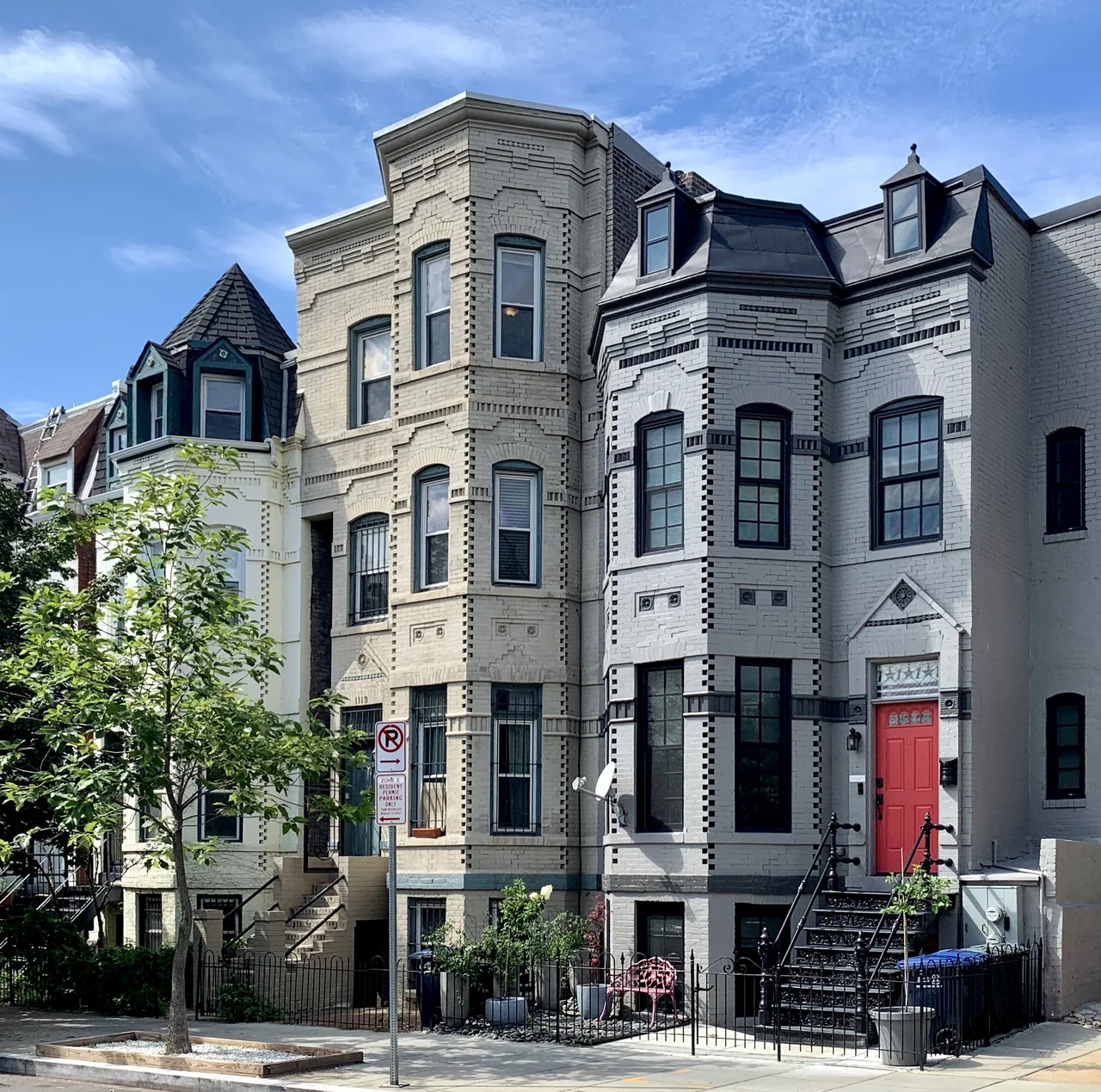
Shaw is bounded roughly by Florida Avenue NW on the north, M Street and Massachusetts Avenue on the south, First Street NW on the east, and 12th Street NW on the west, centered near 38.9120 degrees N, 77.0214 degrees W. From the air the neighborhood reads as a tight grid of nineteenth-century brick row houses, broken by the modernist mass of the Walter E. Washington Convention Center on its southern edge and the open quad of Howard University to the north. Best viewed at 1,500 to 3,000 feet AGL; the area lies within the Washington FRZ. Nearest airports are Ronald Reagan Washington National (KDCA) 4 nm south, College Park (KCGS) 5 nm northeast, and Washington Dulles (KIAD) 23 nm west.
Nearby Stories
- Gunston Hall 1.1 km away
- 2023 Baltimore Shooting 4.9 km away
- Battle of Middleburg 6.6 km away
- Crownsville Hospital Center 10 km away
- Battle of Loudoun Heights 13 km away
- First Battle of Rappahannock Station 20 km away
- Howard County, Maryland 21 km away
- Harriet Tubman Underground Railroad 50 km away