.JPG)
Sheerness Dockyard
On the morning of 10 June 1667, Dutch warships under Admiral Michiel de Ruyter sailed past an unfinished English fort at the mouth of the Medway, captured it almost without firing a shot, plundered the half-built dockyard alongside it, and put both to the torch. They then continued upriver and burned three of the Royal Navy's largest battleships at their moorings at Chatham, towing away the flagship Royal Charles as a prize. The Raid on the Medway is still the worst defeat in the history of the English navy. A parliamentary committee concluded that the disaster was "chiefly occasioned by the neglect of finishing the fort at Sheerenesse." By August they were rebuilding. Three centuries of dockyard work followed.
Why Sheerness
The Royal Navy had used Chatham, twelve miles upriver, since the reign of Elizabeth I, but the Medway's winding course and shifting depths made it slow to enter and leave. Ships waiting on the wind could be trapped at the Nore anchorage for days. The Navy Board considered alternatives on both banks of the estuary and finally chose the north-western tip of the Isle of Sheppey - directly accessible from the open Thames Estuary, beside an existing if derelict Tudor blockhouse. Building started in the early 1660s. A mast house, store shed, smith's forge, two slipways, houses for the carpenter and storekeeper. The yard struggled for workers and materials. It was still not finished when the Dutch came. After the raid the priority of the work was no longer in doubt.
Two Centuries of Mud Dock
Through the late 17th and 18th centuries Sheerness was the Royal Navy's repair and patrol base at the mouth of the Medway. Two dry docks reached from a tidal basin known as the Mud Dock; ships requiring major work were still sent upriver to Chatham, Woolwich or Deptford. Sheerness specialised in fast turn-around: small repairs, sometimes building cruisers and sloops, ferrying victuals and stores to the fleet anchored at the Nore. Workers were housed in barrack lodgings inside the fort walls and in hulks moored as breakwaters along the foreshore. The little town of houses outside the gate - Blue Town, named for the colour the navy provided the paint - was supplemented in the later 18th century by Mile Town, built a deliberate mile away. The modern town of Sheerness still sits on those two foundations. Conditions inside the yard were grim: ground reclaimed from the marshes using rotting hulks subsided so badly that by 1800 the whole site was tilting toward the river.
Rennie's Triangle
Between 1815 and 1830 Sheerness was almost completely rebuilt under the direction of the great engineer John Rennie the Elder and his sons. Almost £2.6 million was spent - extraordinary for the early 19th century. Sheerness became one of the most unified dockyards in the world, designed and built as a single project in a single architectural style. From the air the yard is a triangle: a long perimeter wall runs from the Boat Basin in the north along the estuary foreshore, past the officers' houses, then turns west to the Medway. Inside it three basins - Boat Basin, Small Basin, Great Basin - opened into five dry docks. The Great Basin's three docks, each 225 feet long, could take First Rate ships of the line. The Duke of Clarence - later William IV - opened it in person on 5 September 1823. The Quadrangle Storehouse stood five stories high under a clock tower. The Archway Block, designed as a fire-proof integrated timber workshop, spanned the main east-west road. At the far end of that road stood the Dockyard Chapel.
The Building That Predicted Skyscrapers
In 1858 the dockyard architect Greene began work on what would become the most quietly important building in the yard - and one of the most important industrial buildings anywhere in the world. Behind the Working Boat House he raised a four-storey Boat Store on an entirely metal frame, rigidly braced by portal frames. The technique he used - a self-supporting rigid steel skeleton rather than load-bearing masonry - was the same engineering principle that Chicago architects would adopt twenty-five years later for the world's first skyscrapers. The Sheerness Boat Store was built three decades before the Home Insurance Building in Chicago. It is now Grade I listed and rated of "international significance in the development of modern architecture." In 2015 the Victorian Society listed it among Britain's most endangered buildings. It still stands inside the working port at Sheerness, mostly empty, slowly decaying.
Closing the Yard
Sheerness built over a hundred warships in its working life. The first was the seven-gun ketch Transporter, launched in 1677. The last was HMS Cadmus in 1903. In between, the yard launched HMS Rattler in 1843 - the first warship in the world to use screw propulsion rather than paddle wheels - and HMS Salamander in 1832, one of the first Royal Navy paddle steamers. The only Sheerness-built warship still afloat is HMS Gannet, launched in 1878 and preserved at Chatham Historic Dockyard. After 1903 shipbuilding moved to bigger commercial yards, and Sheerness specialised in refitting torpedo-boat destroyers. The garrison was decommissioned in 1959. On 31 March 1960 the dockyard itself closed. All 2,500 workers were made redundant in a single day. Admiralty House was demolished in 1964. The Quadrangular Storehouse came down in 1978. The Great and Small Basins and three dry docks were filled with rubble and paved over.
What Survives Among the Cranes
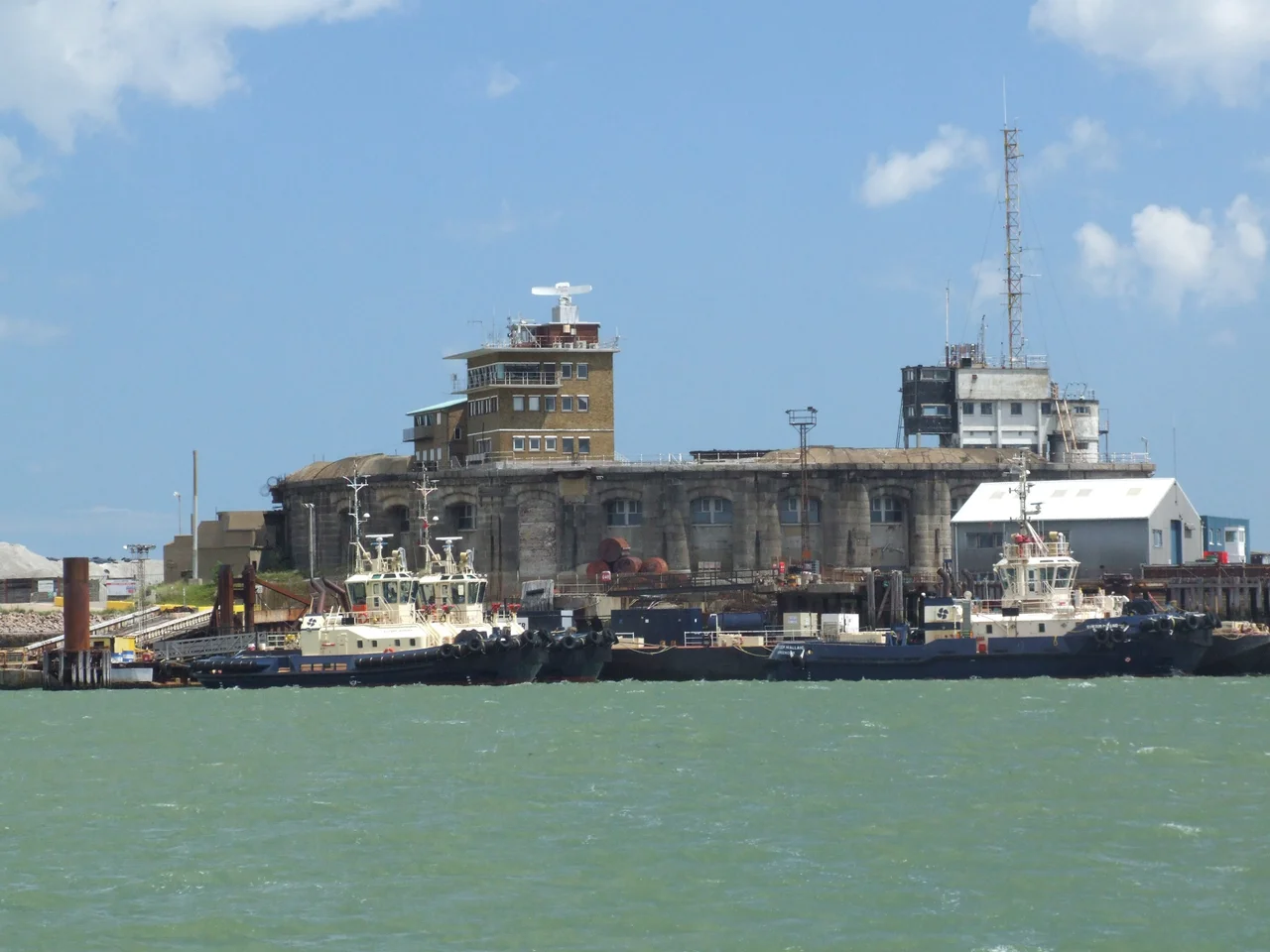
From 1974 to 1994 Olau Line ran ferries from Sheerness to Vlissingen in the Netherlands, using a passenger terminal built over the old dock. Peel Ports now operates Sheerness as a commercial port, handling cars and forest products, with its navigation control in Garrison Point Fort. Inside the perimeter wall, the Spitalfields Trust acquired the residential quarter in 2011 and is restoring six Grade II* and four Grade II listed buildings - the officers' terraces, the Boatswain's House, the dockyard chapel beyond the wall. The Grade I Boat Store still stands among the working cranes, and so do Rennie's archway block and parts of the Boat Basin with their original iron lock gates. The dockyard remains on the World Monuments Fund watch list. Most of the structures from 1830 are still here - not perfectly, but enough to read the plan. Two and a half centuries of British naval power are written into the brick and stone of this Sheppey triangle, including the engineering breakthrough that built modern New York and Chicago.
From the Air
Sheerness Dockyard occupies the north-western tip of the Isle of Sheppey at 51.44°N, 0.75°E, where the River Medway meets the Thames Estuary. Recommended viewing altitude is 2,000-3,000 feet. The site is the rough triangle of working port immediately south of Garrison Point Fort - look for the long perimeter wall, the surviving dockyard buildings clustered near the river, and the line of cranes along the quays. The Sheerness Boat Store is visible as a tall plain brick-clad shed in the heart of the port area. Nearest airports: London Southend (EGMC) about 6 nm north across the estuary, Rochester Airport (EGTO) 11 nm south-southwest. The site is within the London TMA - coordinate with Southend or Thames Radar.
Nearby Stories
- Royal Tunbridge Wells 6.6 km away
- Broadstairs 6.8 km away
- Belmont Castle 8 km away
- White House Farm murders 10 km away
- Port Lympne Mansion 12 km away
- North Weald Airfield 14 km away
- Battle of the Narrow Seas 17 km away
- Maunsell Forts 25 km away