.jpg)
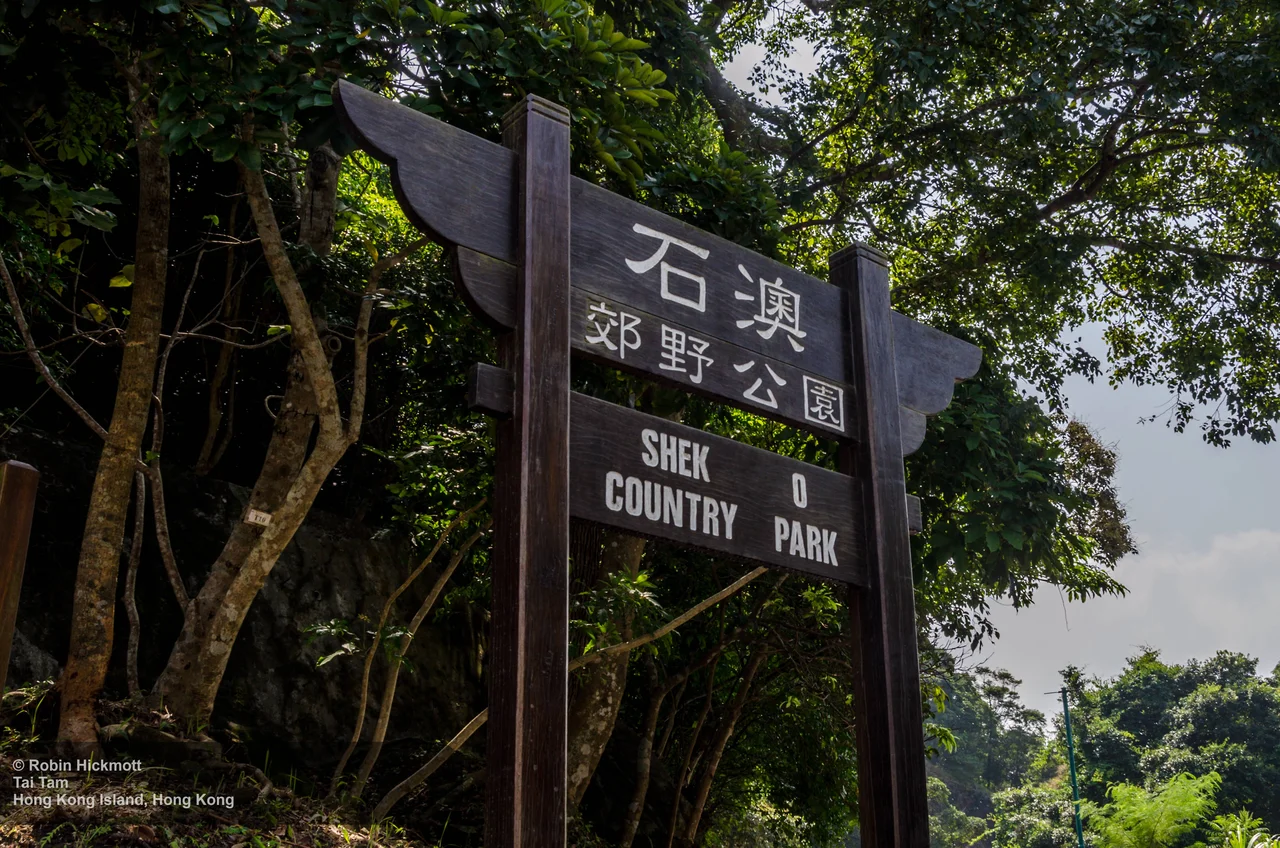
Shek O Country Park
In 2004, Time Magazine Asia named the Dragon's Back the best urban hiking trail in Asia. The trail runs along the spine of the D'Aguilar Peninsula at the southeastern end of Hong Kong Island, with the South China Sea on one side and the city's skyline dissolving into the haze on the other. The park opened on 21 September 1979 and covers 701 hectares — a substantial piece of protected land in a territory that has always been short of it.
Dragon's Back
The Dragon's Back trail follows a ridge connecting Shek O Peak to the lower ground above Shek O village, with views that take in the full sweep of the southeastern Hong Kong coastline. The exposure is unusual. Most trails in Hong Kong's country parks pass through forested terrain; the Dragon's Back spends much of its length in open air above the treeline, with wind from the sea and a changing horizon as you move along the ridge.
Shek O Peak sits at one end of the ridge. From the summit, on a clear day, you can see the Soko Islands to the southwest, the open South China Sea to the south, and the urban mass of Kowloon and the New Territories to the north — the full geographic context of Hong Kong in a single panorama. The trail is accessible enough for casual hikers but long enough that it requires a full morning or afternoon. Most people end the walk by descending to Shek O Beach, which functions as the natural reward for the effort.
What Else the Park Contains
Dragon's Back gets the attention, but Shek O Country Park holds more than one trail. Pottinger Peak, Mount Collinson, Wan Cham Shan, and D'Aguilar Peak are all within the park's boundaries. The Hong Kong Trail — a 50-kilometer route traversing the length of Hong Kong Island — passes through here. To Tei Wan Village sits within the park, one of the small traditional settlements that country park designation has helped preserve from redevelopment.
The park faces the South China Sea on its southern and eastern edges, which gives the coastal sections a different character from the interior — saltier, more exposed, with vegetation shaped by constant wind and occasional typhoon damage. The transition from dense city to this kind of landscape happens within minutes of leaving the road.
New Species in an Old Place
In 2019, researchers discovered a previously undescribed spider species in Shek O Country Park: Uroballus carlei, a jumping spider that appears to mimic lichen moth caterpillars. The discovery was published in a peer-reviewed journal that year. Hong Kong's country parks, protected since the 1970s, have become important refuges for biodiversity that would otherwise have nowhere to go in one of the world's most densely developed territories.
That a new species could be described from a park minutes from the centre of a city of more than seven million people says something worth noting. Protected land does its work quietly. The conservation that the country parks system enforces — no permanent development, no commercial extraction — has maintained enough habitat that the ecological record is still being written here, one discovery at a time.
The Green Margin of the City
Shek O Country Park is part of a chain of country parks that encircles much of Hong Kong Island, protecting the hillsides from development and keeping the water catchments intact. When you look at Hong Kong Island from the air, the green of the parks stands in sharp contrast to the dense grey-white grid of the built-up northern shore. The parks are not wilderness — they are managed, traversed by trails, monitored for fire — but they function as a margin, a boundary between what the city has consumed and what it has agreed to leave alone.
The southeastern corner of Hong Kong Island, anchored by Shek O Country Park, remains the least urbanized section of the island. The combination of difficult topography, country park designation, and the relative inaccessibility of the road that winds in from the highway has kept it that way. Dragon's Back, Shek O Peak, the beach below — this is Hong Kong as it existed before the density, still legible in the landscape.
From the Air
Shek O Country Park covers the southeastern D'Aguilar Peninsula of Hong Kong Island, centered approximately at 22.24°N, 114.24°E. From altitude, the park is visible as the large green mass occupying the southeastern tip of the island, in clear contrast to the dense built-up areas along the northern shore. Dragon's Back ridge is identifiable as the main spine running southeast toward the coast. Shek O Peak marks the ridgeline's southeastern high point, with Shek O Beach visible as a pale arc below it. Nearest ICAO airport: VHHH (Hong Kong International Airport), approximately 30 km to the west-northwest. Recommended viewing altitude: 5,000–8,000 feet to see the full country park in context with Hong Kong Island's urban-green contrast.
Nearby Stories
- Lok Ma Chau Loop 2.3 km away
- Portas do Cerco 2.3 km away
- Kweilin Incident 17 km away
- Wanshan Archipelago Campaign 34 km away
- Nanxiong Formation 115 km away
- Battle of Nanpeng Island 148 km away
- Heyuan 169 km away
- Cape Maobitou 632 km away