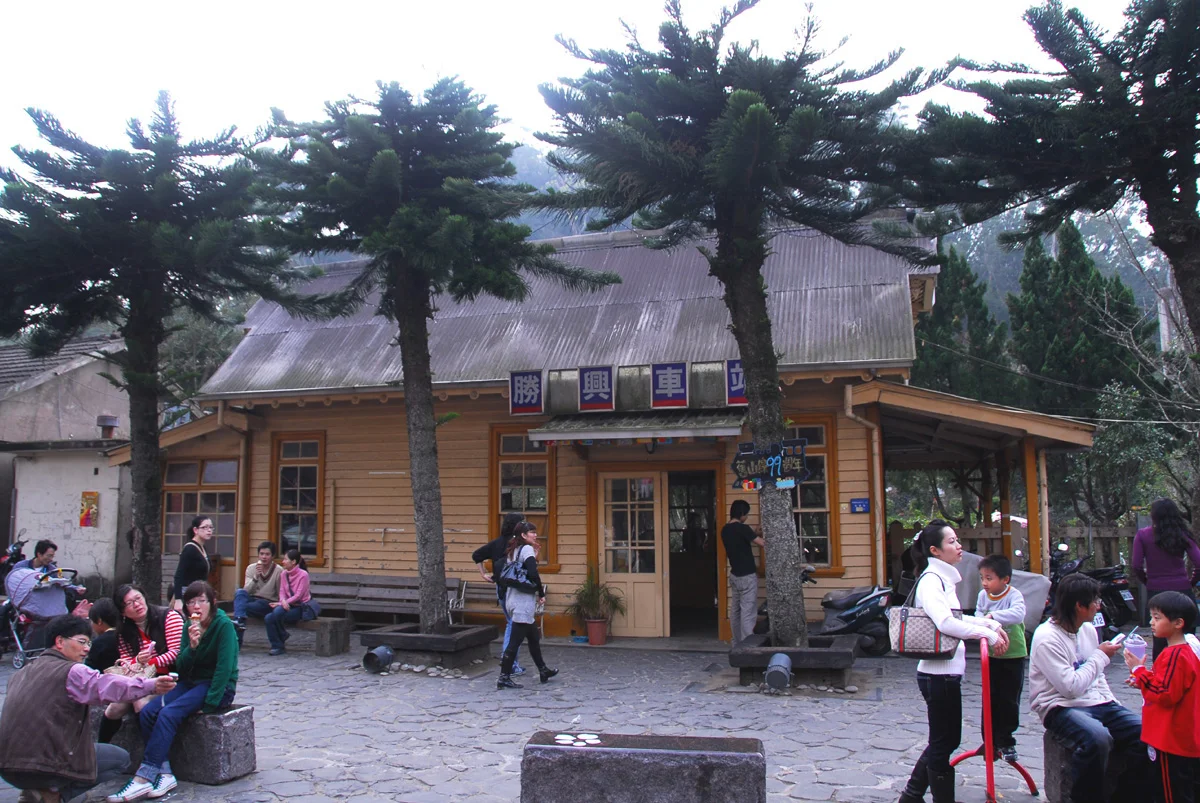

Sheng Hsing Railway Station
In 1905, workers completed a railway station in the mountains of Miaoli using an age-old Japanese carpentry method: not one nail was driven into its wooden frame. The joints were cut and fitted to hold each other in place, the way temples and traditional architecture had always been built. It took five years. The station sat at 402 meters above sea level, the highest point on Taiwan's main north-south railway line. For most of the 20th century, trains climbed to Shengxing and descended the other side, negotiating one of the steepest stretches of the Taiwan Railway's West Coast line. Then, in 1998, the trains stopped coming. The station survived anyway.
The Highest Point on the Main Line
When the Old Mountain Line was completed through Sanyi Township in the early 20th century, Shengxing Station occupied a distinction that few railway stations in Taiwan could claim: it was the highest point on the main north-south route. Located in southern Miaoli County at an altitude of 402 meters, the station served passengers and freight on the mountain section of the Taiwan Railway's West Coast line. The route through here was a serious engineering challenge. The terrain between the coastal plain and the Taichung basin is steep, and the railroad threaded it with switchbacks, embankments, and tunnels. One of those tunnels — 726 meters long, completed in 1905 — still stands near the station, its stone portal largely intact. The tunnel survived the 21 September 1999 Chi-Chi earthquake, which registered magnitude 7.6 and heavily damaged much of the surrounding region. A century of typhoons and seismic events, and the masonry held.
Built Without Nails
The station building itself is the thing. Shengxing Station was constructed entirely of wood, using traditional joinery rather than iron fasteners. This method — familiar from Japanese temple construction and traditional Hakka architecture — relies on precisely cut mortise-and-tenon connections that lock together under the weight of the building itself. The result is a structure that flexes slightly in earthquakes rather than cracking, and that ages in a particular way: the wood darkens and settles, the joints tighten, and the whole thing becomes more itself over time. Five years elapsed between groundbreaking and completion. The finished station is modest in footprint but striking in detail — covered platforms, deep eaves, and the particular warmth of aged timber that no concrete reproduction can replicate. When the Miaoli County Government designated Shengxing a historic site in 1999, they were recognizing what anyone who has stood on its platform already felt: this building matters.
The Day the Trains Stopped
Passenger services to Shengxing Station ceased on a specific date: when the Taiwan Railways Administration opened its new, lower-gradient section of the Mountain line in 1998, the steeper Old Mountain Line was retired from regular service. The new route bypassed the switchbacks and steep grades that had defined mountain rail travel in Miaoli for nearly a century. Shengxing became a station on what was now called the Former Mountain Line — still existing, still physically intact, but no longer on an active passenger route. The TRA chose not to demolish it. Instead, the station was kept as a tourist attraction, maintained by the railway administration and visited by people who came specifically to see the wooden building and walk the old trackbed. The last regular passenger train had stopped on September 23, 1998, when the new Mountain Line route rendered the old steep grade redundant — the retirement of a historic route by a more efficient alignment.
Steam Returns to the Mountain Line
In 2010, something changed. As part of a regional tourism initiative, the TRA began running steam train excursions on the Old Mountain Line on special occasions. Shengxing Station was once again a stop on a passenger service. The steam trains — pulling vintage rolling stock up the same steep grades that the original Mountain Line engineers had designed a century earlier — became a seasonal event that draws rail enthusiasts, families, and anyone who wants to experience what railway travel through these mountains felt like before the new line flattened the route. The station's surroundings have adapted to its tourist role: tea shops and traditional Hakka restaurants cluster nearby, offering visitors somewhere to sit after the train journey. The combination of historic station, tunnel, and old barracks at the tunnel entrance — where World War II troops were once stationed to guard the railway — makes the Shengxing area one of the more densely layered historical sites in Miaoli County.
From the Air
Shengxing Station is located at approximately 24.388°N, 120.782°E in Sanyi Township, Miaoli County. From the air at 3,500 feet, the mountain terrain of Sanyi is clearly visible, with the old railway route traceable as a series of embankments and tunnel portals cutting through the forested hillsides. The station building itself — small, wooden, set in a narrow mountain valley — is most visible from low-level flight along the valley axis. The 726-meter tunnel portal near the station is a recognizable ground feature. Nearest major airport: RCMQ (Taichung International), approximately 20 km to the south-southeast. The coastal plain to the west and the red cliffs of Huoyan Mountain to the north-northwest provide useful visual orientation references.
Nearby Stories
- Wufeng Lin Family Mansion and Garden 6.5 km away
- Tapung Old Fort 9.4 km away
- 1991 Miaoli Train Collision 9.7 km away
- Taroko National Park 20 km away
- China Airlines Flight 204 21 km away
- Taiwan Strait 38 km away
- Taixi, Yunlin 43 km away
- China Airlines Flight 611 69 km away