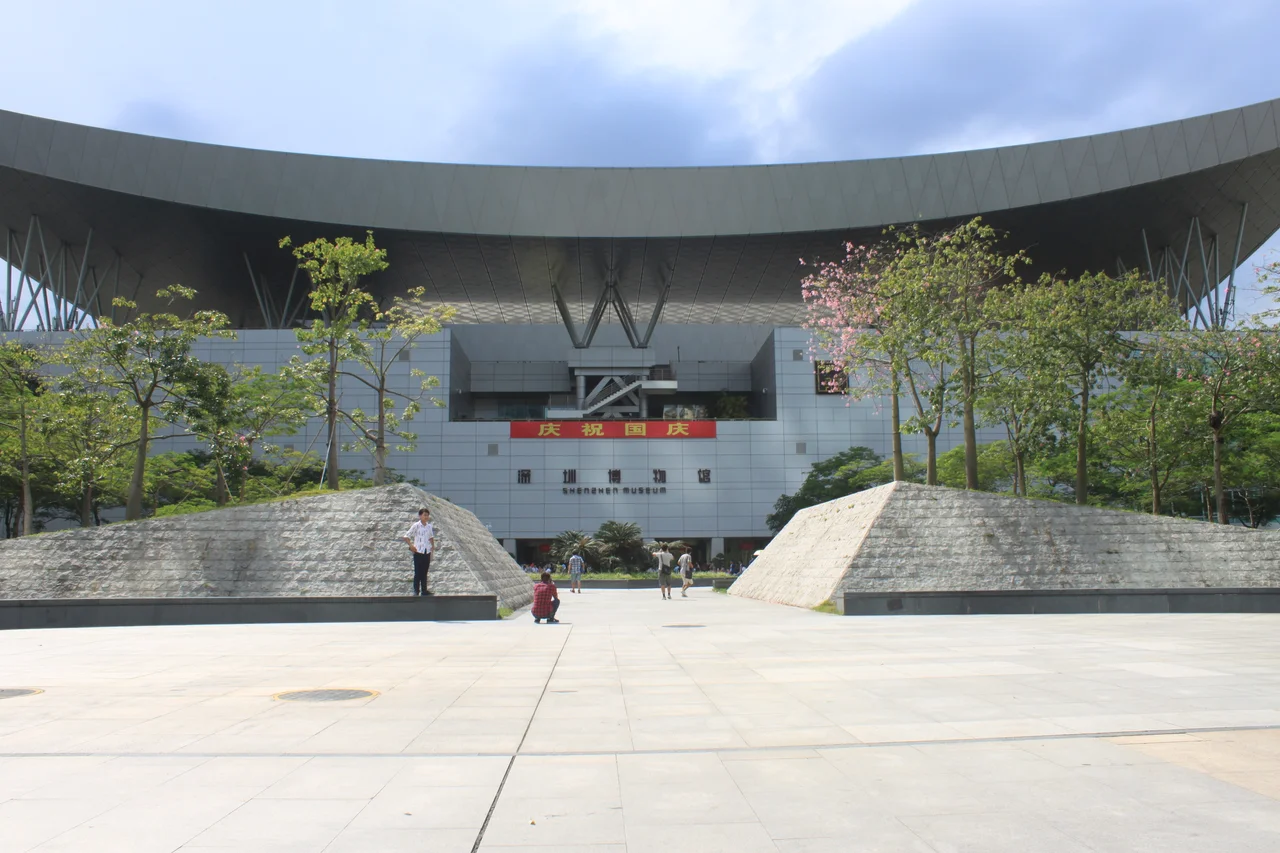

Shenzhen Museum
Among its most prized possessions: a long-handled spade, painted red, with a small Flying Sparrow emblem near the blade. Deng Xiaoping used it to plant a lychee tree in Shenzhen in January 1992, at the start of the southern tour that relaunched China's reform era. The Shenzhen Museum keeps that spade, along with the furniture from Deng's hotel room and the white Toyota van in which he traveled the city — objects so ordinary they seem incapable of carrying the weight of history. And yet here they are, alongside Han Dynasty bronze vessels and Ming porcelain, in a museum that insists on holding ancient civilization and contemporary revolution in the same building.
Four Sites, One Story
The Shenzhen Museum is not one building but four, spread across different corners of a city that did not exist in its current form forty years ago. The main branch for history and folk culture sits inside the Civic Center in Futian District — a civic complex so expansive it feels more like a government campus than a downtown. A second branch, the Museum of Ancient Art on Tongxin Road, opened in 1981 and focuses on pre-modern artifacts. The Shenzhen Reform and Opening-up Exhibition Hall occupies space within the Museum of Contemporary Art and Urban Planning, blending civic history with architectural display. And in Luohu District, the Dongjiang River Guerrilla Command Headquarters Memorial Museum marks where Communist guerrillas once coordinated resistance during World War II. Together, the four sites span thousands of years and several entirely different visions of what Shenzhen is and has been.
Relics of a Forgotten Depth
Shenzhen's reputation as a city without history is a myth the museum quietly dismantles. More than 20,000 historical and cultural relics fill its collections, the majority originating within the city or its surrounding region. Visitors encounter artifacts from the Neolithic Xiantouling culture, which flourished along this stretch of the Pearl River Delta coast long before the Cantonese or Han Chinese arrived. Ceremonial bronzes, painted ceramics, and silk textiles trace the arc of Guangdong's integration into successive Chinese dynasties — the Han, Tang, Song. The folk culture galleries preserve the material lives of the Hakka and Punti communities that farmed this coastal plain for centuries before a government decree in 1980 turned their villages into a special economic zone. The museum makes no attempt to hurry past this older Shenzhen. It insists you sit with it.
The Weight of That Spade
The Reform and Opening-up Exhibition Hall makes a more urgent argument. By January 1992, the market reforms Deng Xiaoping had championed since 1978 were stalling. Conservative opposition within the party was growing. Deng, then 87, made an unscheduled tour of southern China — Shenzhen, Zhuhai, Shanghai — delivering speeches that reasserted his commitment to economic opening and effectively relaunched the reform project. The exhibition preserves the physical residue of those days: the spade from the tree-planting ceremony, the desk and chairs from Deng's hotel suite, the van. These are not grand objects. Their plainness is the point. Change at this scale, the museum implies, was made by ordinary people moving through ordinary rooms, making decisions with consequences they could not fully anticipate. The artifacts invite reflection rather than celebration.
A Museum Built at the Speed of Shenzhen
The original museum was established in 1981 — one year after Shenzhen was designated a Special Economic Zone — but did not formally open to the public until 1988, when the city had grown enough to need an institution that could account for what had already happened. The main branch now covers 37,000 square meters in total area, with a building footprint of 18,000 square meters. That the museum exists at all is a statement: Shenzhen, which is often described as a place without a past, chose almost immediately to start building one. The Civic Center building that houses the history branch is itself a piece of architectural ambition, its wide public plazas and modernist scale reflecting the civic confidence of a city certain it will keep growing. The museum inside that structure quietly asks what, exactly, is worth keeping as it does.
What Connects Ancient and Modern
Walk through the Shenzhen Museum on a weekday morning and you will find school groups in the Han bronzes gallery, retirees lingering at the folk culture dioramas, and young professionals moving quickly through the reform exhibition before heading back to the city's technology parks. The museum draws an unlikely cross-section. It asks each visitor to hold two things at once: the depth of a region whose coastal culture stretches back millennia, and the shock of a transformation so rapid it compressed what other cities took centuries to become into a single generation. There is no simple synthesis on offer. The museum presents the distance between a Han bronze vessel and Deng Xiaoping's van, and lets you sit with the strangeness of that gap.
From the Air
The Shenzhen Museum's main Civic Center branch sits at approximately 22.546°N, 114.057°E in Futian District, roughly 35 km northwest of Shenzhen Bao'an International Airport (ZGSZ). Approach from the northwest at 3,000–5,000 feet along the Pearl River Delta coastline and the Civic Center's distinctive fan-shaped roof and central axis become visible. The large Lianhuashan Park immediately north of the Civic Center serves as a useful visual landmark — its hillside statue of Deng Xiaoping is visible on clear days. The cluster of supertall towers in the Futian CBD, including the Ping An Finance Center, lies just to the south. Best visibility October through December when humidity drops and the subtropical haze thins.
Nearby Stories
- Hong Kong Disneyland 4.1 km away
- Mount Guanyin (Dongguan) 7 km away
- 2024 Lixinsha Bridge Collapse 7.4 km away
- Portas do Cerco 12 km away
- Lotus Hill 15 km away
- Nanxiong Formation 78 km away
- Heyuan 130 km away
- Checheng Fu'an Temple 629 km away