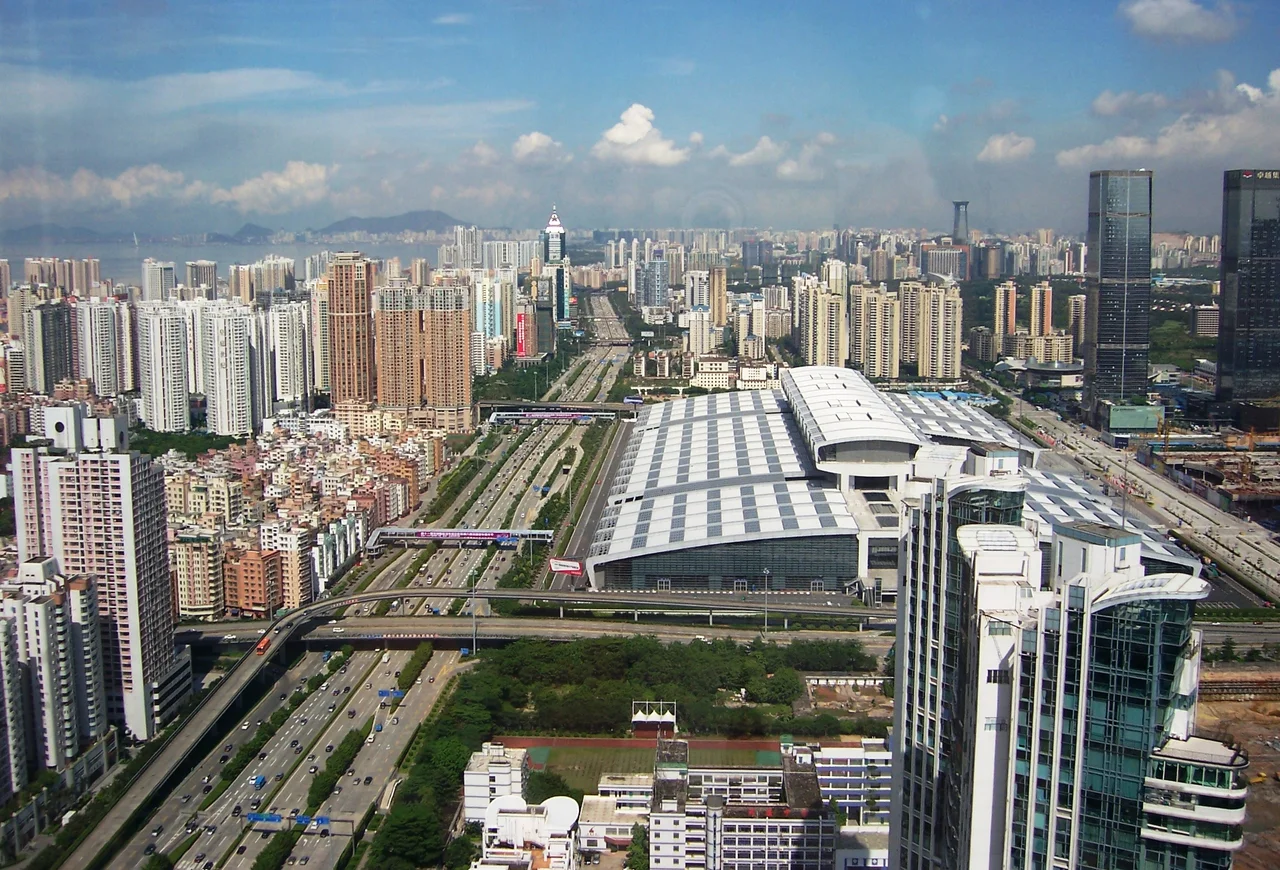

Shenzhen Special Economic Zone
The idea came, in part, from a small airport in western Ireland. Shannon Free Zone, established in 1959 to attract foreign investment to a remote corner of the country, showed that a government could carve out a patch of territory and play by different rules there — lower taxes, fewer restrictions, special incentives — without disrupting the rules everywhere else. When Deng Xiaoping's planners were searching for a model for China's reform experiment in 1980, Shannon was one of the templates they studied. What they built at Shenzhen would eventually dwarf its inspiration by every measure imaginable.
A Sealed Enclave for Unsettling Ideas
The political logic of the Shenzhen Special Economic Zone was as important as its economic logic. Markets, private enterprise, foreign investment, performance incentives — these were ideas the Chinese Communist Party had spent three decades denouncing as bourgeois corruptions. Introducing them throughout the country at once would have been politically impossible. The solution was containment: create a sealed zone where the experiments could run, where failure would be limited and success could be observed before being replicated. Shenzhen won the designation in May 1980 partly because of its geography. The Hong Kong border was just across the river, and Hong Kong was exactly what the reformers wanted Shenzhen to eventually resemble — a dense, prosperous, internationally connected economy. Capital, expertise, and management knowledge could flow across the border in manageable quantities. If things went wrong, the fence kept the contagion local.
From 310,000 to Millions
Before 1980, Shenzhen was a market town — not, despite the popular legend, a fishing village — with approximately 310,000 residents and fewer than 30,000 industrial workers. The transformation that followed was unlike anything in modern urban history. By the end of 2000, the population had reached 4.33 million, with a labor force of 3.09 million. By 2007, the official count stood at 8.6 million, though estimates accounting for unregistered migrant workers put the true figure between 12 and 14 million. Most of the people who drove this growth were not the state officials and entrepreneurs who settled permanently, but the temporary residents — migrant laborers from rural Hunan, Sichuan, Anhui, and dozens of other provinces — who came for factory jobs and sent money home. Less than 30 percent of Shenzhen's population at any given time held official household registration. The other 70 percent built the city and then, often, moved on.
The Legislative Laboratory
From 1979 to 1990, the Shenzhen SEZ was described by economists and legal scholars as China's most active site of legislative experimentation. The rules governing foreign trade, investment contracts, labor relations, and land use were written here first, then refined, then spread to the rest of the country as they proved workable. National economic law on foreign trade and investment during this period bore the imprint of what had been tried at Shenzhen. It was a deliberate method: use the zone as a drafting room for policies that could not yet be debated openly at the national level. The World Bank later credited China's sustained growth during this period — which pulled more than 400 million people out of poverty — partly to the reform momentum that Shenzhen and the other early special economic zones generated.
The Cost of Speed
The growth was not without consequence. Rapid urbanization took a significant toll on water quality throughout the Pearl River Delta, and Shenzhen's waterways bore some of the heaviest impacts. Industrial emissions, automobile traffic, and the constant churn of construction generated persistent air pollution. The migrant workers who powered the economic miracle often absorbed the worst of these effects — living in crowded factory dormitories, working in facilities with limited environmental controls, lacking the household registration status that would have entitled them to public services. The women among them, who formed a substantial portion of the manufacturing workforce, navigated particular pressures: the discrimination and physical demands of factory work on one side, and on the other, a degree of freedom from traditional family expectations that life in a migrant city could unexpectedly provide. The SEZ created opportunities and extracted costs, and they did not fall on everyone equally.
Expansion and Legacy
Until 2010, the Shenzhen Special Economic Zone comprised four of the city's nine districts — Luohu, Futian, Nanshan, and Yantian — covering 493 square kilometers. That year, the zone was expanded to encompass the entire city, effectively ending the original distinction between the SEZ enclave and the broader municipality. The physical barrier that had once marked the SEZ boundary came down. What remained was the legacy: a city whose existence proved that China's reform-era policies could produce sustained, massive growth, and a policy framework that influenced every other special economic zone and development district that followed. The 40th anniversary celebration, held on 14 October 2020, brought Xi Jinping to Shenzhen to invoke the city's example as a model for future innovation. The experiment had become an institution.
From the Air
The Shenzhen Special Economic Zone originally occupied the southern core of Shenzhen, centered approximately at 22.533°N, 114.083°E in the Futian District. Shenzhen Bao'an International Airport (ZGSZ) lies roughly 30 km to the northwest, along the eastern shore of the Pearl River estuary. From the air at 4,000–6,000 feet on approach from the southwest, the original SEZ boundary corresponds roughly to the dense urban core visible between the Hong Kong border river (Shenzhen River) to the south and the older industrial belt to the north. The Ping An Finance Center's 599-meter tower in Futian anchors the skyline visually. Looking south from altitude, the contrast between Shenzhen's dense verticality and Hong Kong's hills across the border is striking. Best observed on clear autumn days when the Pearl River Delta haze clears.
Nearby Stories
- Hong Kong Disneyland 4.1 km away
- Mount Guanyin (Dongguan) 7 km away
- 2024 Lixinsha Bridge Collapse 7.4 km away
- Portas do Cerco 12 km away
- Lotus Hill 15 km away
- Nanxiong Formation 78 km away
- Heyuan 130 km away
- Checheng Fu'an Temple 629 km away