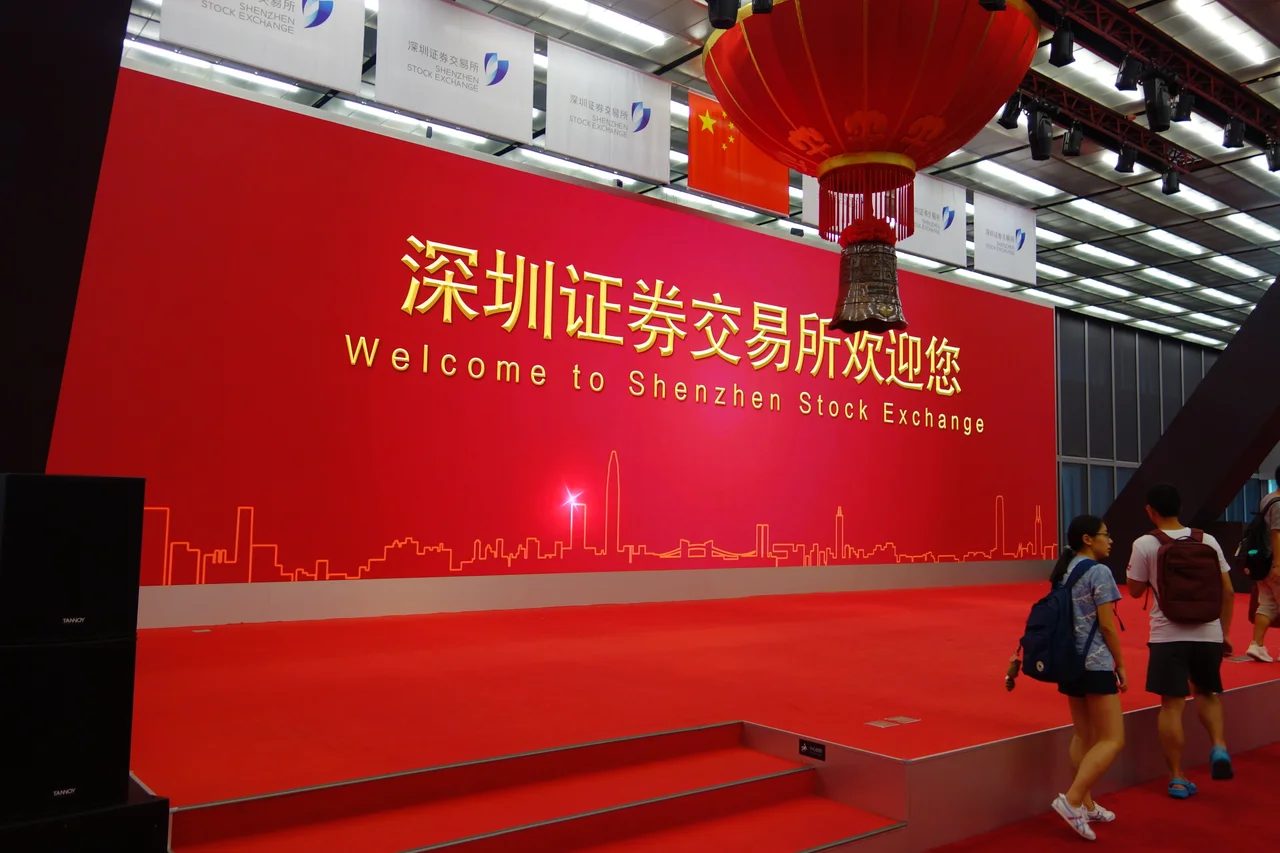

Shenzhen Stock Exchange
"Are securities and the stock markets good or bad? Do they entail dangers? Are they peculiar to capitalism? Can socialism make use of them?" Deng Xiaoping asked these questions in 1990 — not rhetorically, but as a public defense of something deeply controversial. A stock exchange, in the People's Republic of China, was not simply a financial instrument. It was an ideological provocation. The Shenzhen Stock Exchange opened on 1 December 1990 anyway, designated an "experimental point" under municipal control, as if the party needed the option to disavow it if things went wrong. Things did not go wrong.
An Experiment That Refused to Stay Small
For its first seven years, the Shenzhen Stock Exchange operated under a kind of institutional probation. Municipal government ran it, and Beijing watched. Then in July 1997 — the same year Hong Kong reverted to Chinese sovereignty — the State Council moved the exchange under direct supervision of the China Securities Regulatory Commission, a signal that stock markets had earned a legitimate place in what the party was calling the "socialist market economy." The exchange's market capitalization, which once seemed extraordinary in the millions, now exceeds US$4.4 trillion. As of July 2024, it ranks as the sixth-largest stock exchange in the world by that measure, sitting in the company of the New York Stock Exchange, NASDAQ, and the Shanghai exchange just up the coast. The distance traveled from "experimental point" to global financial institution is one of the stranger journeys in modern economic history.
The Building That Floats
The Shenzhen Stock Exchange's headquarters on Shennan Boulevard in Futian District is not a conventional skyscraper. Rem Koolhaas and his firm, the Office for Metropolitan Architecture, designed a structure that inverts the usual logic: instead of a tower rooted heavily to the ground, the building's trading floors and upper offices are suspended in a massive cantilever that lifts them above a public podium at street level. The result, completed in 2013, is a 254-meter, 46-floor building that appears to hover — a market that floats, literally, above the city below it. Construction began in 2008. The geometry is deliberate: the cantilevered platform creates sheltered public space underneath while the tower rises clean above, separating the world of finance from street life without severing it entirely. As a piece of architecture, it is one of the more intellectually coherent statements Shenzhen has made about what it is.
ChiNext and the Startup Economy
In October 2009, the Shenzhen exchange launched ChiNext — a NASDAQ-style board designed specifically for high-growth, high-tech companies that could not meet the stricter listing requirements of the main board. The timing was calculated. China's technology sector was accelerating, and small and medium-sized companies in renewable energy, healthcare, and consumer tech needed access to capital that the established exchanges, with their emphasis on profitability history and asset size, were not built to provide. ChiNext launched with 28 listed companies. By 2021, more than 800 companies traded on the board. A 2016 reform introduced a registration-based IPO system that simplified how new companies could list, lowering the administrative barrier further. The board has become a primary funding vehicle for China's startup economy, connecting venture-stage companies to retail and institutional investors in a market that did not exist fifteen years ago.
Listing in Shenzhen
Getting onto the Shenzhen Stock Exchange's main board requires meeting standards set by the China Securities Regulatory Commission: minimum net assets or revenue thresholds, demonstrated profitability or substantial market value, transparent corporate governance, and financial statements certified by auditors as conforming to Chinese accounting standards without qualification. Companies must also provide continuous disclosure of material financial information. In practice, the requirements filter for established businesses with real operating histories. ChiNext offers an alternative pathway for younger companies: lower entry barriers, strict operational requirements after listing, and exposure to investors willing to accept higher growth risk. The two-tier structure — main board for incumbents, ChiNext for challengers — gives the exchange a broader reach than either board could manage alone.
The Question Deng Asked
Deng Xiaoping's rhetorical questions from 1990 have never fully resolved. The Shenzhen Stock Exchange is simultaneously a market mechanism, a state-supervised institution, and a political statement about what kind of economy China intends to run. Foreign investors participate through controlled channels. The China Securities Regulatory Commission retains authority to intervene in ways that no Western securities regulator would. Trading suspensions, circuit breakers, and government guidance operate alongside the price signals that markets are supposed to generate freely. Whether this constitutes a stock market in the conventional sense, or something new — a socialist market instrument that works by different rules — remains an open question. What is not in question is the scale: US$4.4 trillion in listed value, 2,375 companies as of early 2021, in a building designed to float above the street like a market suspended between worlds.
From the Air
The Shenzhen Stock Exchange building stands at approximately 22.544°N, 114.049°E on Shennan Boulevard in Futian District, roughly 28 km southeast of Shenzhen Bao'an International Airport (ZGSZ). Approaching from the northwest at 3,000–4,000 feet along the Shennan corridor, the OMA building's distinctive cantilevered form is recognizable among the Futian CBD towers — a dark, rectangular mass that appears to project laterally rather than simply rise vertically. The Ping An Finance Center, at 599 meters, dominates the skyline to the northeast and provides a fixed reference point for orientation. The Shenzhen River and Hong Kong border lie approximately 4 km to the south. Clear weather between October and December offers the best visibility for observing the Futian financial district from altitude.
Nearby Stories
- Hong Kong Disneyland 4.1 km away
- Mount Guanyin (Dongguan) 7 km away
- 2024 Lixinsha Bridge Collapse 7.4 km away
- Portas do Cerco 12 km away
- Lotus Hill 15 km away
- Nanxiong Formation 78 km away
- Heyuan 130 km away
- Checheng Fu'an Temple 629 km away