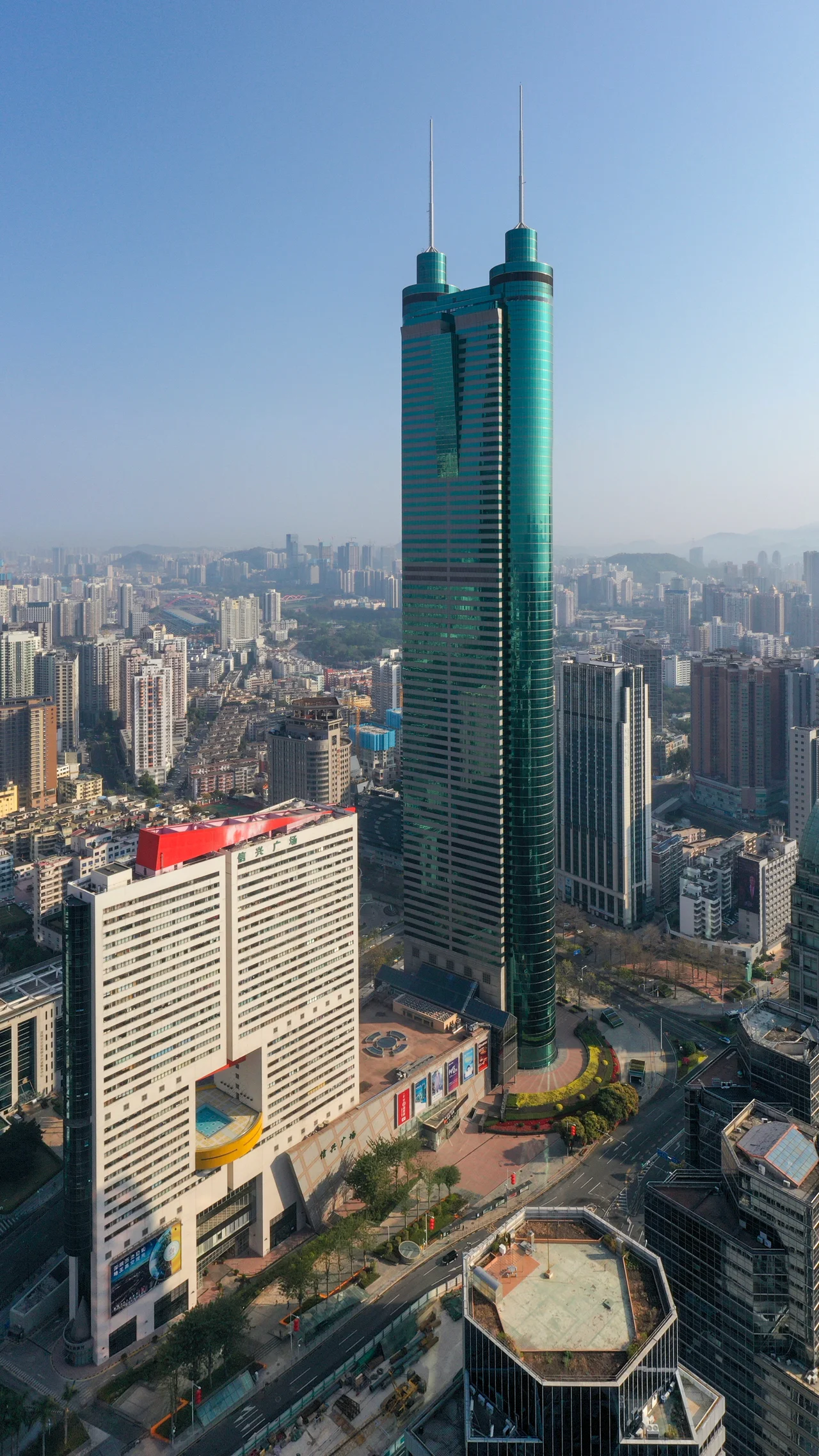

Shun Hing Square
The land auction that preceded Shun Hing Square became the building's nickname. When the plot in Luohu District sold for the highest price in Shenzhen's history at the time, developers began calling the planned tower 地王大厦 — Diwang Building, meaning "King of the Land." The name stuck, and in a city defined by the competitive pursuit of superlatives, it fit. Shun Hing Square opened in 1996 at 384 meters, with 69 floors, and immediately became the tallest building in mainland China — the first skyscraper on the mainland to rank among the ten tallest in the world. It held that title for exactly one year, until CITIC Plaza in Guangzhou topped out in 1997. Shenzhen had made its statement. Now someone else had to make a taller one.
Built at Speed
Shun Hing Square was constructed at a pace of four floors every nine days — a schedule that required extraordinary coordination between the structural engineering teams and the workers assembling the all-steel frame. In total, 24,500 tonnes of steel went into the structure. For comparison, the Eiffel Tower used approximately 7,300 tonnes; Shun Hing Square consumed more than three times as much. The all-steel method, unusual for China at the time, was one reason the building still holds records: as of 2025, it remains the tallest all-steel building in China. The main tower contains offices, a multi-level parking garage, and a five-story shopping arcade with four sets of escalators and seven elevators. Individual floors range from 3,450 to 4,900 square meters. At the top — the 69th floor — is the Meridian View Center observation deck, from which the geometry of Shenzhen's growth is visible in every direction.
A Record That Lasted a Year
Shun Hing Square held the title of China's tallest building for twelve months, from its completion in 1996 until CITIC Plaza in Guangzhou surpassed it in 1997. That brevity is itself a measure of the era: construction across the Pearl River Delta was moving so fast that any record was provisional. The building also has a more precise claim to history: it was the first skyscraper in mainland China — as opposed to Hong Kong, which was still under British sovereignty when the Bank of China Tower and Central Plaza were completed — to rank among the ten tallest in the world. Shenzhen, a city that did not exist as an urban center sixteen years earlier, had produced a building that stood in the top ten on Earth. The city was fifteen years old in 1996. The record-breaking was almost beside the point; the building was the point.
Where It Stands Now
Shenzhen's skyline has grown so rapidly since 1996 that Shun Hing Square, once its tallest structure, now ranks seventh among the city's towers. The 599-meter Ping An Finance Center, completed in 2017, is more than 200 meters taller. The 441.8-meter Kingkey 100 surpassed Shun Hing Square in September 2011. Nationally, the building sits 29th among mainland China's tallest structures. Globally, it ranks 55th. It remains the third-tallest building in the world with fewer than 70 floors — a niche record that reflects how unusual its height-to-floor-count ratio was at the time of construction. From the Meridian View Center observation deck, visitors look out over a skyline that has grown up around and past the building in the decades since it opened, a panorama that is itself a time-lapse of what Shenzhen has become.
Steel and Symbol
In 1996, Shun Hing Square was more than a building. It was a message. Shenzhen, which China's central government had designated a Special Economic Zone only sixteen years earlier, had produced a supertall skyscraper that placed it on the global map of ambitious architecture. The all-steel construction method signaled technical sophistication. The record height signaled ambition. The Diwang name — borrowed from the price of land, the most fundamentally capitalist of inputs — flagged the market logic driving the whole enterprise. Other Chinese cities were building. Other cities would soon build taller. But Shenzhen had done it first, and the fact that the record lasted only a year was the least relevant thing about it. The city had demonstrated what it intended to be. The tower, still visible from most of Luohu District, still makes that argument every day.
From the Air
Shun Hing Square stands at approximately 22.545°N, 114.106°E in Luohu District, near the Shenzhen River border with Hong Kong. Shenzhen Bao'an International Airport (ZGSZ) is roughly 38 km to the northwest. On approach from the southwest at 4,000–6,000 feet, Shun Hing Square is identifiable in the eastern cluster of Luohu's older high-rises — a tapering steel tower with a distinctive tapered crown, surrounded by newer but shorter buildings. The Futian CBD towers (including Ping An Finance Center at 599 meters) rise to the west and are more prominent at altitude, but Shun Hing Square's Luohu location close to the Hong Kong border makes it a useful navigation landmark when identifying the border crossing area. Hong Kong's New Territories are visible immediately to the south. Clearest visibility October through February.
Nearby Stories
- Hong Kong Disneyland 4.1 km away
- Mount Guanyin (Dongguan) 7 km away
- 2024 Lixinsha Bridge Collapse 7.4 km away
- Portas do Cerco 12 km away
- Lotus Hill 15 km away
- Nanxiong Formation 78 km away
- Heyuan 130 km away
- Checheng Fu'an Temple 629 km away