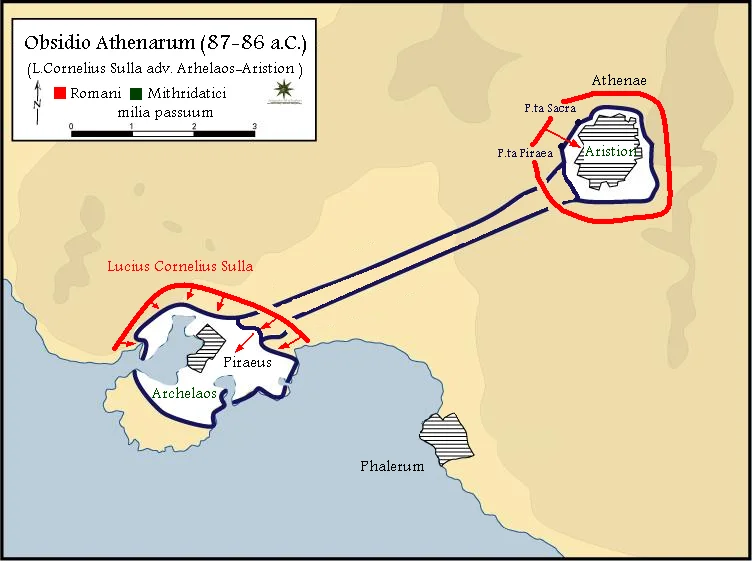

Siege of Athens and Piraeus (87–86 BC)
By the end of the siege, the people of Athens were eating their shoes. Shut inside their walls through the winter of 87 into 86 BC, with the Roman army of Lucius Cornelius Sulla ringing the city, they had been reduced to boiling shoe leather and chewing grass. When a delegation finally went out to plead for terms, they could think of nothing better to do than recite the ancient glories of their city. Sulla cut them off. "I was sent to Athens," he told them, "not to take lessons, but to reduce rebels to obedience."
How Athens Chose the Wrong Side
The catastrophe grew out of a wider war. Mithridates VI, king of Pontus, had risen against Rome and, in a single coordinated massacre known as the Asiatic Vespers, his agents are said to have killed tens of thousands of Roman and Italian settlers across Asia Minor. As his power swept westward, the Greek cities defected to him, and Athens fell under a Mithridatic-backed ruler, the tyrant Aristion. When Sulla landed in Greece in 87 BC, his first target was the famous city that had thrown in with Rome's enemy. He marched southeast and closed in on Athens and its harbor town of Piraeus.
Two Sieges at Once
The long walls that once joined Athens to its port lay in ruins, so Sulla had to besiege the city and the harbor separately. He struck first at Piraeus, knowing that without its port Athens could never be resupplied. When his initial assault was thrown back, he settled in for a brutal campaign of engineering. He needed timber for his siege works and took it without mercy, felling forests for a hundred miles around - including the sacred groves where Plato's Academy and other holy sites had stood. Short of money, he stripped the great Greek temples of their treasures, melting sanctuary offerings into coin so well struck it stayed prized for generations. The gods of Greece paid for the conquest of a Greek city.
The Night the Walls Came Down
Inside Athens the people starved while Aristion clung to power. Greek deserters slipped word to Sulla that a stretch of wall, the Heptachalcum, had been left poorly guarded, and his sappers went to work undermining it. Some nine hundred feet of fortification collapsed between the Sacred and Piraeic gates on the city's southwest side. Around midnight on the first of March, 86 BC, after five months of siege, the Romans poured through the breach near the Kerameikos, the old potters' quarter and burial ground. The veterans who entered were hardened men, fresh from years of civil war in Italy, and Aristion's earlier taunts had left Sulla in no mood for mercy.
The Cost in Lives
What followed fell hardest on people who had no say in any of it. The Roman soldiers killed through the night, and Plutarch wrote that blood ran in the streets of the inner city and flowed out through the Dipylon Gate. These were not soldiers dying in a fair fight but ordinary residents of a starving city - the same people who had been chewing leather to survive - cut down in their own neighborhoods near the Kerameikos. The slaughter stopped only when Sulla's Greek companions, Midias and Calliphon, and the Roman senators in his camp begged him to relent. He declared, at last, that enough had died, and spared the survivors. Aristion fled to the Acropolis and held out until his water ran dry; he and his followers were executed after they surrendered.
What the Stones Remember
Sulla burned much of Piraeus to the ground and marched off to finish the war, defeating Mithridates' armies at Chaeronea and Orchomenus before the two men signed peace in 85 BC. For centuries afterward the sack lived in memory as the moment Rome broke Athens, plunging the proud old city into a long economic decline. Yet modern archaeology complicates the story: excavators have found that the physical destruction, though real, was less sweeping than the ancient accounts of total ruin suggest. The deepest wound was not to the buildings but to the people who lived among them - the men, women, and children of a city that had simply backed the losing side.
From the Air
The siege ranged across central Athens and the port of Piraeus, with the decisive breach near the Kerameikos at roughly 37.9794 degrees N, 23.7161 degrees E, just northwest of the Acropolis. Piraeus lies about 5 nautical miles southwest on the coast. From the air the line between the two - the route of the vanished long walls - runs from the Acropolis rock down to the harbor basins of modern Piraeus. Recommended viewing altitude 2,500-4,000 feet AGL to take in the city, the Kerameikos archaeological site, and the port together. Nearest airport is Athens International (LGAV), about 20 nautical miles east-southeast. Visibility is usually excellent over the Saronic Gulf; watch for coastal haze near Piraeus and summer thermals over the heated city.
Nearby Stories
- Great Sand Beach 5 km away
- Battle of Delium 7.7 km away
- Tower of Aliartos 9 km away
- HMHS Britannic 10 km away
- Saronic Gulf 15 km away
- Sousaki Volcano 17 km away
- Sanctuary of Apollo Maleatas 24 km away
- Skyros 66 km away