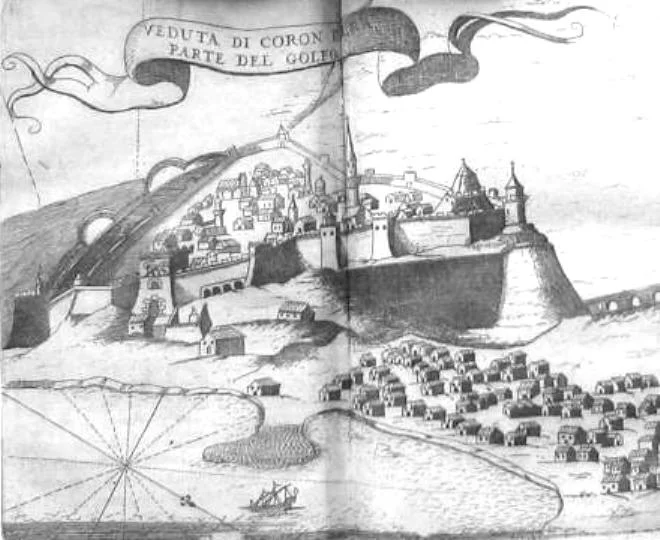

Siege of Coron (1533–1534)
Suleyman the Magnificent was not a man accustomed to losing. When the Genoese admiral Andrea Doria seized the Ottoman-held fortress of Koroni in 1532 for the Habsburg Emperor Charles V, the sultan's response was disproportionate in the way that only humiliation can produce. He threatened the Imperial ambassador in Constantinople with demolishing the Church of the Holy Sepulchre in Jerusalem and erecting a mosque in its place. He offered to hand the city of Algiers back to Spain in exchange for Koroni. Neither threat nor offer moved Charles. So in the spring of 1533, Suleyman sent his fleet.
The Blockade and the Man Who Bluffed His Way Through It
On 23 April 1533, the Ottoman admiral Lütfi Pasha surrounded Koroni by sea and land with 60 galleys and smaller fustas. Inside the town, the Spanish commander Jerónimo Mendoza faced a siege that slowly consumed everything. When food ran out, the garrison and townspeople ate their horses and mules. Lütfi sent an emissary offering honorable surrender; Mendoza replied that he and his men would die before soiling their honor with such cowardice. The standoff hardened.
Help came in improbable form. On 27 May, Andrea Doria dispatched his adoptive relative Cristoforo Pallavicino in a single galley, the Marquesota, carrying supplies and 10,000 écus in wages. To slip through the Ottoman blockade, Pallavicino stretched an awning over his galley and sailed in as if he were a Turkish vessel. The ruse worked. His arrival with food and money lifted the garrison's spirits. Pallavicino then developed a second trick: he came out daily to feign attacks he never pressed, maneuver and withdraw, until the Ottoman ships stopped reacting. On 4 July, after feinting toward a Turkish cargo ship, he rammed the blockade and broke into open sea with 23 galleys in pursuit — and escaped.
The Battle Off Cape Galo
Doria had been assembling a relief fleet in Messina — 27 galleys from Genoa, Sicily, Naples, Malta, and the Papal States, plus 30 large carracks. He did not wait for additional ships from Álvaro de Bazán the Elder, who was delayed, and sailed in early August in two sections with his cousin Franco Doria. En route, the fleet captured Venetian ships they discovered were supplying the Ottoman armada — a complication that underscored how tangled the politics of the Mediterranean had become.
When the Christian fleet rounded Cape Galo on 8 August, the Ottoman armada immediately weighed anchor and attacked. Doria's battle plan began to unravel: his two heavy 60-gun galleons failed to hold position as intended, the galleys fell into disorder between the carracks, and two carracks became entangled by their yards and drifted to a halt. Troops aboard, unaccustomed to naval warfare, panicked and abandoned the ships in small boats. Eight Ottoman galleys swarmed the stranded vessels. One carrack was taken, its crew killed or captured. In the other, a Spanish officer named Alonso de Hermosilla held the aftercastle with his men — and, notably, fought his way through the assault wielding a large two-handed sword called a montante, having just watched his companion captured in a skiff.
Doria rallied. He ordered the galleys to tow the remaining sailing ships and then launched a concentrated artillery attack on the Ottoman fleet, driving it back. Antonio Doria led the recapture of both stranded ships, at a cost of 90 Christian soldiers and several sailors killed, while killing 400 Ottoman Janissaries and capturing 300 more, including their captain-general Yusuf Aga. Lütfi, citing orders to preserve the Ottoman fleet at all costs, withdrew toward Modon.
The Calculation That Abandoned a City
After lifting the siege, Doria made a choice freighted with consequence: he took with him the 2,800 poorest citizens of Koroni to settle in Sicily. He freed the captured Janissary commander Yusuf Aga in exchange for a promised prisoner release — a deal the Ottomans never honored. Then he sailed home, leaving the fortress garrisoned but strategically exposed.
The debate that followed among the Habsburg allies cut to the heart of the problem: Koroni was simply too far inside Ottoman territory to defend indefinitely. Representatives of the Papal States, Malta, and Venice argued for holding it; Charles V tried to transfer responsibility to any of them, or to France, or to negotiate with Suleyman directly in exchange for the Peñón of Algiers. None of these alternatives came together.
In the spring of 1534, the Ottomans attacked again. The Spanish commander Rodrigo de Machicao was killed raiding the Ottoman camp at Androussa. Word came from the emperor: evacuate. The Spanish garrison and the local Greek allies who chose to leave sailed out in five ships on 1 April 1534, handing the town back to the Ottomans. The fortress that had cost so many lives — Spanish, Ottoman, Greek — returned to the empire that had held it before, and would hold it for the next century and a half.
What the Siege Left Behind
The 1533-1534 siege has a human afterlife that most military histories overlook. The Albanian community of Koroni who had supported Doria's cause departed with him rather than remain under Ottoman rule. They eventually settled in the Kingdom of Naples, founding communities including San Chirico Nuovo, Ginestra, and Maschito — villages where the Arbëreshë dialect of Albanian is still spoken today, a linguistic inheritance from people who chose to leave their homes rather than stay under a different flag. The siege of Koroni thus became, among its other consequences, the origin story of several Italian towns.
For the Ottoman Empire, the episode exposed the fleet's weaknesses at a moment when Suleyman was building toward greater Mediterranean ambitions. He would soon bring Hayreddin Barbarossa — the corsair lord of Algiers — into imperial service as his admiral, with instructions to build a navy capable of dominating the entire sea. The fall of a small Peloponnesian fortress had, indirectly, accelerated that project.
From the Air
The siege took place at and around Koroni (36.783°N, 21.950°E), at the southwestern tip of the Peloponnese on the Gulf of Messinia. The cape and harbor where the naval battle off Cape Galo unfolded are visible from the air at 3,000 to 5,000 feet — the headland juts into the sea in a way that makes the strategic value of the position obvious even from altitude. Nearest airport: LGKL (Kalamata International), approximately 50 km northeast. The Messenian Gulf stretches south toward open water where the Ottoman and Habsburg fleets maneuvered; on a clear day the opposite Mani coastline is visible across the water.
Nearby Stories
- Ithomi, Messenia 6.7 km away
- Dimitrios (Shipwreck) 8.7 km away
- Battle of Agios Vasileios 20 km away
- 2023 Messenia Migrant Boat Disaster 20 km away
- Strofades 43 km away
- Battle of Cape Spada 146 km away
- Siege of Chania (1645) 218 km away
- El-Kouf National Park 425 km away