
Siege of Gythium
Gorgopas found out what his co-commander intended and killed him on the spot. That act of violence — a Spartan killing a Spartan inside the walls of a besieged port — tells you almost everything you need to know about the crisis gripping Sparta in 195 BC. The city that had once dominated Greece was now ruled by Nabis, a tyrant who had declared himself king, and its vital harbor at Gythium was surrounded on land and sea by a coalition that stretched from Rome to the shores of Asia Minor. When the killing was done and Gorgopas held sole command, the garrison fought harder for a while. Then the Roman general Titus Quinctius Flamininus arrived with four thousand reinforcements, and the arithmetic of survival changed.
A Weakened Sparta and a Dangerous Tyrant
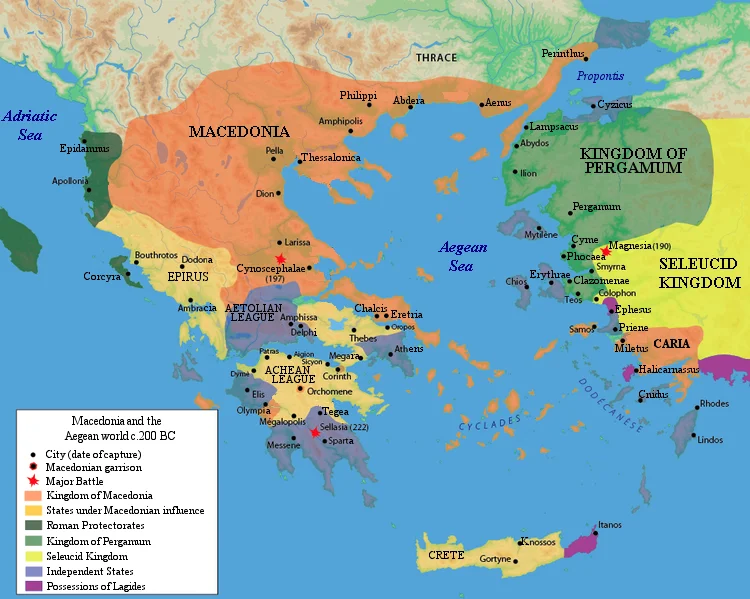
The events that led to the siege began two years earlier, in 197 BC, when Rome defeated Macedon at the Battle of Cynoscephalae and emerged as the dominant power in Greek affairs. Rather than occupy Greece outright, Rome chose to garrison select cities and manage competing interests from a distance — a strategy that left room for unstable situations to develop. Nabis of Sparta had declared himself king and taken control of Argos, a gain that alarmed the Achaean League, which had long sought to incorporate Sparta into its confederation. Nabis was expanding at the expense of Rome's allies, and that made him Rome's problem.
In 195 BC, Flamininus summoned his forces at Plataea in Boeotia. He marched to Argos, where ten thousand Achaean infantry and a thousand cavalry joined him. After initial skirmishes, the allied army advanced toward Sparta, picking up fifteen hundred Macedonians and four hundred Thessalian cavalry along the way. The Romans suffered a setback in a small engagement near Sellasia, north of Sparta, and withdrew. It became clear that taking Sparta directly, across broken terrain and against determined defenders, would be costly. Taking Gythium first — stripping Sparta of its fleet base and supply port — was the more efficient approach.
The Siege: Bombardment, Betrayal, and a Commander's Murder
Gythium was garrisoned by Spartan forces under two joint commanders: Dexagoridas and Gorgopas. The allied coalition brought naval power as well as land forces — the fleets of Rhodes and Pergamum joined the Roman and Achaean troops, tightening the blockade from the sea while siege engines battered the walls from land. Several coastal cities in Laconia had already surrendered, giving the allies a foothold on the shore and cutting off Gythium from support.
At some point, one of the two Spartan commanders decided the situation was hopeless. Dexagoridas, as recorded in the ancient sources, opened secret communications with the Roman legate and agreed to surrender the city. When Gorgopas discovered the arrangement, he killed Dexagoridas and assumed sole command. The killing briefly stiffened resistance — soldiers who had been on the edge of surrender now fought with the energy of men who had committed to a course. But the military reality had not changed. When Flamininus himself arrived with four thousand additional troops, Gorgopas and the surviving garrison negotiated terms: the city would surrender, and the garrison would be permitted to leave unharmed. The Romans accepted. Gythium fell.
The Aftermath: A Port Lost, a Tyrant Diminished
The loss of Gythium was strategically decisive. Nabis was forced to abandon Argos and most of the Laconian coastal cities. Rome organized the towns that had broken away from Sparta into the Union of Free Laconians, a coalition that would persist for centuries. Nabis himself survived — the Romans chose not to strip him of power entirely, preferring to keep a subordinate Spartan state as a counterweight to the growing Achaean League. It was a calculated decision, not mercy.
Nabis made one further attempt to reclaim Gythium, attacking it two or three years after the siege. He was unable to capture it. In 192 BC, before he could try again, he was assassinated by members of the Aetolian League. His death ended what remained of Spartan ambition under the tyrants. In 189 BC, the Spartans — denied any port of their own — attacked and seized the city of Las. The Achaeans demanded that those responsible be handed over; when Sparta refused, the Achaeans captured the city themselves. The coast of Laconia had passed decisively out of Spartan control, and the ancient maritime power of Sparta was finished.
What the Siege Reveals
The Siege of Gythium is a small engagement by the standards of ancient warfare, but it illuminates something important about how power actually shifts. No great battle decided Sparta's fate — no Thermopylae in reverse, no dramatic last stand. Instead, a port surrendered under bombardment, a general killed his co-commander, and a garrison marched out under agreed terms. The men who filed out of Gythium under Gorgopas's command were not dead; they were simply out of the war. Nabis lived for three more years. But the moment Gythium's gates opened to the Romans, Sparta's capacity to resist had been fundamentally broken. The empire is in the logistics, as it always is.
From the Air
The site of ancient Gythium corresponds to modern Gytheio, visible at the northern end of the Laconian Gulf where the Mani Peninsula meets the sea. The small islet of Cranae lies just offshore. From altitude, the town's waterfront and harbor are clearly legible. The landscape of low hills and coastline that the Roman and allied forces crossed in 195 BC can be traced from the air: the Taygetos range rises to the northwest, and the terrain opens southward toward the Gulf.
From the Air
The Siege of Gythium took place at modern Gytheio: 36.762°N, 22.566°E, on the eastern Mani coast of the southern Peloponnese. Nearest major airport: LGKL (Kalamata International), approximately 65 km northwest. Recommend 4,000–6,000 ft for overview of the coastal geography that shaped the siege. The Laconian Gulf spreads southward; Sparta lies 40 km inland to the north-northwest.
Nearby Stories
- Battle of Agios Vasileios 11 km away
- Battle of Makryplagi 16 km away
- Conquest of Coron (1685) 17 km away
- The Dokos Shipwreck 32 km away
- Hydra: Fire Ships and Stone Mansions 61 km away
- Battle of Cape Spada 107 km away
- Siege of Chania (1645) 168 km away
- Temple of Zeus, Cyrene 417 km away