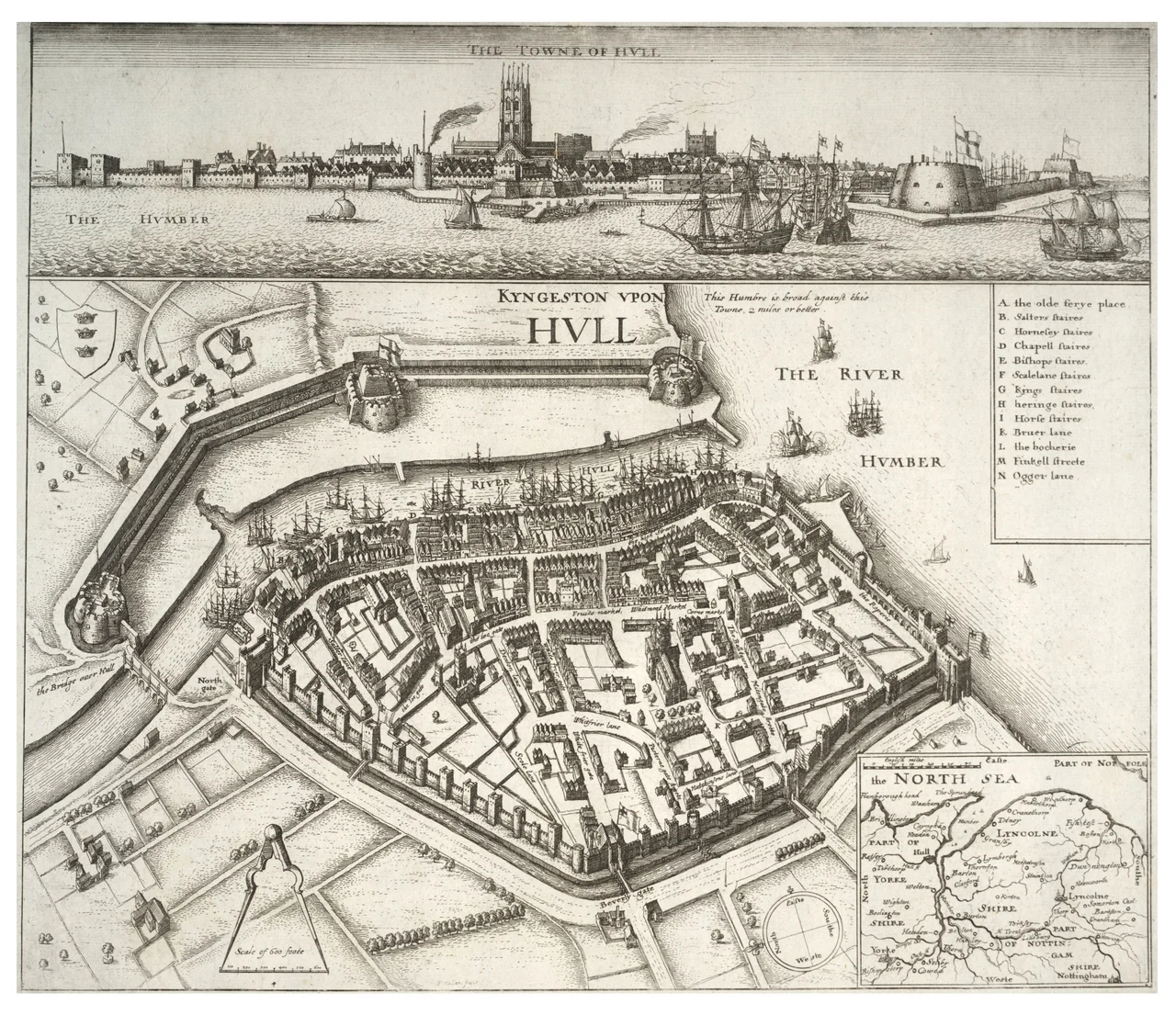

Siege of Hull (1642)
Sir John Hotham stood on the wall above the Beverley Gate and refused his king. It was 23 April 1642, the wind off the Humber, the trained bands of Yorkshire ranged behind Charles I, and the heralds shouting that the magazine inside Hull was royal property. Hotham, who had served Charles in the Bishops' Wars, who called himself loyal, would not unbar the gate. Doing so, he said, would label him 'the odious name of villain and faith-breaker.' For a while the two men argued through the wood. Hotham lowered food down to the king from the parapet. Then Charles called him a traitor and rode away to Beverley. Four months later, with the country sliding toward open war, Charles came back with an army to take Hull by siege.
The town and its arsenal
Hull in 1642 was the second-largest town in Yorkshire, with a population of about 7,000. Only York was bigger. It sat at the confluence of the River Hull and the Humber, the export point for the manufactured goods of northern England, and it held the second-largest arms magazine in the kingdom after the Tower of London itself. Inside its walls were 120 artillery pieces, 7,000 barrels of gunpowder, and weapons for somewhere between 16,000 and 20,000 men. Whoever held Hull could equip an army. Charles and Parliament both knew this, and both moved at the start of the year to claim it. Hull was already fortified. Medieval walls and 25 towers ringed the west side. On the east bank stood a curtain wall with three Tudor blockhouses. By the 1630s a new outer ditch and earthen batteries had been added. The historian Andrew Hopper called it 'arguably the strongest fortress town in England.'
Two governors, one town
On 11 January 1642 the Earl of Newcastle arrived at Hull bearing the king's commission to take governorship. He travelled under the false name Sir John Savage, was recognised at once, and discovered the townsfolk would not let him in. A few days later Captain John Hotham, son of Sir John, turned up with 300 militia and threatened to report the town to Parliament. He was admitted. By March the elder Hotham had moved into Hull with Parliament's orders 'not to admit any forces into Hull without orders from both houses of Parliament.' He had served in the Thirty Years' War in the Palatinate and had a reputation, according to Sir Hugh Cholmeley, for letting his temper outrun his judgement. He felt slighted by the King and Lord Strafford. Now he held the keys to the king's arsenal.
Beverley Gate
Eager to seize the magazine before Parliament could ship it south, Charles sent his eight-year-old son James, Duke of York, into the town on 22 April as a guest of the mayor. The next morning the king himself rode up with the Earl of Montrose, the Earl of Lindsey, Prince Rupert of the Rhine, and a small army of local trained bands. Hotham raised the drawbridges and climbed onto the wall. The heralds demanded entry. Hotham refused. He offered to let the king in with twelve men. Charles wanted thirty. They argued until evening. Charles declared Hotham a traitor and suggested the townspeople throw him off the walls. The townspeople did not. The Royalists rode back to Beverley. Parliament responded by celebrating Hotham. His pamphlet defending the refusal made him a national figure and for a time Parliament's supporters were called Hothamites.
The siege
On 3 July, Charles marched back from York with 3,000 infantry and 1,000 cavalry. Hotham, whom Lord Digby had tried to bribe into a quiet surrender, refused him a second time. Parliament had already shipped three-quarters of the magazine to London by sea. They had also sent Sir John Meldrum with reinforcements to take effective command, partly because they had begun to doubt Hotham themselves. The Hull garrison opened the sluice gates, breached the Humber banks, and flooded the surrounding fields. They demolished the old Carthusian hospital and the village of Myton to deny the Royalists cover. The siege that followed was, by the standards of the European wars, amateurish. Meldrum led a sally against the king's cavalry, killed two men and captured thirty. The Royalists managed to land a battery east of the town. Charles withdrew to York, leaving Lindsey in command. On 27 July, Meldrum sortied west to the Royalist arsenal at Anlaby, captured fifteen cannon and a 36-pound mortar, and that was effectively that. Lindsey lifted the siege.
What it cost the Hothams
Less than four weeks later, on 22 August 1642, Charles I raised his royal standard at Nottingham and the First English Civil War formally began. The Parliamentary army went into that war better armed than the Royalists, and the historian I. E. Ryder called the holding of Hull 'one of the pivotal actions' of the conflict's first year. Sir John Hotham did not enjoy his victory. He kept quarrelling with Lord Fairfax over Yorkshire strategy, attacked Selby and Cawood Castle against orders, and began secretly negotiating his own defection to the Earl of Newcastle. His son was arrested by Oliver Cromwell for disloyalty in June 1643. Parliament sent Matthew Boynton to seize Hull. The Hothams were captured at Beverley, taken to the Tower of London, tried and sentenced to death. The two men whose refusal at the Beverley Gate had announced Parliament's defiance to the country were executed at the end of January 1645. Charles I followed them to the scaffold four years later. The Beverley Gate itself was demolished in 1775, but its foundations were rediscovered in 1986 and are preserved today in the city centre as the place where the war started.
From the Air
The siege played out across the low ground at 53.74 degrees north, 0.33 degrees west, at the mouth of the River Hull. From the air the old walled town's footprint is invisible beneath the modern centre, but the surge barrier where the River Hull joins the Humber marks roughly the southeast corner of the medieval defences. The Beverley Gate site lies a few hundred metres inland near Princes Quay. Anlaby, where Meldrum captured the Royalist mortar, is two miles west; the village of Myton was demolished during the siege itself and lies under what is now western Hull. Humberside (EGNJ) is the closest field at 16 nautical miles southwest. Recommended altitude 3,500 to 5,500 feet AGL gives a clear view of how easily the flooded fields would have stopped a 17th century army moving towards the walls.
Nearby Stories
- Skipsea Castle 3.9 km away
- 2025 North Sea Ship Collision 4.8 km away
- Gainsborough, Lincolnshire 6.1 km away
- SM UC-47 9.7 km away
- Howden 12 km away
- Battle of Stamford Bridge 14 km away
- Battle of Winceby 28 km away
- HMS Cobra 50 km away