
Siege of Hull (1643)
Hull was supposed to fall this time. The Earl of Newcastle came up from Lincolnshire in late August 1643 with 12,000 foot, 4,000 horse and a siege train that included two cannon big enough to be given names, Gog and Magog. Royalist fortunes had never looked better. King Charles's army was advancing on Oxford, Lord Hopton's was pushing east from the West Country, and Newcastle's northern army was clearing Yorkshire and Lincolnshire ahead of a planned three-pronged drive on London. Only one stubborn town stood in the way of the northern claw. By 12 October the king's general would be retreating back to York, having lost guns, men and the initiative he never recovered.
Yorkshire collapses
After the Royalist victory at Adwalton Moor on 30 June 1643, Lord Fairfax's army was broken and Yorkshire fell open. Fairfax and his son Sir Thomas Fairfax made their way separately to Hull. The town was, by midsummer 1643, the only Parliamentary stronghold left in the county. Sir John Hotham, the same man who had refused Charles at the Beverley Gate the year before, was now scheming to hand it to Newcastle. The people of Hull and Major-General Robert Overton arrested him in July. Lord Fairfax was invited to take command on 22 July and accepted. He fortified the walls, set up a forward base at Beverley, and began raiding Royalist garrisons across the East Riding. Newcastle, marching south through Lincolnshire with the Eastern Association apparently open in front of him, suddenly had a hostile army at his back. He turned north.
Beverley falls, Hull holds
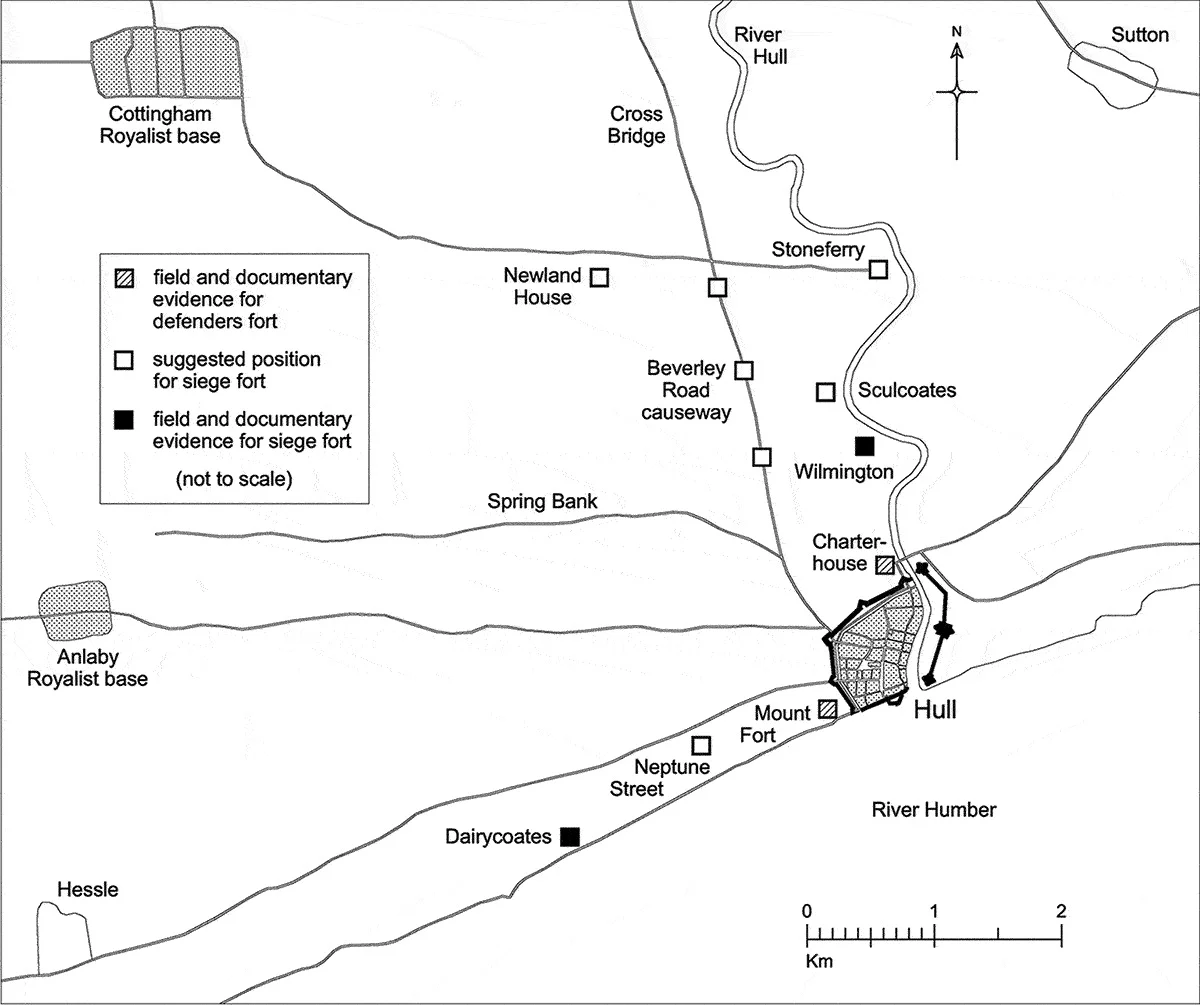
Newcastle moved with 16,000 men. Fairfax had 1,800 foot and 20 troops of horse at Beverley. The arithmetic was hopeless. Beverley was abandoned on 28 August and within the week the Parliamentary army was back inside Hull's walls. Newcastle followed and began constructing siegeworks in the villages ringing the town. On 2 September his guns opened fire. The shot was almost spent by the time it crossed the marshy ground to the walls. The Royalists pushed their earthworks closer; one of them, Fort Royal, was stormed by the defenders within a week and destroyed. On 14 September Fairfax did what Hotham had done the year before, ordered the sluice gates opened and the banks of the Humber broken. The flood pushed two miles inland and turned Newcastle's siege lines into islands.
Reinforcement by water
Parliament controlled the navy and the Humber stayed open. The warships Lion under Captain Thomas Rainsborough and Employment arrived to patrol the estuary and protect convoys. On 22 September, Oliver Cromwell crossed the Humber from Lincolnshire with arms and ammunition. Four days later Sir Thomas Fairfax ferried his cavalry and dragoons back the other way to reinforce the Eastern Association army then forming under Lord Manchester. Sir John Meldrum brought 500 more men into Hull. The defenders were now better supplied than the besiegers. On 9 October Newcastle ordered a general assault on the walls; the Royalists took some outer works and could push no further. Two days later the garrison answered. Fifteen hundred men, soldiers from the regiments, sailors from the warships and townspeople from the streets, came out under Meldrum in two columns commanded by Colonel John Lambert and Colonel Rainsborough. They drove the Royalists back, captured emplacements and took heavy guns.
The turning
On 11 October, the same day Hull's defenders were storming the siege lines, Sir Thomas Fairfax's cavalry helped destroy a Royalist army at the Battle of Winceby in Lincolnshire. Newcastle had lost his rear and his front in the same week. On 12 October he admitted defeat and pulled the siege off, leaving guns behind, and retreated to York. The lifting of the siege became an annual public holiday in Hull until the Restoration brought it to a quiet end. The defeat at Hull and the defeat at Winceby ended the Royalist three-pronged advance on London before it ever crossed the Trent. The northern army, which had looked unstoppable in June, was now penned back into Yorkshire. The slow Parliamentary counter-advance that followed would culminate the next summer at the Siege of York and the Battle of Marston Moor, where the Royalist cause in the north would be broken for good.
From the Air
The second siege played out around the same low ground at 53.74 degrees north, 0.33 degrees west. From the air the layout is best understood by following the Humber west to east. Newcastle's siege lines ran through the modern suburbs north and east of the city centre; Fort Royal stood somewhere near the present line of Beverley Road. The flooded area extended roughly two miles inland and gave the defenders the geometry they needed. Humberside (EGNJ) is the nearest civil field, 16 nautical miles southwest across the estuary. Leeds Bradford (EGNM) is 50 nautical miles west. Recommended altitude 4,000 to 6,000 feet AGL shows the relationship between the town, the Humber, and the open Lincolnshire ground across the estuary that brought Cromwell's relief column in.
Nearby Stories
- Skipsea Castle 3.9 km away
- 2025 North Sea Ship Collision 4.8 km away
- Gainsborough, Lincolnshire 6.1 km away
- SM UC-47 9.7 km away
- Howden 12 km away
- Battle of Stamford Bridge 14 km away
- Battle of Winceby 28 km away
- HMS Cobra 50 km away