
Siege of Kinsale
Four thousand Spanish soldiers stepped ashore at Kinsale on 2 October 1601. Their commanders, Don Juan del Aguila and Don Diego Brochero, had sailed from Spain with six thousand men and a hold full of arms. Bad weather had separated nine of their ships, taking back most of the veteran troops and gunpowder. What remained landed at the wrong end of Ireland - far from the Gaelic chieftains they had come to help, and directly in the path of the English army that ruled the south. The battle that followed across the next three months would decide who owned the country.
Why Spain Came
Philip II of Spain had been hunting for a way to bleed England since the Armada of 1588 broke against the Atlantic weather. Tying English troops down in an Irish rebellion would draw resources away from the Dutch revolt against Spanish rule and give Spanish privateers a friendly base on England's northwest flank. He launched a second armada at Ireland in 1596, which storms smashed off Cape Finisterre. A third in 1597 also failed. Philip II died, but his son Philip III kept the strategy. By 1601 the Irish rebellion led by Hugh O'Neill, Earl of Tyrone, and Hugh Roe O'Donnell - the Nine Years' War - had bled English forces for nearly a decade. Spanish gold and powder had been arriving in dribs and drabs. Now, at last, came soldiers.
The 300-Mile March
The Spanish chose Kinsale because they could reach it. The Irish chieftains had every reason to wish they had landed somewhere closer to Ulster. O'Neill and O'Donnell ruled the north. Kinsale lay on the far south coast, deep inside English-held country, surrounded by a population whose loyalty was uncertain at best. The choice forced O'Neill's hand. If he abandoned the Spanish, no further help would come from Spain. If he marched to them, he had to lead his army 300 miles in a wet, stormy winter through hostile territory, and abandon the guerrilla tactics that had served him so well. O'Donnell argued for going. O'Neill agreed. They set out separately to ease the supply burden - O'Neill with 2,500 foot and 500 horse, O'Donnell with 1,500 foot and 300 horse - and rendezvoused at Kinalmeaky, where additional forces from Leinster and Munster joined them.
The English Closing In
While the Irish marched, Lord Mountjoy's English army was bombarding Kinsale and its outer defences. At the end of October English cannon hammered Ringcurran fort, the headland position that controlled the harbour. The Spanish commander Don Pedro de Heredia refused to surrender, and when a breach opened, fifty Spaniards tried to slip away. Most were caught. Inside Kinsale town, Aguila tried to send out a relief force; Lieutenant-Colonel Francis Roe and a hundred English fought the relief column to a standstill until Sir Oliver St John reinforced him with thirty musketeers, and the Spaniards were driven back. Ringcurran fell. Then it was the turn of Castle Ny-Parke on the opposite headland - the medieval fort that would later become the site of James Fort. A wooden siege engine collapsed before its walls. The English regrouped and stormed it under Sir Richard Smyth. All 33 defenders were killed, wounded, or captured. From the high ground the English now had clear lines of fire onto the Spanish positions in Kinsale itself.
The Battle and Its Aftermath
On 24 December 1601 - Christmas Eve in the old style - O'Neill and O'Donnell launched their long-prepared attack on the English siege lines, with the Spanish garrison meant to break out and join them from inside the town. Coordination failed in the cold dawn. The Irish columns lost contact in the dark; the Spanish never marched. English cavalry under Mountjoy caught the Irish foot in the open and broke them. Within hours the largest Gaelic army ever assembled was scattering across the Munster countryside. O'Neill retreated north. O'Donnell sailed for Spain to seek more aid and died there a year later, aged 29. Aguila surrendered Kinsale on terms in January 1602. The reinforcements Spain had launched after him turned back when news of his surrender reached them at sea. The Nine Years' War ended formally in 1603 with O'Neill's submission at Mellifont. Within four years the Gaelic earls of Ulster sailed for Europe in what became known as the Flight of the Earls. Gaelic Ireland as an independent political order ended at Kinsale. On the headland above the harbour, Charles Fort would rise in the 1670s on the same Ringcurran ground - England's answer to make sure no Spanish fleet would ever again decide who ruled Ireland.
From the Air
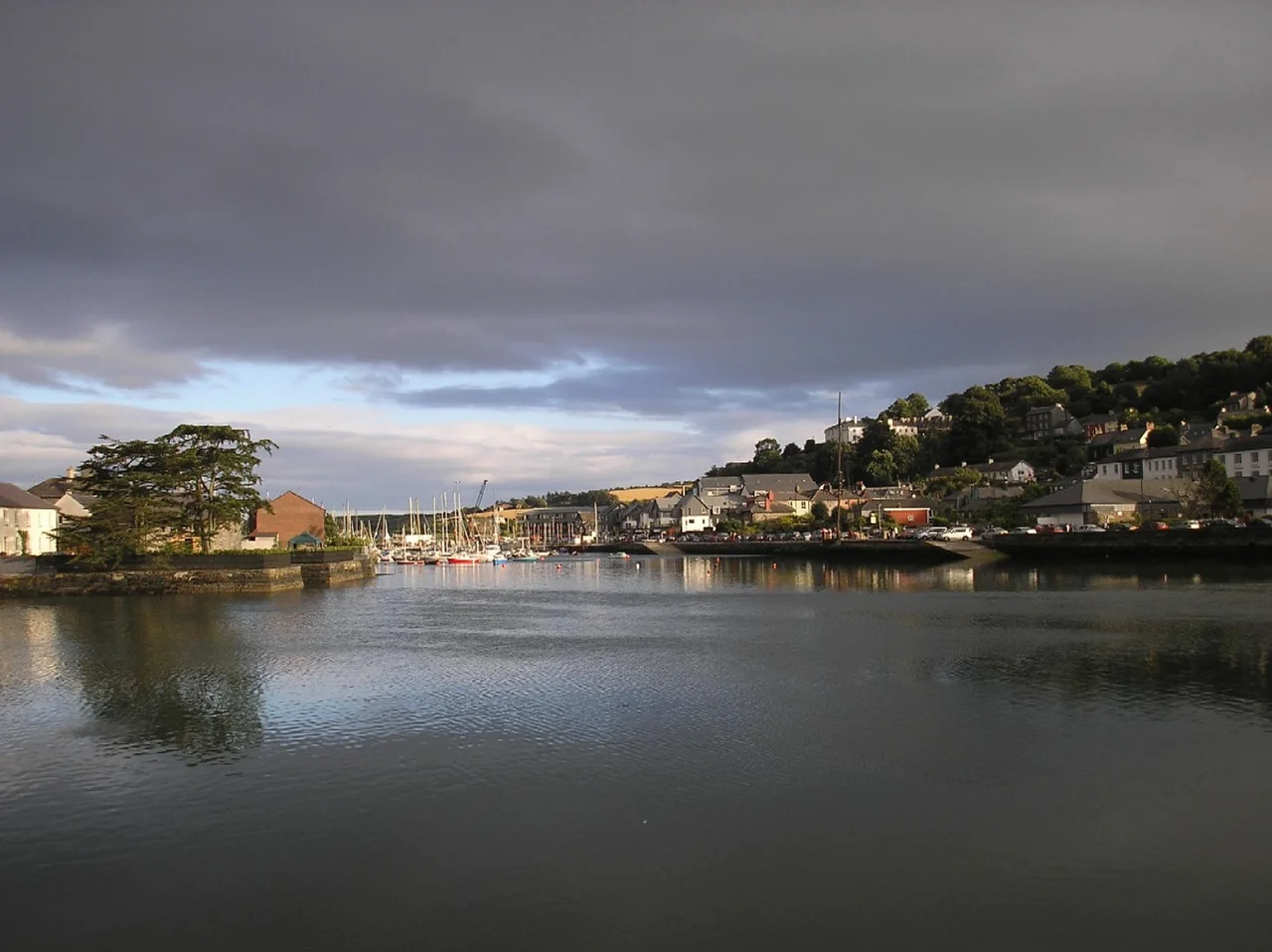
The siege ground centres on Kinsale Harbour at 51.7075 N, 8.5306 W. The town sits at the head of the harbour with the open Atlantic to the south. James Fort (built 1602-07 on the Ringcurran/Castle Ny-Parke ground that fell to the English) lies on the western headland; Charles Fort (built 1677-82) marks the eastern. Cork Airport (EICK) is 18 km north. Best aerial views come from 2,000-3,000 ft AGL with both star forts in frame across the harbour mouth.
Nearby Stories
- Ballycotton 8.7 km away
- West Cork 8.8 km away
- Cloghan Castle, Lough Hyne 11 km away
- Mourne Abbey 12 km away
- The Sinking of the Lusitania: The Torpedo That Changed the War 12 km away
- Headford Ambush 14 km away
- Lismore Castle 16 km away
- SM U-27 101 km away