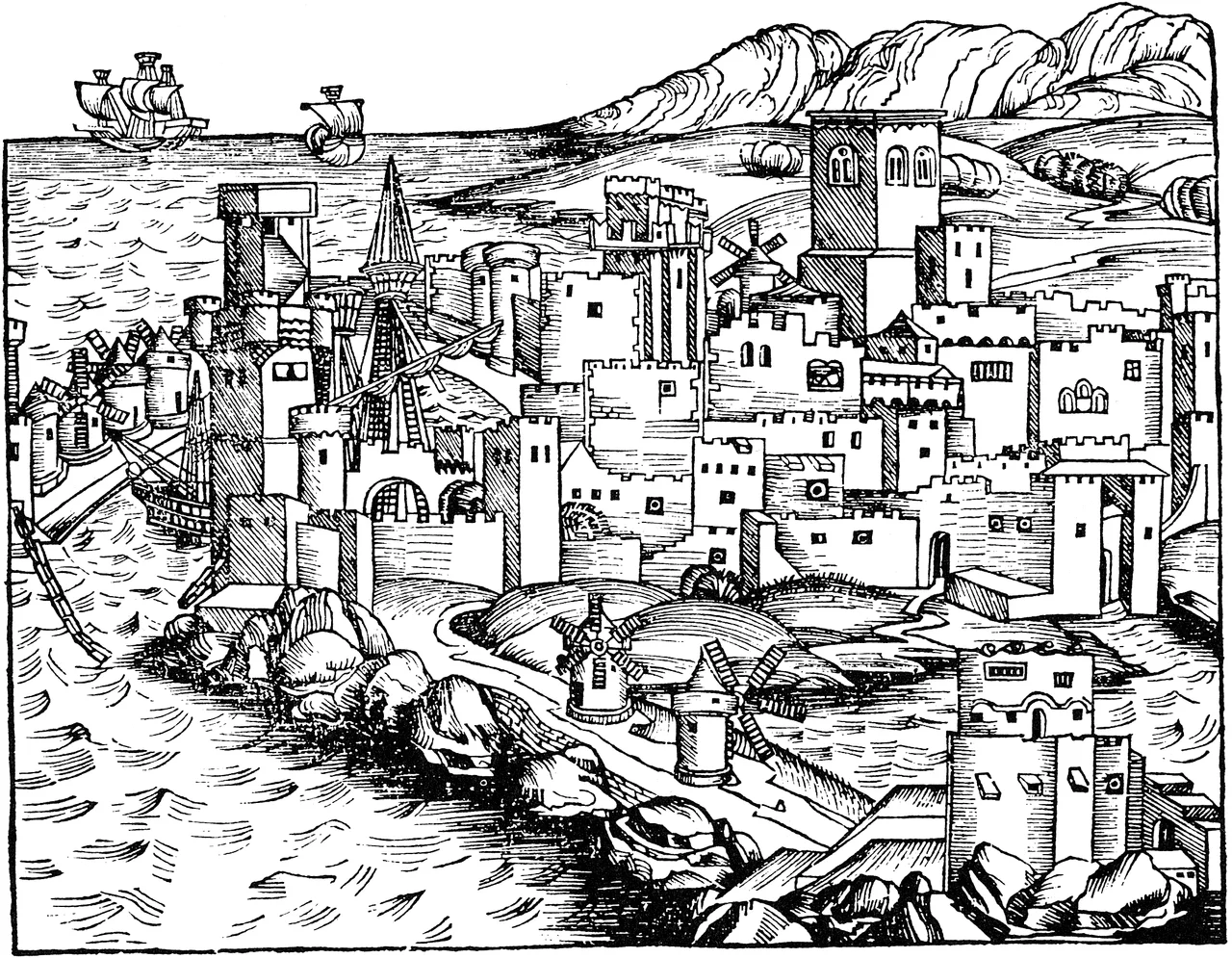

Siege of Rhodes (1480)
On the morning of July 27, 1480, the Ottoman army threw 2,500 janissaries at the Tower of Italy on the eastern wall of Rhodes city. They got over the parapet. They were inside. Grand Master Pierre d'Aubusson, already wounded in five places, came at them with a lance and the rest of the Knights followed. Three hours of close-quarters fighting later, between three and four thousand Ottoman soldiers lay dead on the breach, the survivors had been pushed out, and the Hospitaller counterattack had reached the Vizier's tent and seized the holy standard of Islam from where it had been planted. By August 17, Mesih Pasha would order what was left of his army to embark. Rhodes had held.
Mehmed's Calculation
After the Fall of Constantinople in 1453, Sultan Mehmed II spent the next two and a half decades pushing Ottoman frontiers in every direction. By 1480, the empire stretched from the Crimea to Albania, with the Black Sea closed to non-Ottoman shipping and the Aegean increasingly dominated. Two obstacles remained in the eastern Mediterranean. The first was Rhodes, where the Knights Hospitaller continued to harass Ottoman shipping. The second was Italy itself. Mehmed planned simultaneous campaigns: an army under Mesih Pasha would take Rhodes, while a second force crossed the Adriatic to land at Otranto in southern Italy and open a corridor for further conquest. If Rhodes fell quickly, the two operations would reinforce each other. If Rhodes held, the entire strategy began to wobble.
The Tower of Saint Nicholas
On May 23, 1480, an Ottoman fleet of 160 ships and an army of about 70,000 men appeared off Trianta on the Rhodes coast. Mesih Pasha's first objective was the Tower of Saint Nicholas, a fortified position controlling the entrances to both Mandraki and Akandia harbors. The Turkish artillery hammered the tower for weeks. From June 9 onward, infantry assaulted in waves. Pierre d'Aubusson personally led reinforcements to the garrison and helped throw back the attackers. The tower held. The Ottoman commander then shifted attack to a weaker section of the wall on the east, near the Jewish quarter, the battle station of the "tongue" of Italy. Knights and townspeople, working under continuous bombardment, dug a new internal moat behind the wall and threw up fresh fortifications inside the breach as the outer wall came down.
The Morning of July 27
At dawn, the Ottoman commander committed his elite. About 2,500 janissaries stormed the Tower of Italy and got across the parapet. They opened the way for the main assault force behind them. The town stood in genuine danger of falling in the next hour. Pierre d'Aubusson, by now wounded in five places and refusing to leave the wall, fought hand-to-hand with a lance. The Knights followed his example, and the wave broke against them. Three hours of brutal close-quarter fighting in the breach left the Ottoman vanguard decimated. The survivors began to fall back. The Knights pressed the counterattack into the Ottoman lines and reached as far as the Vizier's command tent, capturing among other booty the holy standard of Islam. Between three and four thousand Ottoman soldiers were killed during the day. The Vizier and the senior commanders were dragged out by their own retreating troops.
The Withdrawal
Mesih Pasha did not order an immediate departure. The Ottoman army stayed in position for nearly three weeks, regrouping and considering whether another assault was possible. It was not. Casualties were too heavy, morale was broken, the campaigning season was running out, and the calculation that had brought Mehmed's army to Rhodes had collapsed. On August 17, the fleet weighed anchor and sailed away. Mehmed II in Constantinople was furious. He began preparing a second expedition for the following year. The next year, in 1481, the sultan died before that expedition could sail, and his successors had other priorities. The Ottoman force at Otranto, meanwhile, had also withdrawn, and the Italian peninsula was spared the larger campaign Mehmed had planned. The Hospitaller defense of Rhodes had bought Italy time, perhaps decades of it.
The Book That Carried the News
Among those who watched the siege from inside the walls was Gulielmus Caoursin, vice-chancellor of the Hospitallers. He sat down afterward and wrote *Obsidionis Rhodiae Urbis Descriptio*, a detailed eyewitness account that Edward Gibbon would later translate into English as part of his *Crusades*. In 1482, the German printer Johann Snell carried Caoursin's manuscript to Odense in Denmark and printed it there. That printing is often counted among the very first books ever printed in Denmark, which is to say that the news of how a small Hospitaller garrison held off an Ottoman empire became one of the founding texts of Danish printing. The Knights Hospitaller commissioned a remarkable bombard around 1480 to defend the walls at close range, weighing 3,325 kilograms and firing 260-kilogram granite balls; it sits today in the Musee de l'Armee in Paris. Pierre d'Aubusson lived until 1503, dying eighteen years before the third Ottoman siege under Suleiman the Magnificent that would, finally, end Hospitaller Rhodes.
From the Air
Rhodes city is at 36.43°N, 28.22°E on the northern tip of the island. The Tower of Italy and Tower of Saint Nicholas, both key 1480 battle sites, are still part of the medieval walled city. Diagoras International Airport (ICAO: LGRP) is 14 km southwest. Best viewed from 3,000-5,000 ft. The Mandraki and Akandia harbors flanking the old city show the strategic geometry of the siege clearly from the air. The Trianta landing area is now Ialyssos, on the west coast just south of the airport.
Nearby Stories
- Acropolis of Rhodes 24 km away
- Battle of Rhodes (1912) 33 km away
- Astypalaia 96 km away
- Toplou Monastery 130 km away
- Antalya Museum 204 km away
- Archaeological Museum of Agios Nikolaos 215 km away
- Antalya 218 km away
- Agios Neophytos Monastery 377 km away