
Siege of Rhodes (1522)
On the first day of January 1523, Suleiman the Magnificent watched from a height above Rhodes as the survivors of his enemy walked out of the broken city. The Knights Hospitaller marched in full armour, drums beating, banners flying, with several thousand civilians trailing behind them toward the fifty ships that would carry them to Crete. The young sultan, by some accounts, said quietly to his vizier that it pained him to drive this old man, the Grand Master, from his home. The siege had cost both sides terribly, and the man who had won was not yet thirty.
An Island That Refused to Belong
The Knights of St. John had ruled Rhodes since the early fourteenth century, when they reorganized themselves on the island after Acre, the last Crusader stronghold in Palestine, fell in 1291. From the harbour they raided Ottoman shipping in the Levant, frustrated trade between Constantinople and Cairo, and protected the Christian pilgrim routes. An island roughly the size of Long Island sat just off the southern coast of Anatolia, fortified to the gills, refusing to belong to the empire that surrounded it. A first Ottoman attempt in 1480 failed, and the next year an earthquake shook everything that the cannons had not. The Knights rebuilt in the new Italian style, with thicker walls, doubled ditches, sloped parapets, and overlapping fields of fire. They thought they had built something that could not fall.
Three Hundred Ships
Suleiman arrived in June 1522 with a fleet swollen to over three hundred ships and a force estimated at 75,000 men. The defenders, perhaps 7,000 in all, included only a few hundred actual Knights of the Order. From the moment the bombardment began, both sides understood the math. Turkish sappers tunneled toward the bastions; Knight engineers countermined and listened in the dark for the scrape of shovels. The walls came down a few yards at a time. Assaults were thrown back, then mounted again. By late November both armies were exhausted, the besiegers ravaged by dysentery and winter rains, the besieged out of food and out of hope of relief. No Christian fleet was coming. Suleiman offered terms.
The Negotiated Surrender
Grand Master Philippe Villiers de L'Isle-Adam was old, ill, and unwilling to see the city's civilians butchered. The townspeople pressed him hard to accept. A truce broke down when locals demanded further guarantees, the bombardment resumed, and the bastion of Spain fell on 17 December. On 22 December the representatives of the Latin and Greek inhabitants accepted terms that, by the standards of any sixteenth-century siege, were extraordinary. The Knights had twelve days to leave with their weapons, valuables, and religious icons. Civilians could emigrate within three years. No church would be desecrated or converted. Those who stayed would owe no Ottoman taxes for five years. The terms held.
Who Gained, Who Lost
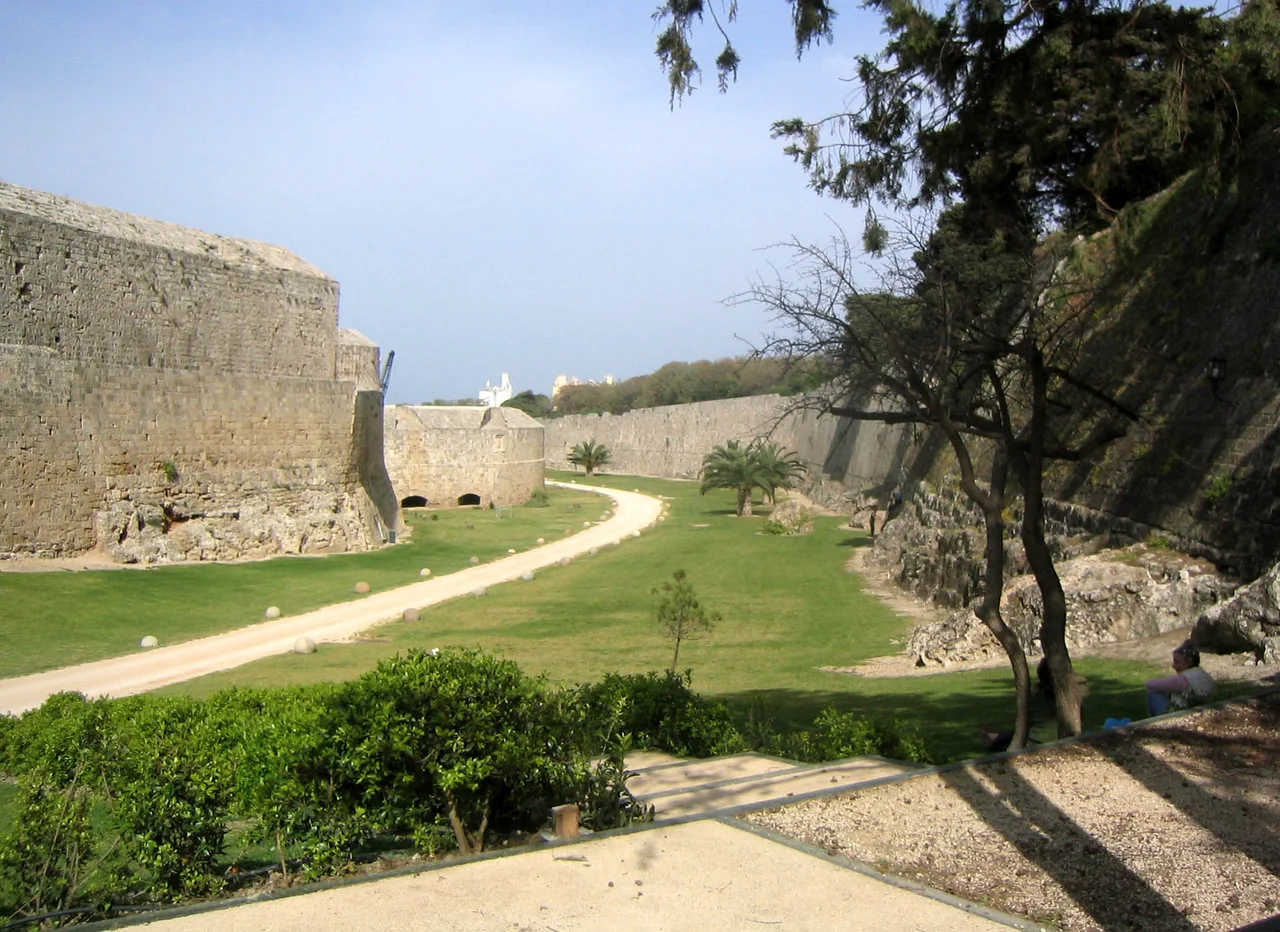
The Knights sailed to Crete, then Sicily, and in 1530 received Malta from Emperor Charles V, where they would hold off another, more famous Suleiman siege a generation later. For the Ottomans, Rhodes was the corkscrew finally pulled from the bottle: maritime communication between Constantinople, Cairo, and the Levantine ports could now run unmolested. From this base, in 1669, the Turks would eventually take Venetian Crete. The island's Greek inhabitants kept their churches and their language. In 1523, the Ottomans resettled 150 Jewish families from Thessaloniki in Rhodes, a community that would flourish on the island for the next four centuries until it was destroyed by the deportations of 1944. The walls Suleiman broke still stand, breached in places, repaired in others, the stone cannonballs still lying in the dry ditches where the gunners left them.
A Ghost in the English Theatre
The siege lodged itself in the European imagination almost immediately. In 1656, more than a century after the last Knight sailed away, William Davenant staged The Siege of Rhodes in London as the first English opera, partly to evade Cromwell's ban on plays by setting his work to music. The story he told was already legend by then: a doomed defense, a magnanimous conqueror, a lost city. What is harder to put on a stage is the slow grinding of the actual siege, the dysentery in the Turkish camps, the hunger inside the walls, the masons working under fire to patch what the cannons had opened the night before. Both sides were brave; both sides were tired; both sides wanted it to end.
From the Air
The medieval city of Rhodes lies at the northern tip of the island at 36.17 degrees north, 28.00 degrees east. The fortified circuit is best seen at 3,000 to 5,000 feet AGL, with the harbour and the medieval walls clearly defined against the modern town. Rhodes International Airport (LGRP), 14 km southwest along the coast, handles most traffic; Kos (LGKO) lies 90 nm northwest. Summer haze can obscure the island from cruising altitude, but morning light from the east illuminates the curtain walls dramatically.
Nearby Stories
- Acropolis of Rhodes 24 km away
- Battle of Rhodes (1912) 33 km away
- Astypalaia 96 km away
- Toplou Monastery 130 km away
- Antalya Museum 204 km away
- Archaeological Museum of Agios Nikolaos 215 km away
- Antalya 218 km away
- Agios Neophytos Monastery 377 km away