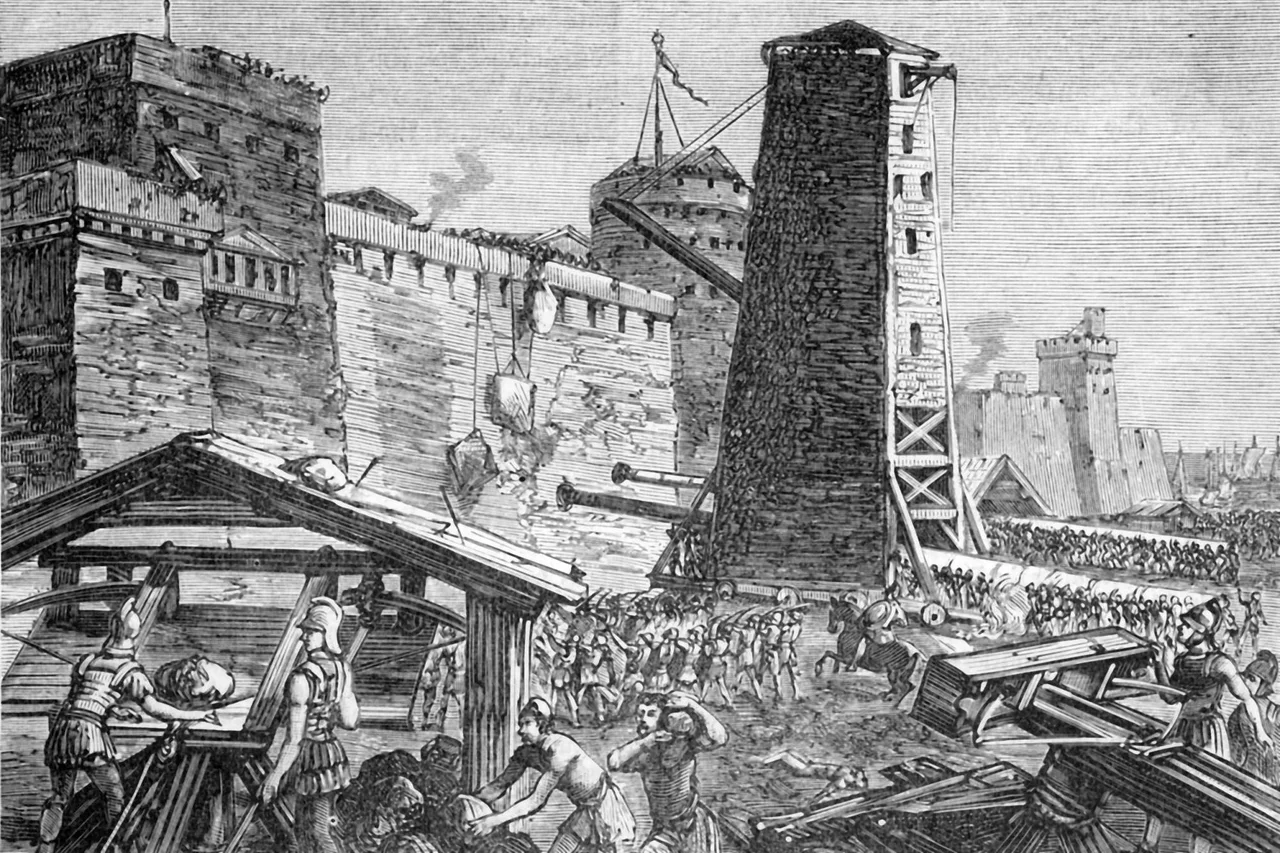

Siege of Rhodes (305-304 BC)
His enemies called him Poliorcetes, the Besieger, and the title was meant as both compliment and warning. Demetrius son of Antigonus had spent his life perfecting the art of breaking cities, and in 305 BC he sailed for Rhodes with 40,000 men, a fleet that filled the horizon, and a war machine so enormous that it had to be rolled forward on iron wheels by 3,400 men working in shifts. The machine was called the Helepolis, the city-taker. It was nine stories tall, plated in iron, and bristling with catapults. A year later, when Demetrius sailed away in defeat, the Rhodians scrapped his abandoned engines, sold them for 300 talents, and used the money to cast a statue of the sun god Helios as tall as the Statue of Liberty.
The Pretext for War
Rhodes in the late fourth century BC was a mercantile republic, small in population but enormous in wealth, its harbour controlling the entrance to the Aegean. Like Switzerland in modern Europe, the island made its living by being neutral; treaties of peace with everyone meant trade with everyone. Demetrius and his father were locked in the long brawl between Alexander's successors, and they wanted Rhodian ships and Rhodian shipyards. Rhodes had a closer relationship with Ptolemy of Egypt than they liked, and that was sufficient pretext. The campaign was effectively, as ancient sources noted with distaste, a piratical enterprise. Even Demetrius's own allies in the Greek world thought the assault unjust and quietly sympathized with the defenders.
Six Thousand Against Forty
The Rhodian citizen-body numbered around 6,000, augmented by a thousand resident foreigners and an unspecified number of slaves. The slaves were promised something rare in the ancient world: if they fought well, the city would buy them from their masters and free them. Many did, and many earned it. The walls were strong, the harbour fortified, and the Rhodians had grain and water enough for a long fight. Demetrius could not seal the harbour entirely; supply ships kept slipping past his blockade. He built a separate harbour for himself alongside the original, deployed a floating boom, and threw assault after assault at the walls. Early in the siege his men breached the wall and poured into the city, only to be cut down to the last man. The Rhodians repaired the breach overnight.
The Helepolis
Both sides used everything the age had invented. The Rhodians dug counter-mines beneath their walls and listened for the Macedonian sappers in the dark. They flooded ditches and built inner walls behind the threatened sectors. Demetrius answered with the Helepolis, a moving fortress 41 metres tall on a base 21 metres square, weighing more than 160 tons, with iron plating to deflect arrows and catapult bolts. It was perhaps the largest siege engine ever built. When the Rhodians fired flaming bolts at it, slaves working under cover stripped its armour and saved the wooden frame. Eventually the defenders aimed water-pumps and undermined the ground beneath it. The Helepolis was rolled back, abandoned. After a year of attrition that bankrupted both treasuries, the Aetolian League and Ptolemy brokered peace. Rhodes kept its autonomy. Demetrius kept his reputation, mostly intact.
Bronze into Sun
The Rhodians were left holding a battlefield of abandoned siege equipment, and they made a decision that has echoed for twenty-three centuries. They sold the metal for 300 talents and commissioned the sculptor Chares of Lindos to build a colossal statue of Helios, the sun god to whom they attributed their deliverance. He cast it from the bronze of Demetrius's weapons. It stood for fifty-six years before an earthquake brought it down in 226 BC, and even fallen it was so impressive that the geographer Strabo wrote about visiting the broken pieces. The Colossus of Rhodes became one of the Seven Wonders of the Ancient World. The lesson the Rhodians left for everyone who would come after, including Emma Lazarus when she wrote The New Colossus for the base of the Statue of Liberty, was that the metal of war can be melted into something else.
What Survived
The walls Demetrius failed to breach are gone now, replaced by the medieval circuits the Knights Hospitaller would build seventeen centuries later on the same lines. The harbour he could not close still functions, still fills with ferries and yachts in summer. The Colossus is gone, no fragment securely identified. What remains is the strategy: a small republic with good walls, a sympathetic public opinion among its neighbours, and the patience to outlast even the most spectacular engineering its enemies could invent. Rhodes had been written off many times in 305 BC. It was not the last time.
From the Air
The ancient city of Rhodes shares its site with the modern town and the medieval citadel at 36.17 degrees north, 28.00 degrees east. From cruising altitude, the harbour entrance Demetrius could not close is the obvious dark mole on the northeast tip of the island. Rhodes International Airport (LGRP) is 14 km southwest; Kos (LGKO) is 90 nm northwest. Visibility along the Anatolian coast is best in spring and autumn; summer haze often softens the island silhouette.
Nearby Stories
- Acropolis of Rhodes 24 km away
- Battle of Rhodes (1912) 33 km away
- Astypalaia 96 km away
- Toplou Monastery 130 km away
- Antalya Museum 204 km away
- Archaeological Museum of Agios Nikolaos 215 km away
- Antalya 218 km away
- Agios Neophytos Monastery 377 km away