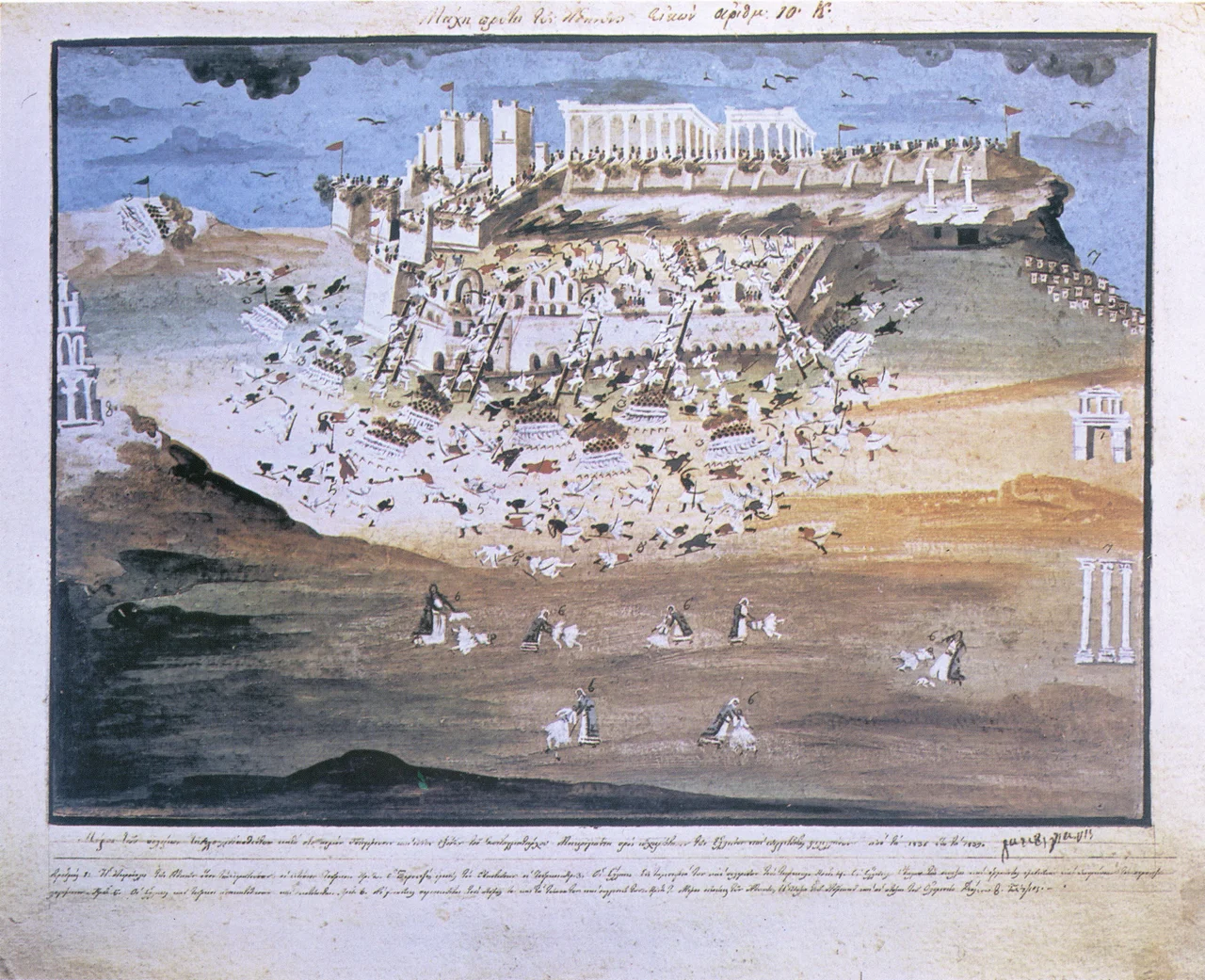

Siege of the Acropolis (1821–1822)
Athens changed hands on 28 April 1821 without a shot. The Ottoman garrison and the city's Muslim families simply withdrew up the sacred rock - the Acropolis - taking Greek community leaders with them as hostages. What followed was a year-long contest for the most famous hilltop in the world, fought not over the marble temples but over the fortress those temples had become. The Parthenon, by then nearly twenty-three centuries old, stood inside the walls as the besieged and their captives waited out the guns below.
A Loose Ring Around the Rock
The first besiegers were locals: roughly 600 Athenians under Meletios Vasileiou, a force too small to storm anything. Word of the uprising spread through the islands, and volunteers arrived by sea from Aegina, Hydra, Cephallonia, and Kea until the Greek camp swelled to around 3,000. Even then the siege stayed loose, a watchful blockade rather than a stranglehold. The Acropolis is a defender's dream - cliffs on three sides, a single climbable approach, ancient cisterns holding water. Men who knew they could not simply rush the walls settled in to wait, while inside, soldiers, families, and hostages rationed what they had and watched the plain below for any sign of rescue.
The Relief That Came and Went
A handful of Ottoman soldiers slipped through the Greek lines and rode to Karystos in Euboea, begging help from the local governor, Omar Bey, and the experienced general Omer Vrioni. The two joined forces and swept down into Attica. The Greek irregulars, never a disciplined army, scattered before them, and Ottoman troops marched back into Athens on 20 July 1821. But relief armies cannot stay forever. Omar of Karystos went home; Vrioni lingered to hunt the rebels, then he too withdrew. The moment he was gone, the Greeks closed the ring again. The garrison's brief reprieve had only deepened its isolation.
French Guns and a Garrison's End
By the spring of 1822 the rebels had something they had lacked: artillery, and men who knew how to use it. French Philhellenes - foreign volunteers drawn to the Greek cause - arrived under Olivier Voutier and turned proper cannon on the fortress. Bombardment is patient, grinding work, and the defenders had nowhere left to turn. After nearly a year under siege, the Ottoman garrison surrendered on 9 June 1822 (Old Style calendar). The terms were generous on paper: troops and civilians would be given safe passage to Asia Minor aboard neutral ships, and any who wished to remain in Athens could do so unharmed.
When the Terms Failed
The surrender held only as long as honor did, and here it did not hold. Greek irregulars in Athens killed nearly half of the Ottomans who had laid down their arms, and further violence fell on Albanian civilians in the city. These were people who had surrendered under a promise of safety - soldiers who had stopped fighting, families who had nothing left to defend. It is among the harder truths of the war for Greek independence: a struggle for freedom that, in this place and this hour, betrayed its own word. The siege had been a feat of endurance. Its ending was a massacre, and the dead deserve to be counted as the people they were.
From the Air
The Acropolis sits at roughly 38.00°N, 23.72°E in central Athens, a flat-topped limestone rock crowned by the Parthenon's columns, rising about 150 meters above the surrounding city. From the air it reads as a bright island of marble and rock amid dense urban sprawl, with the Aegean and the port of Piraeus to the southwest. Best viewed in clear morning light, when the temples cast long shadows. Nearest major airport is Athens International (LGAV), about 30 km east-southeast.
Nearby Stories
- Great Sand Beach 5 km away
- Battle of Delium 7.7 km away
- Tower of Aliartos 9 km away
- HMHS Britannic 10 km away
- Saronic Gulf 15 km away
- Sousaki Volcano 17 km away
- Sanctuary of Apollo Maleatas 24 km away
- Skyros 66 km away