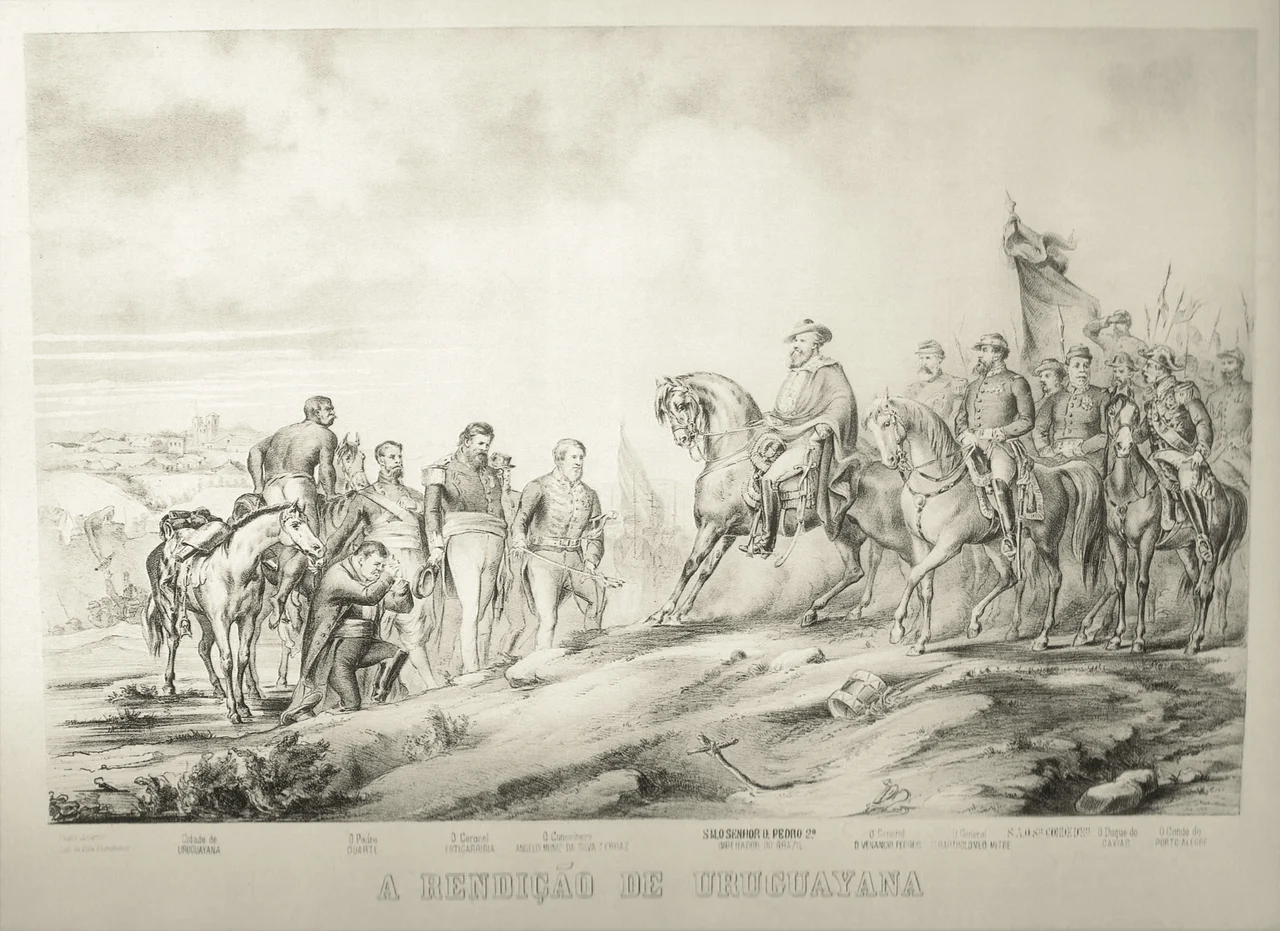

Siege of Uruguaiana
By mid-September 1865, the only food left inside Uruguaiana was sugar. Five thousand five hundred Paraguayan soldiers were dug in behind a barricade of felled trees, ringed by an allied army three times their size, with the Uruguay River at their backs and Brazilian gunboats patrolling the water. Their president had ordered them never to surrender. On 18 September, they surrendered anyway. What makes this riverside town remarkable is not just the siege itself, but who came to witness its end: Emperor Pedro II of Brazil had traveled the length of his vast country to stand on this border and accept the capitulation in person.
The Tide That Reached Too Far
The Paraguayan War pitted the landlocked nation of Paraguay against the combined might of Brazil, Argentina, and Uruguay. In its opening phase, President Francisco Solano López sent his armies south and east, deep into enemy territory. On 5 August 1865, a column under Lieutenant Colonel Antonio de la Cruz Estigarribia took Uruguaiana without firing a shot. The town surrendered, and the Paraguayans occupied it with around ten thousand men, fortifying their position with an abattis, a defensive tangle of sharpened branches. This was the high-water mark of the invasion. Uruguaiana marks the southernmost point Paraguayan forces ever reached. Everything that followed was retreat. By the time the noose closed, hunger and desertion had already thinned that garrison to roughly half its strength.
An Alliance That Barely Held
The army that gathered to retake Uruguaiana was a fractious one. Brazil, Argentina, and Uruguay had signed the Treaty of the Triple Alliance, but their commanders distrusted one another deeply. The Count of Porto Alegre nursed an open contempt for his Hispanic-American allies. When the Uruguayan president, Venancio Flores, boasted that his men could defeat the Paraguayans alone, the Brazilian officers mocked him to his face. Argentina's president, Bartolomé Mitre, claimed command of the whole force, and Porto Alegre flatly refused to recognize it, reminding Mitre that on Brazilian soil a Brazilian would lead. The squabbling stopped only when the emperor himself arrived and quietly divided the army into three, one part for each nation's pride.
The Emperor at the Front
Pedro II reached the siege lines on 11 September. It was an extraordinary thing for a head of state to do, and he did not come alone. The presidents of Argentina and Uruguay were there, along with the Count d'Eu and Admiral Tamandaré, who commanded the Brazilian fleet on the river. Roughly seventeen thousand allied soldiers and fifty-four guns now encircled Estigarribia's shrinking, hungry garrison. The Paraguayan commander knew the math. When the end came, he made one condition: he would surrender only to the Brazilian Emperor, not to the republicans of Argentina and Uruguay, whom he did not trust. On 18 September, with nothing left to eat but sugar, he laid down his arms.
The Long Retreat Home
The surrender broke the back of Paraguay's offensive. López, recognizing that the war had turned, abandoned the Argentine province of Corrientes and pulled back to defend his own frontier. The withdrawal was vast and methodical: General Resquín drove more than 100,000 head of cattle and other livestock across the Paraguay River at Paso de Patria over four days in late autumn. The men who had marched south in triumph now retreated north, herding the spoils of an invasion that had ended in capitulation. The war itself would grind on for five more brutal years and become one of the deadliest conflicts in the history of South America, but the moment captured here, on a quiet stretch of riverbank, was the moment the tide turned. After Uruguaiana, Paraguay was never again on the attack.
From the Air
The site lies at 29.76°S, 57.09°W, on the Brazilian bank of the Uruguay River directly across from Paso de los Libres, Argentina. From the air the river makes an unmistakable navigation line, with the international bridge linking the two cities just downstream. The nearest field is Uruguaiana–Ruben Berta International Airport (ICAO: SBUG), with Paso de los Libres Airport (ICAO: SARL) immediately across the border in Argentina. Recommended viewing altitude is 3,000–5,000 feet AGL for a clear read of the river bend and the twin border towns. The region's humid subtropical climate brings haze in summer; clearest visibility comes in the mild, dry winter months.
Nearby Stories
- Yapeyú, Corrientes 31 km away
- Brazilian Island 50 km away
- Mercedes, Corrientes 55 km away
- Federación 106 km away
- São Borja 113 km away
- Battle of Masoller 122 km away
- Iberá Wetlands 134 km away
- João Goulart's House 139 km away