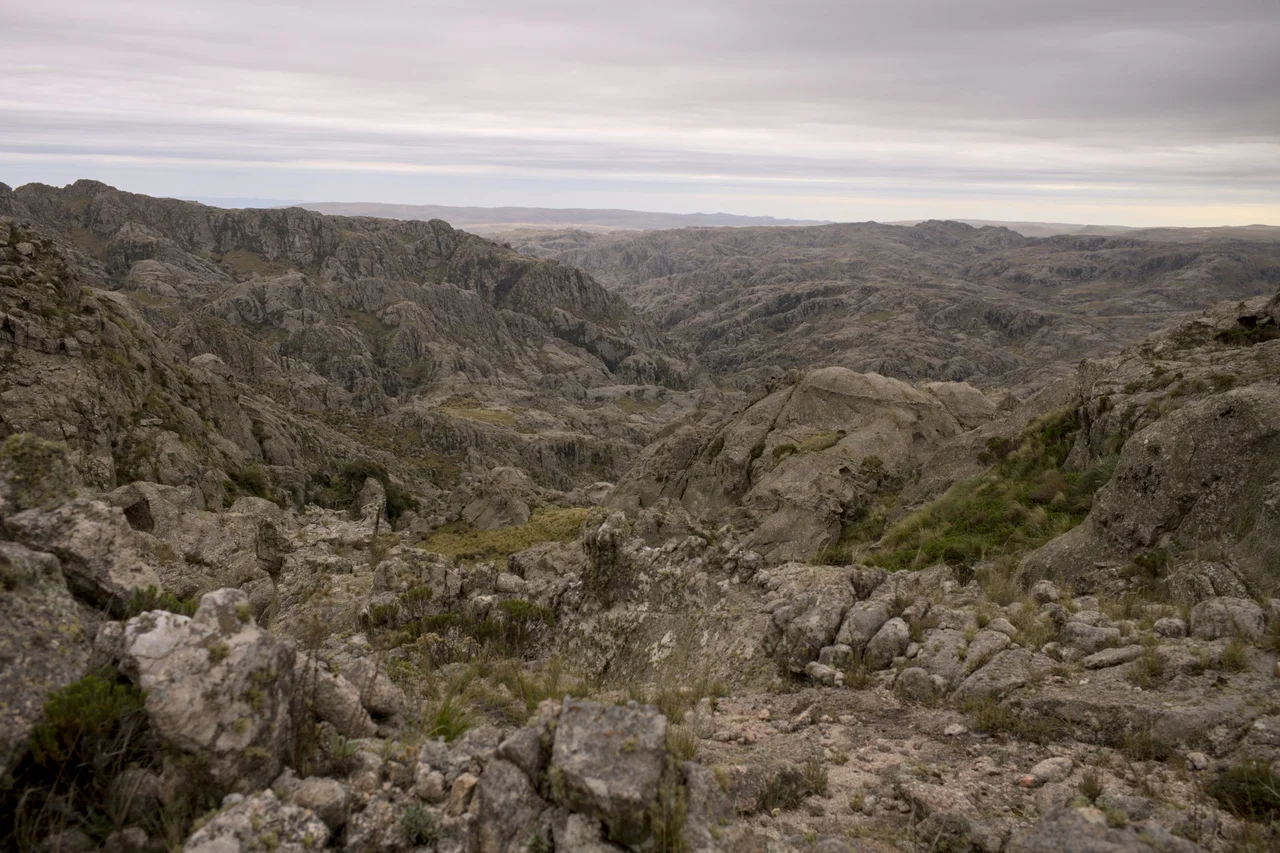

Sierras de Córdoba
These are old mountains, and you can read their age in their shape. Where the Andes thrust up raw and jagged to the west, the Sierras de Córdoba have been worn soft and round over hundreds of millions of years, rolling across central Argentina like the backs of sleeping animals. They rise alone, far from the great cordillera, marooned between the flat Pampas and the scrubby Chaco. No glaciers carved them. Almost no snow falls on them. And yet condors wheel above their highest ridges, and three million people climb into them every year.
Mountains Without Ice
The Sierras de Córdoba belong to the Sierras Pampeanas, a scattering of ranges that march north and south along the eastern flank of the Andes. They sort themselves into bands. The Sierras Chicas run along the eastern edge, rising abruptly above the plains and the city of Córdoba. West of them stand the Sierras Grandes, holding the highest summits, crowned by Cerro Champaquí at 2,790 meters. Their rounded contour tells a story of deep time and dry air. Even on the loftiest peaks, the winters are so parched that little snow accumulates, and there is no trace of the glaciers or frozen ground that shaped mountains elsewhere during the last ice age.
A Line Between Two Worlds
Climb from east to west and you cross an invisible border. The eastern slopes catch the rain, as much as 1,200 millimeters a year, and grow lush. The western slopes lie in the mountains' rain shadow, where the total can fall below 400, and the land turns Chaco-dry. The plants and animals follow suit, with the lowland life of the Chaco giving way, high up, to species more at home in the Andes. Above roughly 2,000 meters, exposure stunts the trees and grasslands take over, dotted with hardy tabaquillo woodlands tucked into sheltered hollows. It is a compact lesson in how altitude and rainfall draw the map of life.
Condors and Cinclodes
More than a hundred bird species live in these mountains, two of them found nowhere else on Earth. The Córdoba cinclodes breeds only here, haunting the tabaquillo groves near water, and Olrog's cinclodes keeps to grassy, rock-strewn slopes by the streams and lakes. Overhead, the Sierras offer something rare: one of the few places outside the Andes where wild Andean condors still ride the updrafts, best seen soaring above the cliffs of Quebrada del Condorito National Park. Not all the news is good. Generations of cattle grazing have reshaped the land, and ranching and hunting have thinned the native mammals badly, a reminder of how heavily even gentle mountains can be used.
Resorts, Vineyards, and a German Accent
Few people live in the mountains themselves; there is little arable land, and most of Córdoba's population stays down in the city. But the cool air has long pulled visitors up. Wealthy córdobeses built summer resorts in towns like Alta Gracia and Jesús María, and today Villa Carlos Paz, Cosquín, La Falda, and Villa General Belgrano draw holidaymakers by the millions. Cosquín alone is a name known across the country for its long-running folk music festival. The valleys carry an unexpected accent. A large German-Argentine community settled here, and the region is known for its craft beers and Alpine-styled villages like La Cumbrecita, where the architecture would not look out of place in Bavaria. Old sweet-wine country around Colonia Caroya and Villa Dolores has been joined by ambitious new boutique wineries on the cooler eastern slopes, coaxing serious vintages from these high terroirs. One local label, Familia Navarro Torre, even took gold at the Vinandino competition with a Cabernet-Malbec, proof that these gentle, ancient mountains still have something entirely new left to offer.
From the Air
The Sierras de Córdoba run through central Argentina, with this point near 30.84 degrees south, 64.48 degrees west, mostly within Córdoba Province and extending into San Luis Province to the southwest. From the air the range is unmistakable: long, parallel, rounded ridges rising green-and-tawny from the surrounding plains, with the Sierras Grandes holding the high ground around Cerro Champaquí (2,790 meters) and the Sierras Chicas walling off the eastern lowlands near the city of Córdoba. The principal gateway is Córdoba's Ingeniero Aeronáutico Ambrosio Taravella International Airport (ICAO SACO). A viewing altitude of 9,000 to 12,000 feet shows the range's full grain and the rain-shadow contrast between wet eastern and dry western slopes. Expect strong summer thermals and afternoon thunderstorms over the high ground; condors favor these same updrafts, so give the ridgelines room.
Nearby Stories
- Battle of San Cala 8.9 km away
- Tren de las Sierras 14 km away
- San José Charterhouse 26 km away
- Mar Chiquita Lake 138 km away
- Battle of Quebracho Herrado 174 km away
- Villa San Agustín 233 km away
- Mailín 244 km away
- San Fernando del Valle de Catamarca 246 km away