
Silliman University
In 1901, a retired businessman from Cohoes, New York, wrote a check for ten thousand dollars. Dr. Horace Brinsmade Silliman had never visited the Philippines, but he believed that education could transform lives anywhere, and the Presbyterian Board of Foreign Missions needed seed money for a school in the Visayas. That single donation founded Silliman Institute -- an elementary school for boys in the coastal town of Dumaguete. More than a century later, the institution that bears his name is a full research university of 62 hectares, the first Protestant university in the Philippines and the first American university anywhere in Asia.
From Schoolhouse to University
The school began modestly, educating young boys in a building whose materials included lumber salvaged from an old theater in New York. It was a Protestant institution in an overwhelmingly Catholic country, yet it grew steadily. By 1910, Silliman Institute had expanded into a college. University status followed in 1938. Americans ran the institution for its first half-century, but after the devastation of the Second World War, Filipino administrators and faculty gradually assumed leadership, reshaping the institution's identity while maintaining its academic standards. Today the university holds autonomous status from the Commission on Higher Education, which has designated it a Center of Excellence in Information Technology, Teacher Education, and Nursing Education, and a Center of Development in Anthropology, Biology, and Medical Technology. Students come from 56 countries, making it one of the most internationally diverse campuses in the Philippines.
Silliman Hall and the Acacia Campus
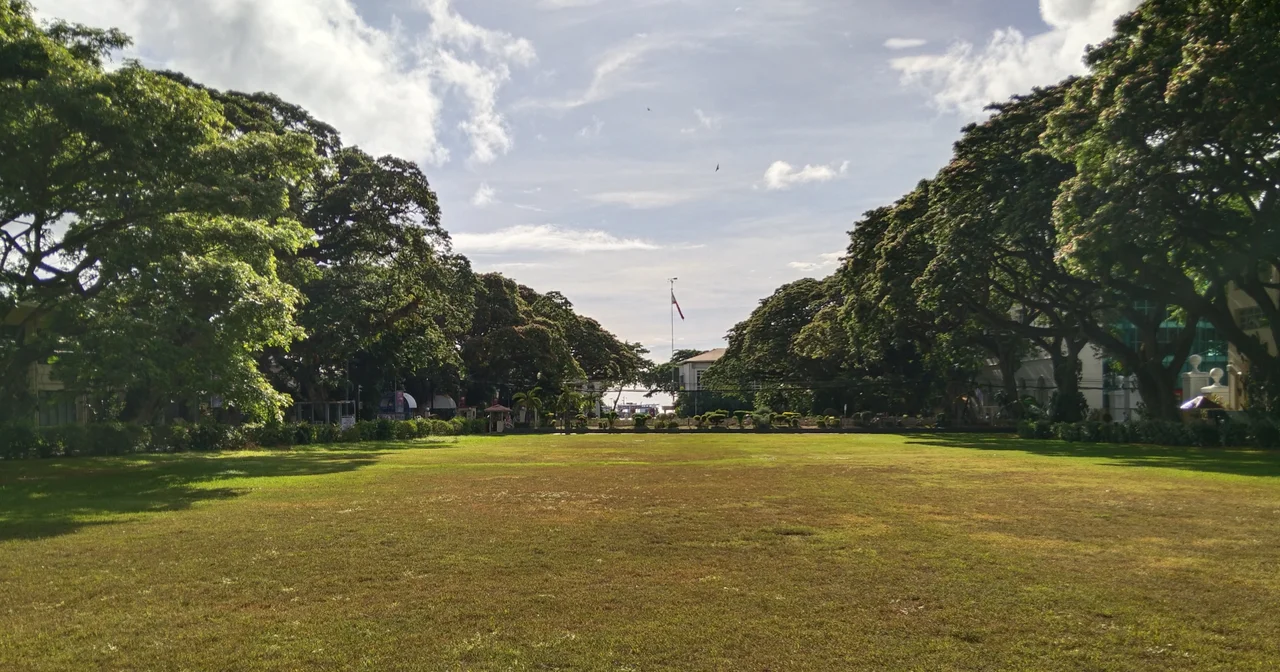
The oldest surviving structure on campus is Silliman Hall, built in 1909 as an addition to the original 1902 building that has since been demolished. It is the oldest standing American-era structure in the Philippines, designated a National Historical Landmark. Its Stick-style architecture -- a relic of late 19th-century American building traditions -- looks improbable transplanted to the tropical Visayas, yet it has endured typhoons, wars, and more than a century of equatorial weather. The main campus along Hibbard Avenue is shaded by enormous acacia trees that give the grounds a character distinct from the concrete density of most Philippine universities. The campus adjoins the city's downtown district, so there is no sharp boundary between town and gown -- students, faculty, and townspeople share the same sidewalks and cafes.
A University That Shaped a Reef
Silliman's influence extends well beyond its campus walls. The university's community-based coastal resource management program helped transform Apo Island, a small island off the coast of Dauin, into one of the world's recognized dive sites. The program demonstrated that marine sanctuaries managed by local communities could restore degraded reefs -- a model now replicated across Southeast Asia. The university also maintains an Anthropology Museum and the Institute of Environmental and Marine Sciences on a separate campus to the north, where researchers study the marine biodiversity of the Tanon Strait and the volcanic ecosystems of the Cuernos de Negros range.
The University as City
Silliman does not merely exist within Dumaguete; in many ways, it is Dumaguete. The 62-hectare campus occupies nearly ten percent of the city's urban core. Its church, medical center -- the Silliman University Medical Center that serves as a major tertiary hospital for the region -- and elementary through graduate schools create a self-contained ecosystem. Walk Silliman Avenue toward the Gate of Knowledge and you cross from commercial district into academic village without any visible transition. The university's Anthropology Museum holds collections documenting the indigenous cultures of the Visayas, and its Institute of Environmental and Marine Sciences conducts research across the Tanon Strait and the volcanic highlands of the Cuernos de Negros range. Remove Silliman from Dumaguete and you would have a pleasant port town. With it, you have a city defined by the belief that one philanthropist's check can echo across a century and reshape an entire region.
From the Air
Silliman University occupies a large, tree-covered campus in downtown Dumaguete at 9.313N, 123.307E, immediately adjacent to the waterfront along the Tanon Strait. From the air, the campus is identifiable by its mature acacia canopy and its proximity to Rizal Boulevard. The nearest airport is Dumaguete-Sibulan Airport (RPVD), approximately 5 km north. Cebu Island is visible across the Tanon Strait to the east.
Nearby Stories
- Tanjay 7.6 km away
- Japanese Cruiser Abukuma 21 km away
- Jose Rizal Memorial Protected Landscape 39 km away
- Guimaras Oil Spill 83 km away
- Cebu 93 km away
- 1995 Ipil Massacre 132 km away
- November 2023 Mindanao Earthquake 402 km away
- Balut Island 463 km away