.jpg)
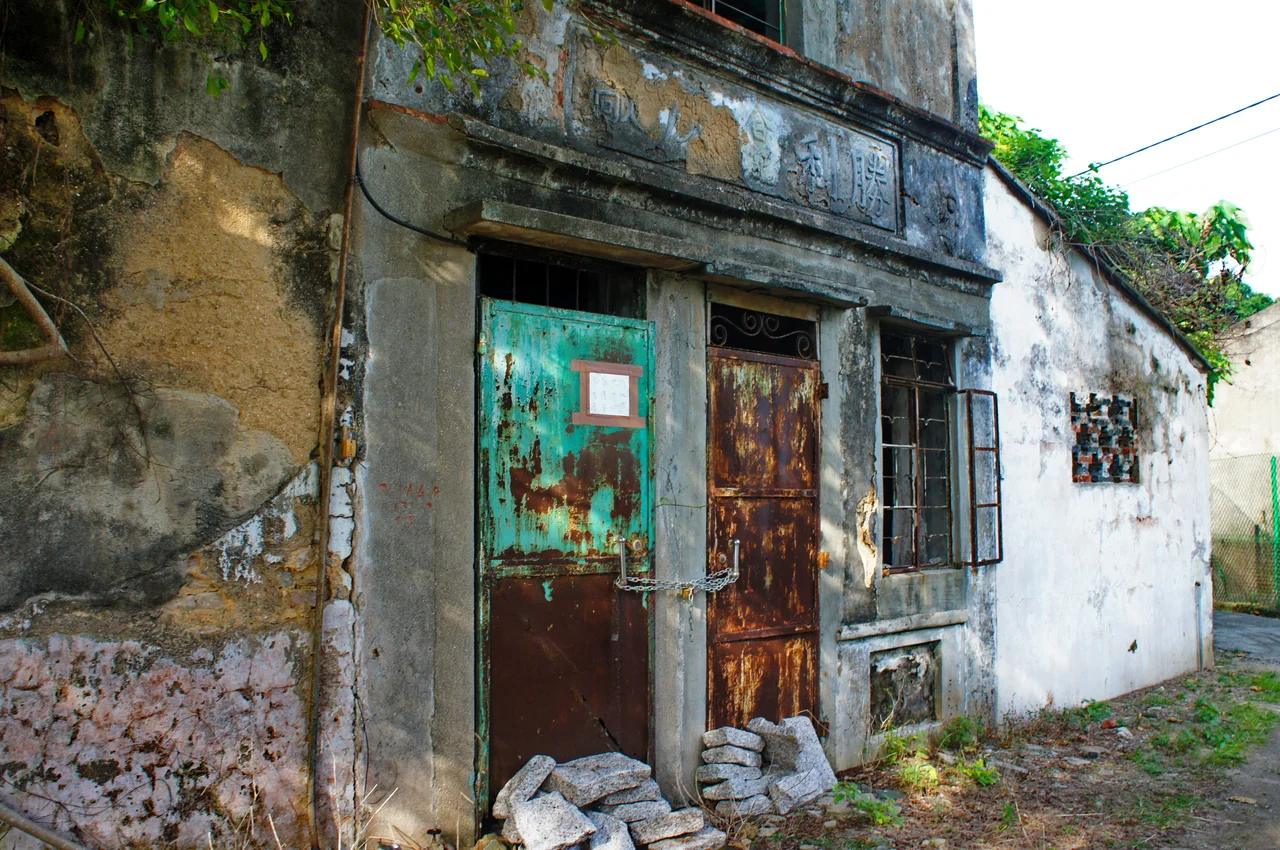
Sing Lei Hap Gei Lime Kiln Factory
Peng Chau is a small island in Hong Kong's outer harbour, about half a kilometre wide and half a kilometre long, reachable by ferry from Central in roughly 30 minutes. Its pace is unhurried, its lanes too narrow for cars, its character determined more by its fishing past than by the city it now borders. Tucked into this quiet island is a structure that most visitors walk past without understanding what they are looking at: the Sing Lei Hap Gei Lime Kiln Factory, a building from the 1920s that carries the memory of an industry that once shaped the physical fabric of Hong Kong.
Eleven Kilns, One Survivor
At its peak, Peng Chau had eleven lime kilns — a concentration that reflects how significant the island's lime industry was to the wider region. Lime was not a luxury material; it was structural. Construction, paper-making, and other industries depended on it, and Peng Chau's kilns supplied that demand by burning oyster shells, clam shells, and coral to produce calcium oxide. The Sing Lei Hap Gei factory was among these eleven. Its origins lie in the 19th century, though the current building was constructed during the 1920s.
Of those eleven kilns, only Sing Lei Hap Gei survives in any recognisable form. The others were demolished as the island's land use shifted and the lime trade declined. The factory originally comprised two buildings, of which the one still standing is the more substantial. Its survival is partly luck and partly the persistence of the family that owned it, who kept the structure standing even as the business wound down.
Shells, Coral, and a Dying Trade
The process of lime production from marine shells was labour-intensive and ancient. Oyster shells and clam shells were gathered or purchased, loaded into the kiln, and fired at high temperatures until the calcium carbonate in the shells converted to calcium oxide — lime. Coral was sometimes added to the mix. The resulting material was used in mortar, whitewash, agriculture, and paper manufacturing, among other applications.
This kind of shell-lime production had been practised across coastal southern China for centuries, using the abundant raw material provided by the region's fishing industry. The kilns on Peng Chau were part of this broader tradition. The industry on the island survived longer than might be expected: the kiln kept operating through the Japanese occupation of Hong Kong during the Second World War, a period that disrupted most of the territory's commercial activity. But the post-war development of cement and other modern construction materials eroded the market for shell lime, and by the 1950s the decline was pronounced. The factory finally closed in the 1970s.
Standing in Dilapidation
For decades after closure, the Sing Lei Hap Gei building stood quietly on Peng Chau, weathering and deteriorating but not demolished. In 2009, the building was submitted to the Antiquities Advisory Board for consideration as a heritage building under the Antiquities and Monuments Ordinance. Heritage status was granted on 20 September 2010 — recognition that this structure represented something worth preserving: not a grand civic building or a colonial institution, but a working industrial site from a largely forgotten chapter of Hong Kong's economic history.
The practical consequence of that heritage designation was financial: it opened access to the Financial Assistance for Maintenance Scheme, which provides funding to private owners of historic buildings to cover preservation and upkeep costs. Without some form of support, many privately owned historic buildings in Hong Kong face an impossible choice between expensive maintenance and gradual collapse. The designation gave the factory's owners a route to keep the structure standing. Today it remains one of the few legible industrial heritage buildings on Hong Kong's outlying islands — a quiet monument to the shell-lime workers and the trade they sustained.
From the Air
The Sing Lei Hap Gei Lime Kiln Factory sits at 22.2806°N, 114.0410°E on Peng Chau island in Hong Kong's outer Lantau Channel. From the air, Peng Chau is the small triangular island approximately 2 kilometres east of the north-eastern tip of Lantau Island. Hong Kong International Airport (VHHH) lies about 10 kilometres to the south-west on Lantau. Recommended viewing altitude is 1,000–2,000 feet to resolve the island's small scale and waterfront details. The ferry pier on Peng Chau's western shore is the primary navigation landmark at lower altitudes.
Nearby Stories
- Lok Ma Chau Loop 2.3 km away
- Portas do Cerco 2.3 km away
- Kweilin Incident 17 km away
- Wanshan Archipelago Campaign 34 km away
- Nanxiong Formation 115 km away
- Battle of Nanpeng Island 148 km away
- Heyuan 169 km away
- Cape Maobitou 632 km away