
Sint-Michielsgestel
In May 1942, the German occupiers turned a small Catholic seminary in this Brabant village into a prison, and its cells filled with some of the most prominent men in the Netherlands: a future prime minister, celebrated novelists, professors who would shape the postwar country. On the surface, Sint-Michielsgestel is the gentlest sort of place, a village of church towers and moated farms split neatly in two by the slow river Dommel. Beneath that calm runs a surprisingly dense layer of history, reaching back nearly two thousand years to the day Roman coins first changed hands on these same green banks.
The River That Made a Village
Everything here begins with water. The Dommel rises from a spring near Peer, across the border in Belgium, and winds a hundred and twenty kilometers north before joining the Meuse just past 's-Hertogenbosch. For most of its length it is unremarkable, but at Sint-Michielsgestel it mattered enormously, because here the river could be crossed safely. A crossing meant trade, and trade meant settlement. Archaeologists working near the hamlet of Halder found the proof: in 1962, thousands of Roman coins turned up in the fields not far from Nieuw Herlaer, evidence that Halder was likely the most important settlement on the Dommel in Roman times. The finds now rest in the small Museum Romeins Halder at Haanwijk, a modest collection that quietly rewrites the age of the place. The village name itself records the geography, 'Gestel' meaning an elevated stretch of sandy ground in the forest, dry land raised just above the marsh.
A Landscape Full of Castles
Few Dutch villages of this size are ringed by so many fortifications. During the Middle Ages, a surprising number of castles and moated sites rose around Sint-Michielsgestel, and the Lords of Herlaer, first mentioned in 1079, held sway from a motte-and-bailey stronghold at Oud Herlaer that probably dated to the eleventh or twelfth century. Little of that great castle survives today, though there are plans to open what remains as a museum. Its successor, Nieuw-Herlaer, endured as a true castle before softening into a manor house that still shows a fifteenth-century stair tower and an eighteenth-century wing. Nearby, Haanwijk preserves a sixteenth-century manor, and the Grote Ruwenberg has passed through lives as a fortified home, a school, and now a conference venue, its original tower still standing. The French period of the late eighteenth century proved disastrous for many of these estates, but their bones remain scattered across the fields.
The Prisoners of Beekvliet
The seminary that became Gymnasium Beekvliet has a darker chapter. On 4 May 1942, the German occupiers imprisoned 460 Dutch men here, all of them politically active or otherwise important to national life. It was a form of hostage-taking, meant to hold the country's leadership in check. Among the captives were the novelists Simon Vestdijk and Anton van Duinkerken, and a cluster of men who would help govern the postwar Netherlands, including Wim Schermerhorn, prime minister from 1945 to 1946, and Jan de Quay. One prisoner, Luuk van Driel, managed to escape with a group by calling the police, an act that made the men local heroes. That the same institution founded to train priests should become a cage for the nation's intellect is one of those grim reversals the war produced so often, and the village has not forgotten it.
Old Tower, New Fame
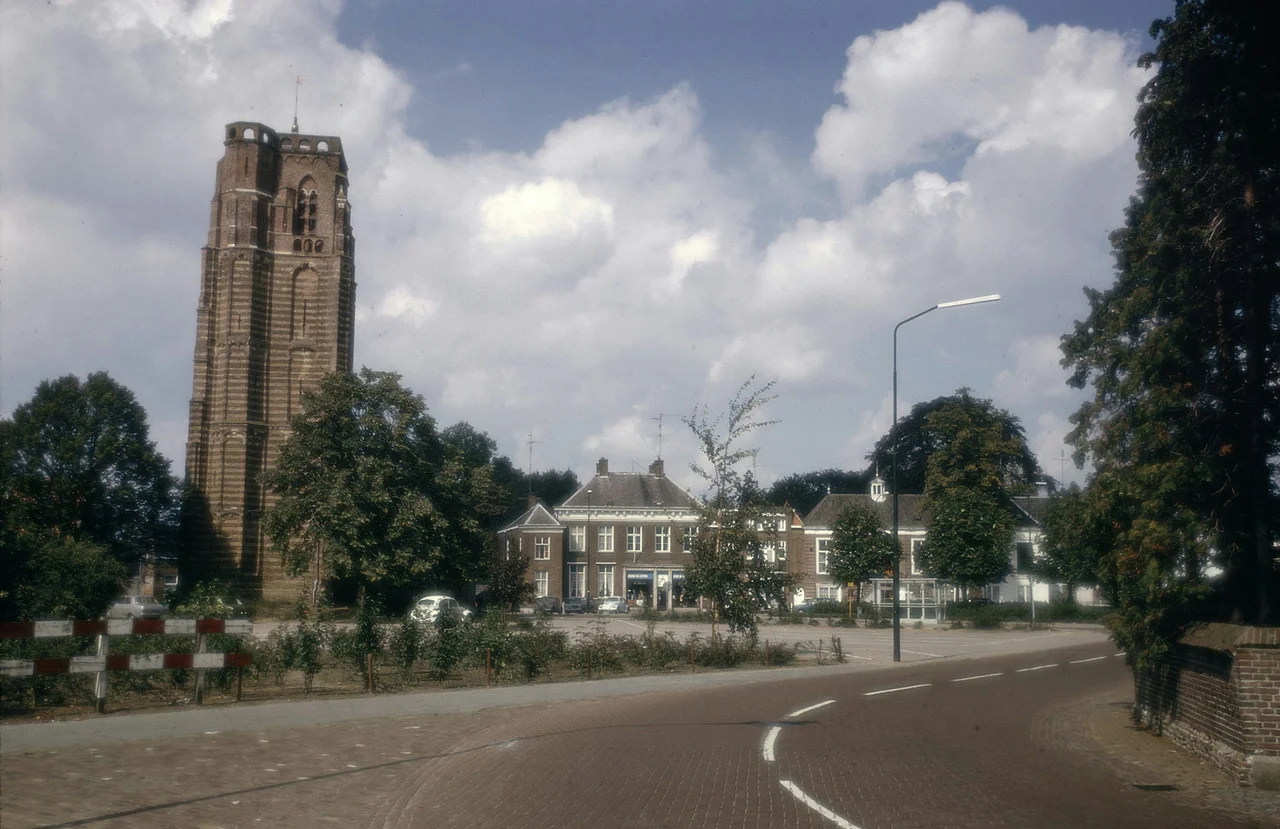
At the heart of the village, on the Petrus Dondersplein near the river, stands the Oude toren, a handsome fifteenth-century church tower built in alternating courses of brick and pale tuff stone. It once belonged to a larger church that was eventually demolished; when the main church passed back to the Catholics in 1808, the Protestant minority built their own more modest one. Today Sint-Michielsgestel draws few tourists of its own, its visitors mostly people who sleep here before exploring nearby 's-Hertogenbosch. Yet the village has one unexpected claim to national fame: cyclo-cross. Since 1974, local organizers have run major races through the mud here, and in 2000 the UCI Cyclo-cross World Championships were held in the village and won by a local rider, Richard Groenendaal. On a cold, churned-up winter course, this unhurried place briefly became the center of the sport.
From the Air
Sint-Michielsgestel sits at 51.64 N, 5.36 E in the Dutch province of North Brabant, straddling the Dommel between 's-Hertogenbosch and Eindhoven. From roughly 2,500 to 4,000 feet in clear weather the river's twin channels and the Oude toren are the clearest landmarks, with the A2 motorway running just to the west. The nearest major airport is Eindhoven (EHEH), about 25 km south, with Amsterdam Schiphol (EHAM) well to the northwest.
Nearby Stories
- Rivierenland 6.2 km away
- Wire of Death 7.5 km away
- Breda 9.6 km away
- Battle of Tolhuis 9.7 km away
- Schoonhoven 11 km away
- Hillenraad Castle 13 km away
- Weeze 16 km away
- Malle 16 km away