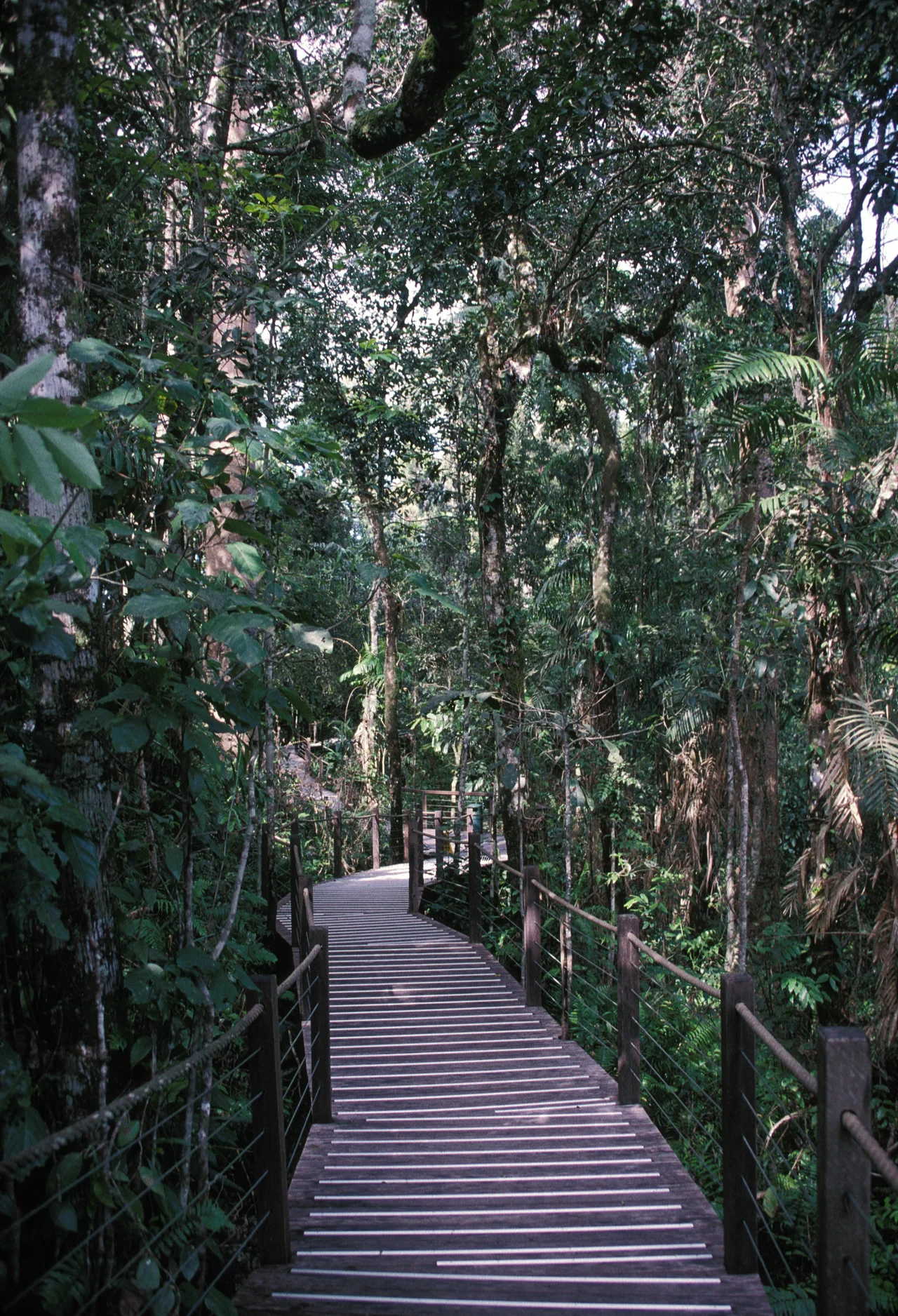

Skyrail Rainforest Cableway
To build a cableway over rainforest, you first have to reach the rainforest - and that was the whole problem. The forest below the MacAlister Range is among the oldest on Earth, a Wet Tropics survivor that predates the Amazon, and bulldozing roads through it to haul in steel and concrete was unthinkable. So the builders of the Skyrail Rainforest Cableway did something audacious: they brought in Russian Kamov helicopters and flew the whole thing in. Towers, cement, 900 tonnes of material into a single station - all of it lowered from the sky into ten-metre clearings, while the workers themselves walked in to each site on foot. When it opened in 1995, the 7.5-kilometre line was the longest gondola cableway in the world, and almost nobody could see how it had got there.
A Forest That Predates the Amazon
The Skyrail glides above the Wet Tropics rainforest, a forest with a claim few places on Earth can match: it is the oldest tropical rainforest in the world, older than the Amazon, with plant lineages dating back some 130 million years to when dinosaurs moved through these same green corridors. From a six-person gondola hanging metres above the treetops, the canopy reveals itself as a landscape in its own right - a rolling, unbroken surface of green broken by the occasional emergent crown, alive with birds and butterflies you would never glimpse from the forest floor. The cableway crawls along deliberately slowly so passengers can take it in, and at two points it sets you down to walk the forest itself.
Built Without a Road
The construction is the legend. Before any work began, the site was surveyed to protect rare and endangered species; topsoil and leaf litter were scraped up, set aside, and returned when the work was done, and seedlings pulled out during clearing were replanted in their original spots. The 32 towers rose from clearings just ten metres square, with crews sterilising their boots and equipment before entering each site to avoid spreading disease through the forest. Because no roads were cut, helicopters did the heavy lifting - the Kamovs ferrying steel, cement and machinery to towers and stations across terrain no truck could reach. The discipline of the build is why the forest beneath the line looks, from above, entirely undisturbed.
An Agreement With the Djabugay
The cableway crosses Djabugay Country, and its planners could not simply build over it. Before construction, the project secured approval from 23 local, state and federal agencies and went through a full Environmental Impact Study - but it also established a formal agreement with the Djabugay Tribal Aboriginal Corporation for the protection of Aboriginal cultural heritage. That recognition mattered: this is the same rainforest whose Dreaming stories shaped the gorge and falls below, and the Djabugay connection to it long predates any tourist venture. The agreement set a precedent for how a major attraction could be built across a living cultural landscape with the involvement, rather than the displacement, of its Traditional Owners.
Two Stops in the Trees
The journey is broken by two rainforest stations, each a chance to step off and into the forest. Red Peak, the highest point on the line at 545 metres above sea level, offers a boardwalk through the trees and complimentary ranger-guided walks that decode the tangle of growth around you. Barron Falls station holds a Rainforest Interpretation Centre developed with the CSIRO - and, since March 2019, the Edge Lookout, a cantilevered platform that reaches 160 metres out over the Barron Gorge floor with a glass section underfoot for those brave enough to look straight down. From here the falls and the gorge open up in full, the same drop the railway crosses far below.
An Engineering Icon
The Skyrail opened to the public on 31 August 1995, a $35 million line running 47 gondolas; expansions soon pushed it to 114 gondolas, capable of carrying over 600 passengers an hour in each direction. The cars later included Diamond View glass-floor gondolas and an open-air Canopy Glider. The cableway has gathered more than 25 awards, much of its recognition for sustainability - in 2012 it became the first tourist attraction in the world to earn Platinum EarthCheck accreditation, and in 2009 Queensland named it one of the state's Q150 Icons for its engineering. Royalty has ridden it - Queen Elizabeth II and Prince Philip in 2002 - but its real distinction is quieter: an attraction that proved a forest this old could be shown to the world without being damaged to do it.
From the Air
The Skyrail Rainforest Cableway runs roughly 7.5 km over the MacAlister Range between the Smithfield terminal (near sea level, about 16.82°S, 145.69°E) and Kuranda (336 m elevation), centred near 16.85°S, 145.69°E. From the air the line is a thin cut over otherwise unbroken canopy, with 32 towers spaced along it and stations at Red Peak (545 m) and Barron Falls. Cairns Airport (YBCS / CNS) lies about 10-12 km southeast at the coastal plain; the Smithfield base station is on the northern Cairns beaches side. The escarpment generates turbulence in strong easterlies and cloud often caps the range in the wet season (November-April); clear mornings give the best views of the canopy and the Barron Gorge beyond.
Nearby Stories
- HMS Mermaid (1817) 17 km away
- Rocky Creek World War Two Hospital Complex 32 km away
- Mount Mulligan Mine Disaster 36 km away
- Mbabaram language 38 km away
- Nuggety Gully Water Race and Chinese Camp 67 km away
- Cyclone Yasi 113 km away
- Kapa Kapa Trail 760 km away