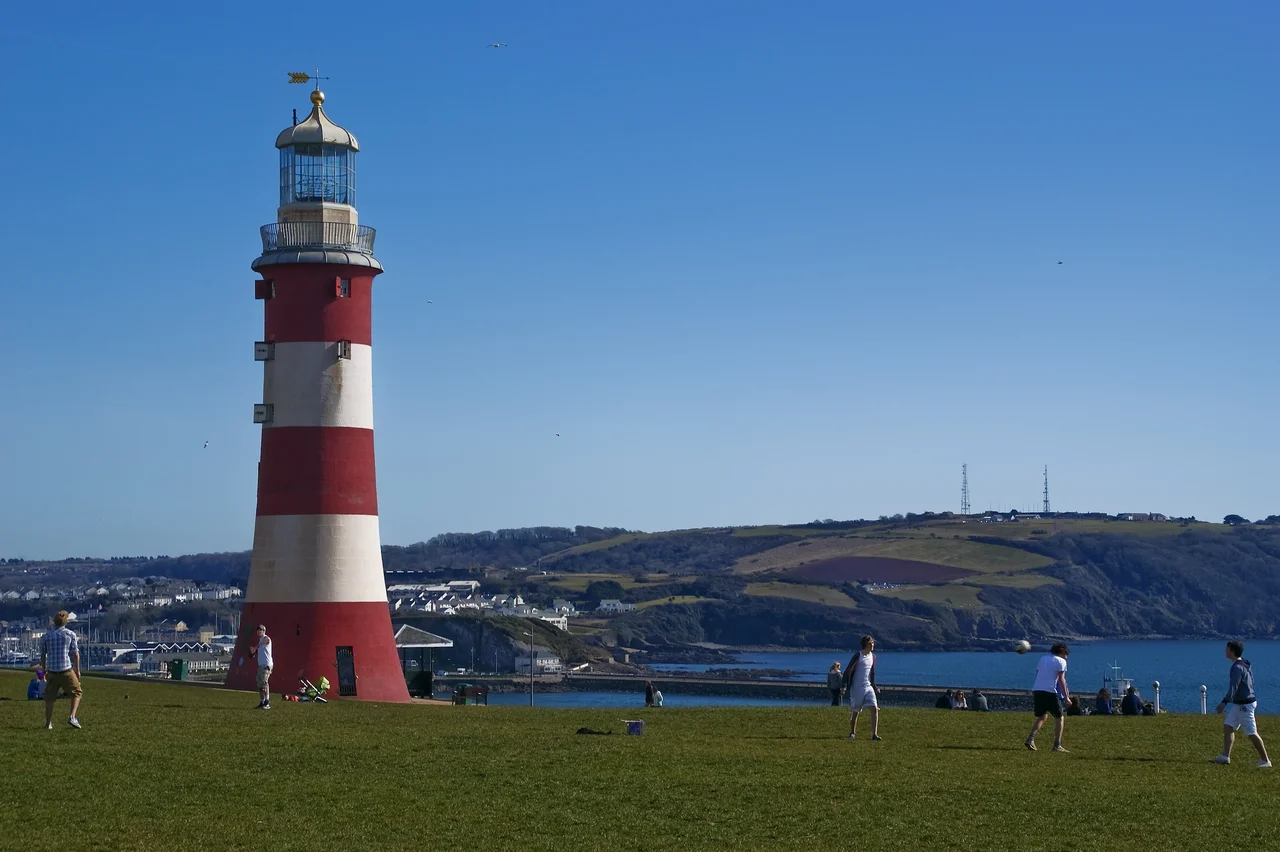

Smeaton's Tower
Twenty-four candles were first lit inside Smeaton's Tower on 16 October 1759, throwing a faint yellow light across the worst rocks in the western approaches to the English Channel. The lighthouse stood on the Eddystone reef, fourteen miles out from Plymouth in some of the most viciously broken seas in British waters. The first lighthouse on this reef had been swept away in the Great Storm of 1703. The second had burned down. John Smeaton, a Yorkshire civil engineer at the start of a career that would later define his profession, built the third. His tower stood for 118 years against everything the Channel could throw at it - until in 1877 the rocks beneath it began to crumble. So the British did something extraordinary: they took it apart, shipped the stones to Plymouth, and rebuilt it on the Hoe as a memorial to the man who had figured out, at last, how to keep a building standing in the middle of the sea.
After Winstanley and Rudyerd
The Eddystone reef is a notorious series of rocks roughly fourteen miles south-southwest of Plymouth, lying directly across the main shipping lane into the western Channel. Ships died on it routinely. Henry Winstanley built the first lighthouse here in 1698, a flamboyant wooden structure that he was so confident in he reportedly said he wished to be inside it during the worst storm imaginable. He got his wish. The Great Storm of November 1703 obliterated Winstanley's lighthouse, taking Winstanley with it; no trace of either was ever found. The second tower, built by John Rudyerd between 1706 and 1709, was a tapering oak-and-iron pillar that lasted nearly fifty years before it burned to the waterline in 1755. The three keepers escaped by jumping into the sea. After that fire, the pressure to build a third lighthouse, quickly and permanently, was intense.
The Yorkshireman with the Dovetailed Stones
John Smeaton was 32 years old when Trinity House gave him the Eddystone contract. He is now considered the father of civil engineering - he was, in fact, the first man in Britain to call himself one - and the Eddystone tower was the work that made his name. He modelled his design on the trunk of an English oak: broad at the base, tapering smoothly upward, with the centre of gravity as low as possible. He used interlocking dovetailed Cornish granite blocks, with each course pinned to the one below by marble plugs, so the whole structure would lock together as a single mass. He developed a new kind of hydraulic lime that would set under seawater - the first true modern hydraulic cement, and the direct ancestor of every Portland cement bag sold today. Construction began in 1756 from a base at Millbay in Plymouth, where Smeaton built a jetty and a workyard in the southwest corner of the harbour. Timber tramways were laid for four-wheeled flat trucks to move the masonry around. A ten-ton vessel named Eddystone Boat carried the worked stones out to the reef. The 2-and-a-quarter-ton foundation stone went out on the morning of 12 June 1756.
Saved from the Press Gang
The workforce was largely Cornish tin miners, used to dangerous work in tight spaces and willing to clamber about on a reef in heaving seas. There was, however, a problem: in 1750s wartime Britain, the Royal Navy's press gangs were liable to grab any working man within reach of a coastal town and drag him aboard a warship as a sailor. The Eddystone work could not afford to lose its trained hands. Smeaton and Trinity House negotiated with the Admiralty for the men to be exempted, and each worker was issued an individual medal that he could show to a press gang officer as proof. It was an elegant administrative fix to a brutal social reality. The work was completed in August 1759 at a cost of 40,000 pounds. On 16 October, the keepers lit the 24 candles for the first time.
Candles, Then Lamps, Then Erosion
From 1810 the candles were replaced by oil lamps and silvered reflectors, and in 1845 upgraded again to the latest fixed-beam Fresnel lens assembly - the great optical innovation that transformed every lighthouse in the world. Smeaton's tower kept burning for 118 years. The lighthouse itself never failed. The reef did. By 1877 the rocks beneath the tower were being eroded by the same waves the tower was built to defy, and engineers reported that each large breaker made the whole structure shake from side to side. A new lighthouse, Douglass's Tower, was begun on an adjacent rock. In February 1882 a temporary light atop the new tower was lit and Smeaton's Tower was decommissioned.
Reborn on Plymouth Hoe
The British could have left it to weather away in the sea. They did not. Trinity House and Plymouth City Council agreed to dismantle the upper sections, transport the granite to shore, and rebuild the tower on Plymouth Hoe as a permanent monument. The foundation stub remains in place on Eddystone Rocks beside its successor; the rest of the tower, reassembled stone by stone above the city, was opened to the public by the Mayor of Plymouth on 24 September 1884. It has been a Plymouth landmark ever since. Visitors can climb 93 steps and a series of steep ladders to the lantern room where Smeaton's 24 candles once burned, and look out across Plymouth Sound to the reef where the tower originally stood. In 1913, during the suffragette campaign, a home-made bomb labelled votes for women and death in ten minutes was found in the entrance; the wick had been lit but blown out by the wind before it could detonate. In 2009, for the 250th anniversary, the lantern was once again lit with 24 real candles. In 2020 a granite bust of Smeaton, carved by Philip Chatfield in Cornish granite, was installed in the lantern chamber - the engineer looking out from inside the engineering.
From the Air
Smeaton's Tower stands on Plymouth Hoe at 50.3644 deg N, 4.1418 deg W, prominently sited above the city centre with clear views across Plymouth Sound. From the air, the painted red-and-white banded tower is unmistakable on its grassy headland - one of the most recognisable maritime monuments in southwest England. The current operational Eddystone Lighthouse stands 14 miles south-southwest of the Hoe on the original reef. Best viewed from 1,500-3,000 ft. Exeter (EGTE) is the nearest active commercial airport, 40 nm to the east-northeast.
Nearby Stories
- Davidstow Circuit 3.7 km away
- Golden Hind 3.9 km away
- Powderham Castle 4.4 km away
- Fowey Lifeboat Station 5.1 km away
- Okehampton Castle 12 km away
- Battle of Plymouth (1652) 19 km away
- Goonhilly Satellite Earth Station 44 km away
- German Submarine U-672 73 km away