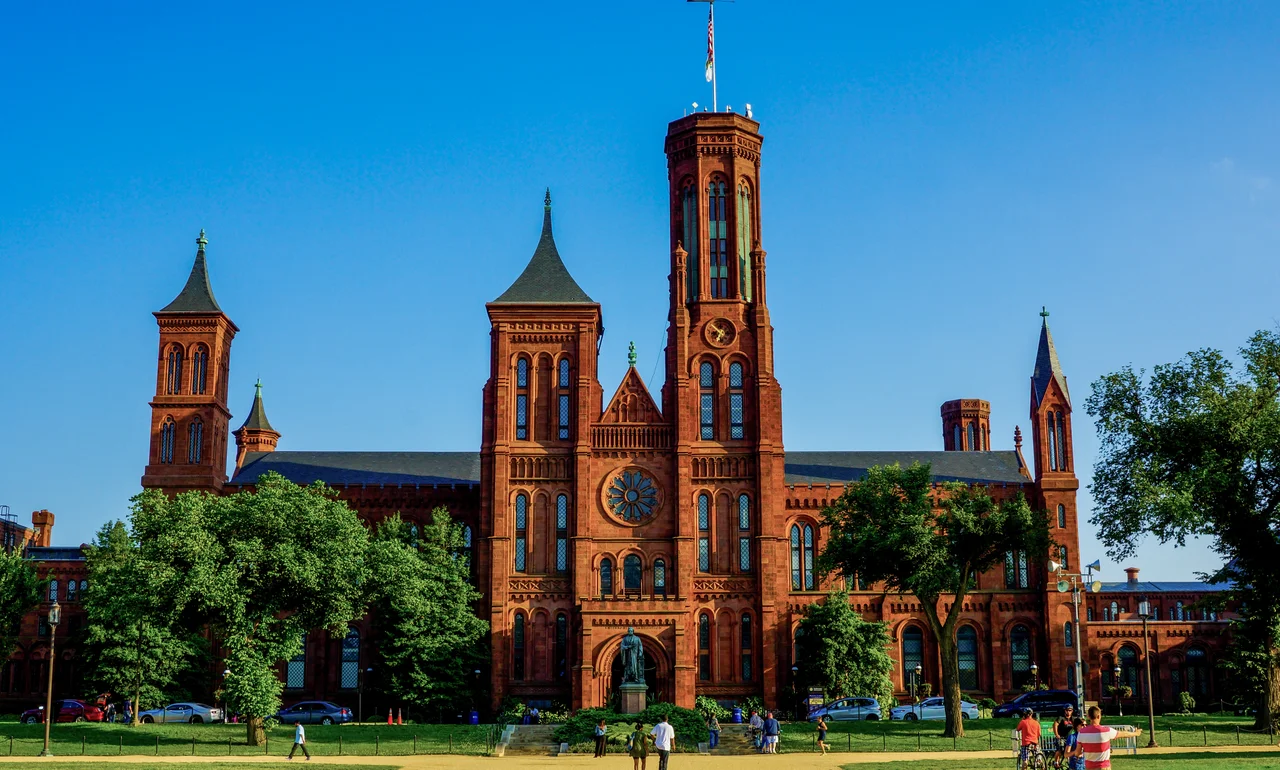

Smithsonian Institution
James Smithson was born around 1765, the illegitimate son of the Duke of Northumberland, and grew up in France because England wanted him as far from his father's family as possible. He became a chemist. He never married, never had children, and never visited America. When his nephew died childless in 1835, Smithson's will took effect: most of his wealth was to pass to the United States of America, to found at Washington, under the name of the Smithsonian Institution, an establishment for the increase and diffusion of Knowledge among men. Nobody in Washington knew quite what to do with this gift. Eight years of congressional argument followed about whether to use it for a university, a national observatory, an agricultural experiment station, or something else. On August 10, 1846, President James K. Polk signed the legislation that resolved the question. Today the institution that nobody quite knew how to start has 21 museums, 21 libraries, 14 research centers, a zoo, and more than 157 million objects in its holdings.
The Bequest
Smithson's reasons remain partly mysterious. His will makes no argument for why the United States should inherit his money, and his surviving correspondence offers only vague suggestions about Enlightenment universalism and his admiration for the young republic. Smithson died in Genoa in 1829. His coffin was eventually brought to Washington and now sits in a crypt inside the Smithsonian Castle. The American diplomat Richard Rush was dispatched to England by Andrew Jackson to collect the legacy after Hungerford's death. Rush returned in August 1838 with 105 burlap sacks containing 104,960 gold sovereigns - roughly 500,000 dollars at the time, an enormous sum given the federal government's modest budget. The coins were melted down at the Philadelphia Mint and recoined as American dollars. Eight years of congressional haggling followed about what kind of institution to build with the money. John Quincy Adams, the former president then serving in the House, insisted that the funds not be diverted to other purposes. He won.
The Castle and What Came After
Construction on the Smithsonian Institution Building began in 1847. The architect was James Renwick Jr., already known for Grace Church in New York, and his design - red sandstone, asymmetrical massing, towers in a sort of Norman-Romanesque revival - looked nothing like the white marble Greek Revival of nineteenth-century Washington. The building was called the Castle by the time it opened in 1855, and the name stuck. The Castle remains the institution's headquarters, and Smithson's tomb sits in a niche near the north entrance. The Smithsonian's first secretary, the physicist Joseph Henry, wanted the institution to focus on original scientific research; instead it became, almost immediately, a depository for the collections that government expeditions kept bringing back. The United States Exploring Expedition, which circumnavigated the globe between 1838 and 1842, deposited 50,000 plant specimens, thousands of animal specimens, and ethnographic objects from across the Pacific. The Mexican Boundary Survey added thousands more. By the time the Arts and Industries Building opened in 1881, the Smithsonian had become what it had been intended not to be: a museum complex.
The Eleven on the Mall
Eleven Smithsonian museums today line the National Mall between the Capitol and the Lincoln Memorial - more museums per linear mile than anywhere else in the world. The National Air and Space Museum, the largest by floor space, opened on July 1, 1976 with the Wright brothers' Flyer suspended from the ceiling and Charles Lindbergh's Spirit of St. Louis hanging beside it. The National Museum of Natural History holds the Hope Diamond, Henry the elephant in the rotunda, and the Tyrannosaurus skeleton known as the Nation's T. rex. The National Museum of American History keeps the Star-Spangled Banner that Francis Scott Key watched over Fort McHenry in 1814, Lincoln's hat from the night he was shot, and the ruby slippers Judy Garland wore in The Wizard of Oz. The National Museum of African American History and Culture, designed by David Adjaye and opened in 2016, is the newest. The National Museum of the American Indian opened in 2004. The Hirshhorn, the Freer-Sackler, the National Museum of African Art, and the National Gallery sculpture gardens fill in the rest. Admission to all of them is free.
Off the Mall
The Smithsonian extends well beyond the Mall. The National Zoological Park in Rock Creek Park, designed in part by Frederick Law Olmsted, opened in 1889 and has hosted giant pandas as guests of the People's Republic of China since 1972, with the latest pair - Bao Li and Qing Bao - arriving in October 2024. The National Postal Museum occupies the 1904 City Post Office building beside Union Station. The Anacostia Community Museum, opened in 1967 in a former movie theater in Anacostia, was Sidney Dillon Ripley's experimental store-front museum and was a national model for neighborhood-based cultural institutions. Two museums sit in New York: the Cooper Hewitt Smithsonian Design Museum, in the Andrew Carnegie mansion at 91st and Fifth, and the National Museum of the American Indian's Heye Center in the Alexander Hamilton U.S. Custom House at Bowling Green. The Steven F. Udvar-Hazy Center, the Air and Space Museum's annex near Dulles Airport in Chantilly, Virginia, holds the Space Shuttle Discovery, the Enola Gay, an SR-71 Blackbird, and Wiley Post's Winnie Mae. Smithsonian Affiliates in Puerto Rico and Panama extend the institution's reach further still.
157 Million Things
Nearly all of the Smithsonian's roughly 30 million annual visitors enter without paying. The institution's $1.25 billion annual budget comes about two-thirds from federal appropriations; the rest from its endowment, private donations, retail and licensing, and a Showtime Channel co-venture from 2006 that gave the cable network first-refusal rights to Smithsonian footage in exchange for funding. Of the 157 million objects the institution holds, only about one percent are on display at any moment. The rest sit in climate-controlled storage in Suitland, Maryland, in subterranean rooms beneath the Mall, and in the basements of the satellite museums. The Smithsonian is not, technically, a federal agency. It is a trust instrumentality of the United States, administered by a Board of Regents that includes the Chief Justice of the Supreme Court, the Vice President, three members of the Senate, three members of the House, and nine private citizens. The current Secretary, Lonnie Bunch, took office on June 16, 2019 - the first African American to hold the position and the first historian since the institution's founding. He had previously been the founding director of the Museum of African American History and Culture.
From the Air
The Smithsonian Castle and most of the institution's Mall museums cluster around 38.8889 degrees N, 77.0260 degrees W, along the south side of the National Mall between 4th and 14th Streets SW. From the air the Smithsonian complex reads as a row of monumental buildings - the red sandstone Castle most distinctive - with the Hirshhorn's cylindrical concrete drum and the National Air and Space Museum's pink-and-white block immediately east. Best viewed at 2,500 to 5,000 feet AGL; the entire site lies within the Washington FRZ and the prohibited area P-56A. Nearest airports are Ronald Reagan Washington National (KDCA) 2.5 nm south, College Park (KCGS) 8 nm northeast, and Washington Dulles (KIAD) 23 nm west.
Nearby Stories
- Gunston Hall 1.1 km away
- 2023 Baltimore Shooting 4.9 km away
- Battle of Middleburg 6.6 km away
- Crownsville Hospital Center 10 km away
- Battle of Loudoun Heights 13 km away
- First Battle of Rappahannock Station 20 km away
- Howard County, Maryland 21 km away
- Harriet Tubman Underground Railroad 50 km away