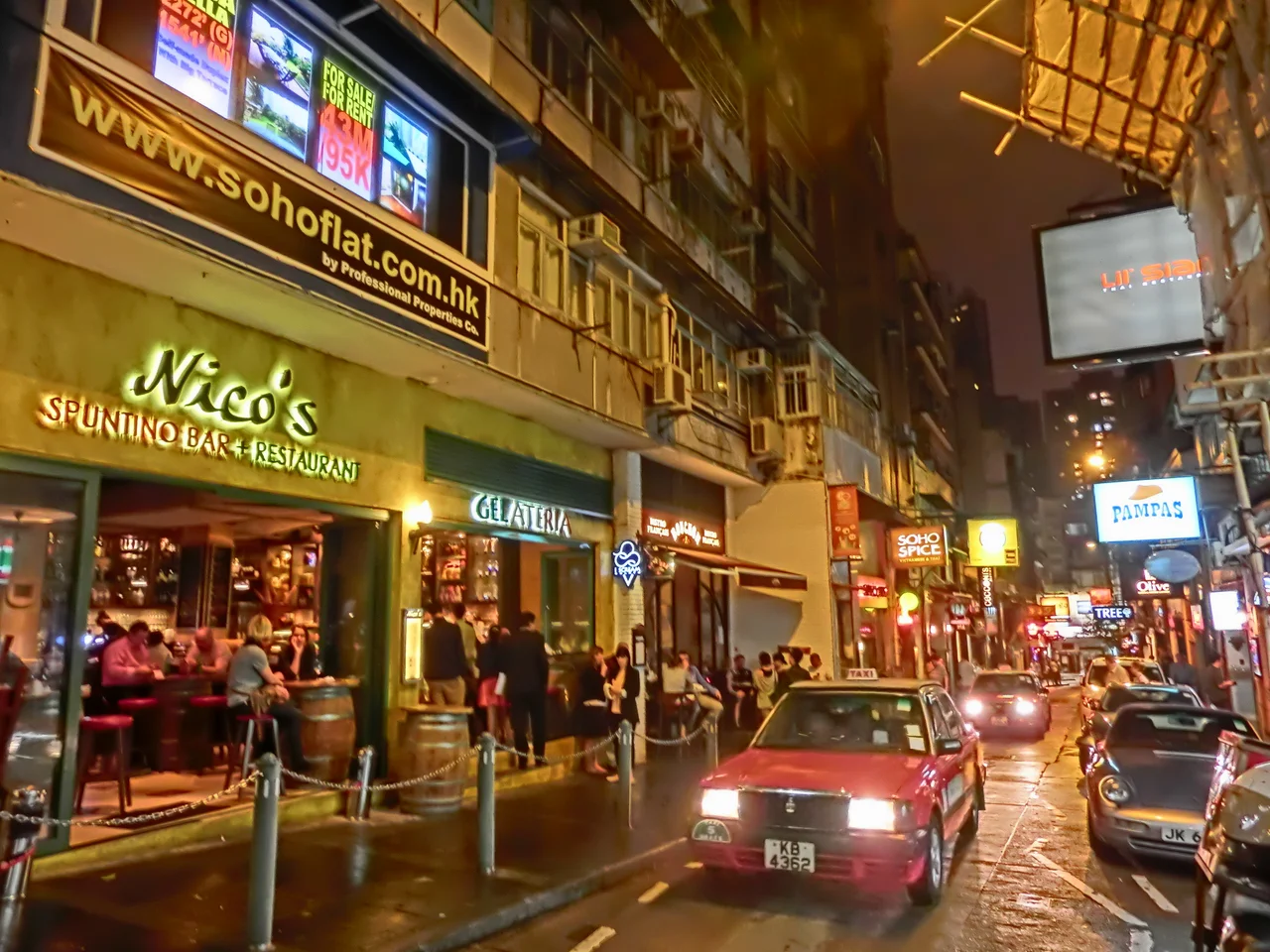

SoHo, Hong Kong
An acronym invented by a restaurant owner and first printed in the South China Morning Post in 1996 — that's the origin story of SoHo. Thomas Goetz, who ran a restaurant on Elgin Street, coined the name for the area south of Hollywood Road, and it stuck with the speed of a rebranding that captures something real. The neighbourhood it named already existed; the escalator that made it accessible had opened three years earlier. But the name gave the district an identity, and the identity attracted more of what the name implied: bars, galleries, international restaurants, and the particular energy of a city discovering a new version of itself.
The Escalator That Made the Neighbourhood
The Central–Mid-Levels escalator opened in 1993. At the time of its construction it was the longest escalator system in the world — a covered outdoor conveyor that climbs from Central up through SoHo and into the Mid-Levels residential area above. Its primary purpose was practical: to move people up a hill that is too steep for comfortable walking and too densely built for a road.
Before the escalator, the streets that now form SoHo's core — Staunton Street, Elgin Street, and the lanes connecting them — were populated largely by elderly local residents, old go-downs, and porcelain shops. The escalator changed the calculus of the neighbourhood. It reduced the friction of the climb, making the area accessible from Central in minutes. Expats who found apartments cheaper than in other parts of the city began moving in around the same time. Bars and restaurants followed, drawn by the foot traffic the escalator generated and the spending power of the new residents. The transformation was rapid enough that within a few years, SoHo had become Hong Kong's most internationally oriented dining district.
A Name Under Dispute
Not everyone welcomed what the name SoHo brought with it. In 2000, Democratic Party politician Kam Nai-wai pushed to officially rename the district the 'Elgin/Staunton Street Themed Dining Area' — a designation that would describe the geography without importing the associations of the SoHo brand. Kam and some longer-established residents connected SoHo with alcohol, late-night noise, and the kind of expatriate culture that they felt was displacing the neighbourhood's character.
The irony is thick. Elgin Street was known in the 1860s as 'Hung Mo Giu Gai' — Foreign Girls Street — because of the large number of European-staffed brothels operating there. It was later renamed after Lord Elgin, who served as British envoy to China during the Second Opium War (1857–1860). The street's colonial name already carried complicated associations. The Democratic Party's campaign against the SoHo name continued for several years before the informal designation prevailed. Today, taxi drivers across Hong Kong simply say Staunton Street or Elgin Street, and everyone understands.
What the Escalator Passes
Walking through SoHo means moving between registers of history without always noticing the transitions. At the northern edge of the district, on Hollywood Road itself, a new multi-storey residential complex called Centre Stage sits alongside the Man Mo Temple, one of the oldest functioning temples on Hong Kong Island. The contrast — glass and steel beside incense smoke and 19th-century stonework — is not accidental so much as inevitable in a city that rarely pauses to let its layers settle.
The Sun Yat-sen Historical Trail, recently signposted, runs 16 points of historical interest from the University of Hong Kong to Central, passing through SoHo's lanes. It traces the Hong Kong connections of the revolutionary leader who spent formative years in the city. Most of the actual buildings from Sun Yat-sen's time have been demolished, replaced by the concrete towers that now define the skyline, but the trail still maps a path through places that carry meaning — century-old steps, quiet residential lanes, the occasional preserved facade.
The SoHo Association and the Comedy Club
The SoHo Association Limited was established in 1998 by Thomas Goetz and others who had businesses in the area. Its founding purpose was practical: to represent members dealing with the city's licensing bureaucracy and to collectively promote the neighbourhood. Jean-Paul Gauci, who had established multiple businesses in SoHo, was the first chairman. The organisation's existence reflects how quickly the district had acquired a distinct commercial identity.
Among SoHo's more unexpected institutions is The TakeOut Comedy Club Hong Kong, which holds the distinction of being the first full-time comedy club in Asia. It represents the kind of cultural infrastructure that takes root in neighbourhoods where international residents form a critical mass — somewhere between a niche interest and a community need. SoHo now contains art galleries, antique stores, nightclubs, and restaurants spanning dozens of cuisines, all compressed into a few steep blocks between Hollywood Road and the escalator's upper reaches. It is, by any measure, a neighbourhood that surprised itself.
From the Air
SoHo sits at 22.2822°N, 114.1528°E on the lower slopes of Victoria Peak, between the Central business district and the Mid-Levels residential area. From the air, the neighbourhood is identifiable by its position on the steeply contoured hillside immediately west of the Central towers, below the green summit of Victoria Peak. The Central–Mid-Levels escalator is occasionally visible as a covered structure on the slope. Hong Kong International Airport (VHHH) is approximately 24 kilometres to the west on Lantau Island. Recommended viewing altitude is 2,500–5,000 feet to take in the relationship between the hill, the harbour, and the surrounding urban fabric.
Nearby Stories
- Lok Ma Chau Loop 2.3 km away
- Portas do Cerco 2.3 km away
- Kweilin Incident 17 km away
- Wanshan Archipelago Campaign 34 km away
- Nanxiong Formation 115 km away
- Battle of Nanpeng Island 148 km away
- Heyuan 169 km away
- Cape Maobitou 632 km away