
Solva Lifeboat Station
The schooner Two Brothers of Holyhead was already in pieces when the rescuers reached the cliff edge. It had been driven onto the rocks near Pointz Castle on January 5, 1867, on a passage from Bangor to Bristol, and the four crewmen had launched the ship's small boat in a doomed attempt to reach the shore. The boat smashed against the rocks within seconds of touching the water. A local man named Thomas Mortimer Rees had himself lowered down the cliff on a rope and somehow brought all four men up alive. The Royal National Lifeboat Institution awarded him its Silver Medal. It also took notice of Solva.
A Widow's Promise
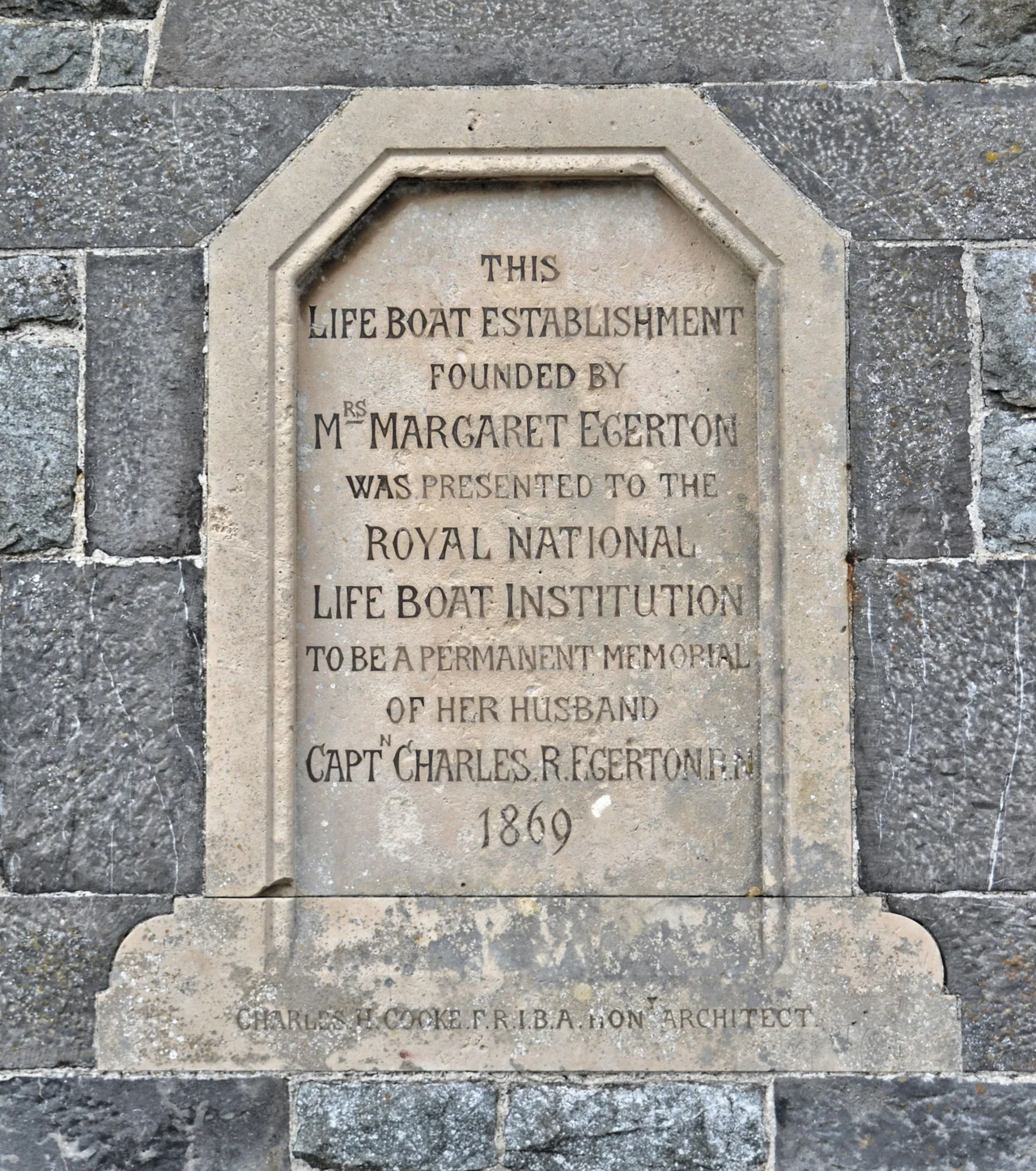
Two years after the Two Brothers wreck, the RNLI's Inspector of Lifeboats visited St Davids and Solva, two small Pembrokeshire harbours separated by three miles of coastline. His December 1868 report recommended stations at both. Then came an unexpected gift. Mrs Margaret Egerton wrote to the Institution offering £700 in memory of her late husband, Captain Charles Randle Egerton RN, who had served for years on the RNLI's committee of management. The committee resolved that her money would build the station at Solva. The boathouse, designed by the Institution's honorary architect Charles Henry Cooke, was one of more than 200 he designed across Britain. A memorial plaque to Captain Egerton was set into the wall.
Twelve Oars and a Sail
On September 11, 1869, the station opened. The Trinity House steamship had towed the new lifeboat round from Milford Haven, where it had been delivered after a sea voyage from the builders. The boat was a 33-foot self-righting pulling-and-sailing design, twelve oars and two masts, with no engine and no shelter for her crew. She bore the name Charles and Margaret Egerton, a memorial in seasoned oak. Her crew were Solva fishermen and farmers, the same men who crewed the St Davids boat on alternate quarters. The arrangement was deliberate. The two stations shared a single trained crew, exercising in turn, so the men knew both boats and both stretches of coast.
Trinity Quay
The Elder Brethren of Trinity House had granted the site at Trinity Quay in Upper Solva at a nominal annual rent and donated materials from the old smith's forge nearby. The quay itself sat on the north shore of the River Solva estuary, where the harbour drains into St Brides Bay through a winding channel that becomes mudflat at low tide. Upper Solva, the older settlement, sits on the hill above the lower village clustered around the harbour. The boathouse looked out across the bay toward Ramsey Island, the Bishops and Clerks rocks beyond, and on a clear day the Wicklow Mountains in Ireland fifty miles to the west. The view was glorious. The sea was treacherous.
Eighteen Years
And then it ended. On May 5, 1887, the RNLI committee resolved to abolish the Solva station. Eighteen years is a short life for a lifeboat house. The reasons were practical. The shared crew with St Davids had proved cumbersome, the launch from Trinity Quay required boats to cross the tide-bound channel at exactly the wrong moments, and the larger station at St Davids covered most of the same water. So Solva closed and St Davids carried on. Today, the St Davids Lifeboat Station at St Justinian, opened in 1869 the same week as Solva's, has saved an estimated 360 lives. Four of its lifeboatmen have died trying. The Solva boathouse still stands at Trinity Quay, repurposed but recognizable, with Captain Egerton's memorial plaque still set into its wall.
What the Sea Remembers
The story of Solva Lifeboat Station survives largely in the Lifeboat Magazine archive, where the RNLI committee minutes of 1869 and 1887 record the bare bones of its life. But the river still empties into St Brides Bay through the same winding channel, the same tides still rip past the same rocks, and the Pembrokeshire Coast Path runs past Trinity Quay on its way north toward Newgale. Walkers stop at the old boathouse and read the plaque, and a few even know to look up and ask why this one closed. The answer is that the sea decides which stations matter. The sea decided Solva did not, and the men who had rowed twelve-oared boats out into winter gales went back to fishing.
From the Air
The former Solva Lifeboat Station sits at 51.87°N, 5.20°W on the north shore of the River Solva estuary, just inside St Brides Bay and three miles east of St Davids. From altitude, look for the narrow winding inlet of the Solva harbour cutting north into the cliffs, with Upper Solva on the hill above. The site is a coastal landmark on the Pembrokeshire Coast Path. Nearest airfield is EGFE (Haverfordwest) about twelve miles east; the former RAF Brawdy lies four miles north-east. Approach altitude of 1,500-2,000 feet AGL gives a good view of the harbour entrance.
Nearby Stories
- RAF Angle 0.9 km away
- Cardigan Bay Special Area of Conservation 5.4 km away
- Abercych 11 km away
- Cantre'r Gwaelod 12 km away
- Burry Port Lifeboat Station 22 km away
- Johnstown Castle 61 km away
- Hook Lighthouse 92 km away
- 1979 Fastnet Race 157 km away