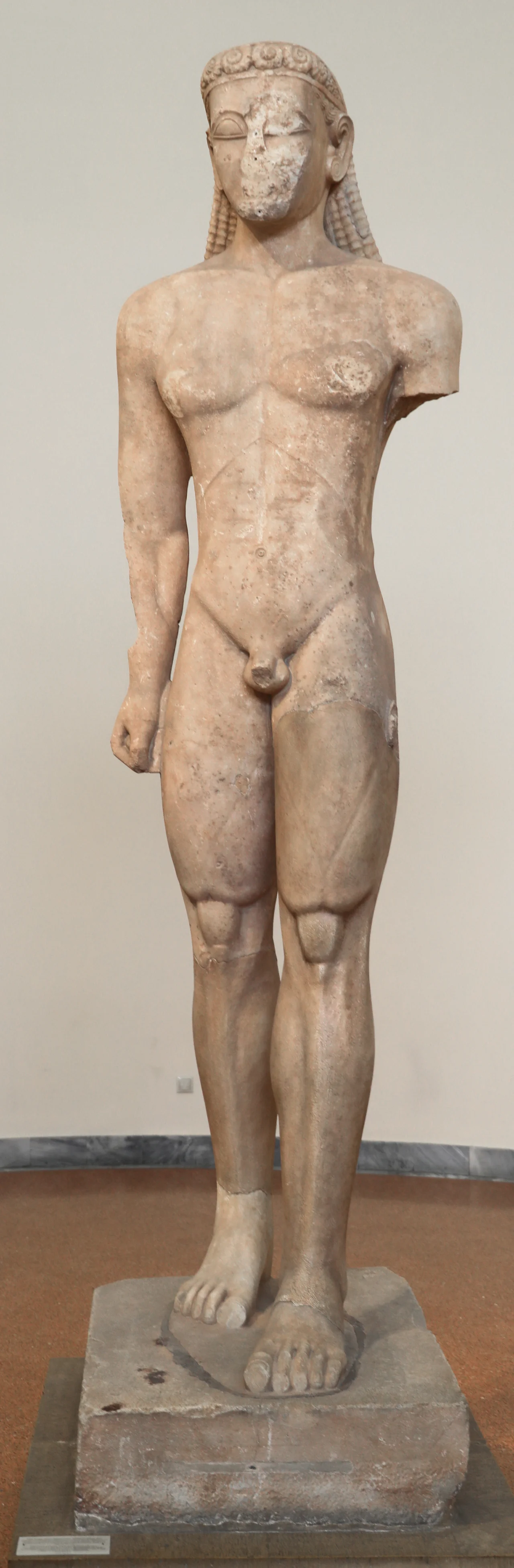

Sounion Kouros
He was buried in a pit near the Temple of Poseidon sometime around 480 BCE, probably hidden after the Persians arrived and destroyed what they found standing. For 2,400 years the ground at Cape Sounion kept him. Then excavators found him in 1906 — broken, heavily weathered, most of the left leg gone, the face badly chipped — and realized they were looking at one of the oldest large-scale marble statues in the Greek world. The Sounion Kouros was carved around 600 BCE from marble quarried on the island of Naxos, and he is extraordinary not because he is finished or refined, but because he is the beginning of something.
The Shape of a New Idea
The kouros — plural kouroi — was a type: a naked young man, standing upright, left leg slightly advanced, arms at his sides, facing forward. The type is immediately recognizable as descended from Egyptian ka statues, those monumental figures carved to house the spirit of the deceased. The frontal stance, the arms, the advanced leg — all are Egyptian inheritance. But the Sounion Kouros departs from his Egyptian ancestors in one significant way: he is nude. Egyptian statues wore kilts. The Greek sculptors stripped them away, and with that choice, something changed.
The Sounion Kouros stands 3.05 meters tall once restored to full height — larger than life, as such statues were meant to be. His muscles are rendered in grooves so emphatic that one scholar called the modeling "decorative to the point of excess and stylisation." The figure looks almost wound tight, as if the stillness is temporary. Scholars describe the pose as neither standing nor walking — "the perfect nimble-footed readiness of the Homeric hero."
A Gift to Poseidon
He was found in a pit alongside fragments of other statues, all of them dedicated to Poseidon, all of them having stood in front of the god's sanctuary at Cape Sounion. The kouros type functioned in two ways in ancient Greek practice: as a votive offering left in sanctuaries for the gods, or as a memorial marker in funerary contexts, honoring heroes. In this case, the setting makes his purpose clear — he was a gift to the sea god, a young man of marble presented at the edge of the Aegean.
Traces of red pigment survive in his braided hair, which flows down the statue's back in shell-like curls tied with a double ribbon in a Heracles knot. The original temple was destroyed by Persian forces in 480 BCE, and the statues dedicated to Poseidon were apparently gathered and buried — an act of either concealment or deliberate interment, preserving what couldn't be defended.
The Century That Followed
The Sounion Kouros belongs to the very beginning of the archaic period's experiment with human form. Over the 6th century BCE, sculptors of kouroi worked steadily toward greater naturalism — bodies became more proportionate, movement more convincing, the relationship between the carved surface and real muscle more sophisticated. The Sounion Kouros sits at the earliest stage of that project, when the ambition was enormous and the technical vocabulary still being invented.
Each side of this statue was carved separately, with limited attention paid to making them read as a convincingly three-dimensional whole. Later sculptors would solve that problem. For now, in 600 BCE, the sheer scale of the attempt was the achievement.
Where He Lives Now
The Sounion Kouros is in the National Archaeological Museum of Athens, one of the highlights of a collection that spans nearly three millennia of Greek material culture. He is displayed as a restored figure — the missing legs and arms acknowledged — and stands alongside other kouroi that chart the rapid development of archaic sculpture. Seeing him next to examples from 540 BCE, then 510 BCE, is to watch Greek art sprint toward naturalism in less than a century. The Sounion Kouros is the starting line.
From the Air
The Sounion Kouros was found near the Temple of Poseidon at Cape Sounion, coordinates 37.65°N, 24.02°E, at the southernmost tip of the Attica peninsula, about 69 km southeast of Athens. The headland is visually dramatic from the air — white marble columns on a promontory above the Aegean, surrounded on three sides by water. The nearest major airport is Athens International Eleftherios Venizelos (LGAV), roughly 50 km to the north-northwest. Approach from the north along the eastern coastline; the cape is unmistakable at the tip of the peninsula. Recommended viewing altitude: 2,000–3,500 feet AGL to appreciate the cliff setting. The statue itself is now in Athens, but the site where it was found remains the Temple of Poseidon sanctuary.
Nearby Stories
- Salamis Naval Base 1.9 km away
- Battle of Andros (1790) 5 km away
- Temple of Aphaia 5.8 km away
- Hydra: The Island That Refused the Car 13 km away
- Gyaros 14 km away
- Saint Ephraim Monastery, Nea Makri 16 km away
- Kythnos 30 km away
- Archaeological Museum of Sifnos 53 km away