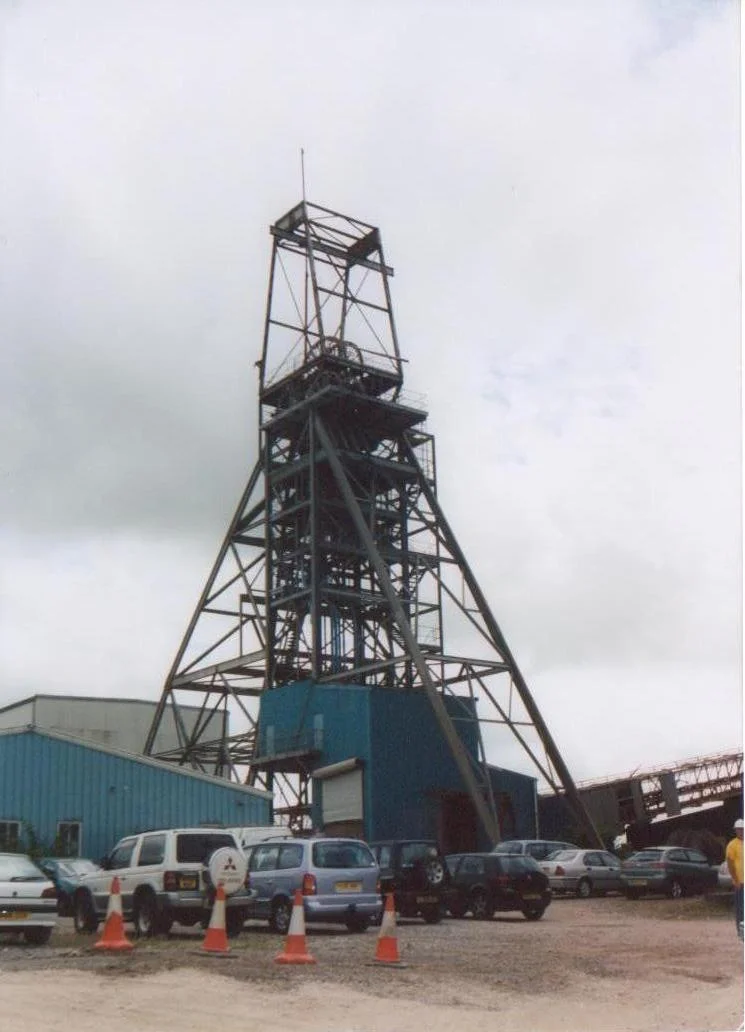

South Crofty
On 6 March 1998, the cage at Robinson's Shaft lifted its final shift to the surface, and Cornwall stopped being a tin country. Somebody had spray-painted a slogan on a corrugated wall at the gate: 'Cornish lads are fishermen, and Cornish lads are miners too. And when the fish and tin are gone, what are the Cornish boys to do?' South Crofty had been digging tin out of the granite under Pool since at least 1592 — older than the East India Company, older than Shakespeare's late plays. For four centuries it had outlasted every other Cornish mine. The last men out walked into bright Camborne sunshine and an industry that had simply, finally, run out of price.
Two and a half miles wide, half a mile deep
The numbers make the mine sound like a fact rather than a place. South Crofty's workings extend nearly two and a half miles across and three thousand feet down, threading over forty named lodes through the granite under the village of Pool. By 2012 its setts had swallowed up the workings of some thirty-four neighbouring mines, including in 1936 the great Dolcoath itself, once the deepest mine in the world. Generations of men knew the depths in fathoms rather than feet: 205 fathoms, then 260, then 310, the language of the sea applied to dry rock because Cornish mining and Cornish fishing were the same trade in different element. Hot, wet, dark, dangerous; men chewed pasties whose crimped crusts gave them a clean handle to throw away because their hands were poisoned with arsenic. The mine produced tin and copper, and on the side it produced wolframite for tool steel and arsenic for everything from pesticides to paint. Between 1907 and 1919 alone, South Crofty shipped out as much as a thousand tons of arsenic in a single year.
The price of tin
South Crofty's century is a graph of the global tin price drawn in the lives of Camborne families. Copper had carried the mine until shallow reserves failed around 1880, and a sudden price crash in 1896 flooded the workings; new backing in 1899 brought South Crofty back from the dead. RTZ pumped capital in during the 1980s. Then on Black Thursday, 24 October 1985, the International Tin Council collapsed in London. The price of tin halved overnight as the cartel's stockpile was force-sold into the market, and within weeks every Cornish mine but South Crofty was finished. Mill operations were progressively shut, ore was trucked across the moor to Wheal Jane for processing, the workforce was cut. South Crofty held on for thirteen more years on government loans, a management buy-out, a Canadian rescue, and the grim arithmetic of selling off surplus land to fund the next month's losses. In 1998 the loans ran out.
Underwater
When mining stopped, the pumps stopped. South Crofty filled with water from below at a rate that engineers measured in tonnes per minute, and within months the lower workings were drowned. For a quarter of a century the mine sat sealed under its own water table while the surface tried to forget what was beneath it. CPR Regeneration, a redevelopment company set up in 2001, lobbied for a leisure centre and then a housing park on the site. Owners came and went: Western United Mines, Celeste Copper, Strongbow Exploration, now Cornish Metals. Tin prices climbed back from four thousand dollars a tonne in 2002 to more than seventeen thousand in 2010, then higher. UNESCO weighed in to protect the surrounding Cornwall and West Devon Mining Landscape, a World Heritage Site since 2006. The mine still owned its ore — Celeste had estimated 7.95 million tonnes of tin in 2012 — but ore at three thousand feet is theoretical until you can stand on dry rock at that depth.
Reopening
In October 2017 the UK Environment Agency granted a permit to discharge up to 25,000 cubic metres of treated mine water per day into the Red River, and Cornish Metals began building a water treatment plant. Drilling resumed in 2020. In January 2025 the National Wealth Fund committed £28.6 million to bring South Crofty back into production, the largest single investment in Cornish hard-rock mining in living memory. The new economics are not nostalgia. The world wants tin for solder in everything from solar panels to electric vehicles, and Chinese and Indonesian sources look increasingly fragile. South Crofty's remaining reserves are still, on paper, a billion-pound resource. The men working there now are second- and third-generation: Tommy Cocking's grandchildren grew up watching the headgear go silent and then, in middle age, watching the pumps switch back on.
Flying over
From the air the survival of South Crofty's surface plant is what catches the eye. Robinson's Shaft headframe and the long roofline of the dressing floors still stand at the southern edge of Camborne, the only intact deep-mine surface complex of its kind in southern England. The Red River runs east toward Hayle Bay, stained pink by tin tailings even decades after the last hoist.
From the Air
South Crofty sits at 50.22 N, 5.27 W in the village of Pool between Camborne and Redruth, central to the Cornwall and West Devon Mining World Heritage Site. Best photographed from 1,500 to 2,000 feet on a south-westerly track to catch Robinson's Shaft and the line of the Red River draining north to Hayle. Newquay (EGHQ) lies 15 miles north-east; Land's End (EGHC) is 17 miles south-west. Mining country: spoil heaps and old engine houses dot the landscape for 20 miles either way.
Nearby Stories
- Wadebridge 8.1 km away
- Caerhays Castle 8.1 km away
- Sevenstones Lightship 16 km away
- Battle off Lizard Point 20 km away
- MV Cita 22 km away
- Carnewas and Bedruthan Steps 30 km away
- 1979 Fastnet Race 71 km away
- HMS Affray 108 km away