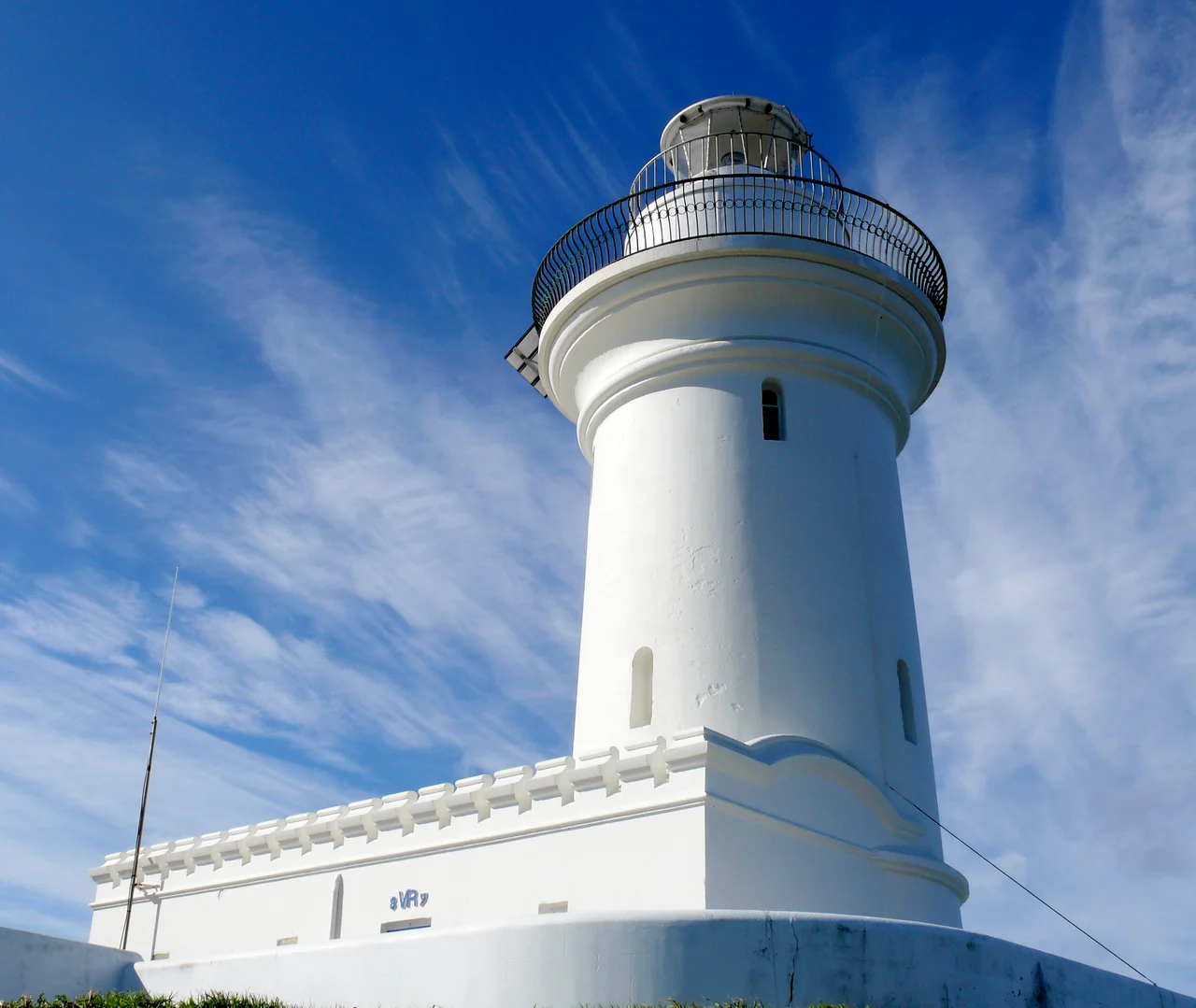

South Solitary Island Light
To reach the front door, you had to be lifted from a boat in a basket. South Solitary Island rises so steeply from the sea, and its seas run so rough, that for nearly a century everything and everyone, the keepers, their children, the drums of kerosene, the coal, the mail, was swung off a pitching launch in a crane-lowered basket and hauled up a steep concrete path to the lighthouse on the summit. Fifteen kilometres off Coffs Harbour, this is the most isolated lighthouse on the entire New South Wales coast. A 1938 inspection found the proof in the visitors' book: from the day it opened, it had managed to fill only twenty pages. The light has burned out here since 1880, alone above the water, flashing white into the dark.
Concrete on a Rock
The case for a light near Coffs Harbour was first made in 1856, with shipmasters favouring South Solitary over its northern neighbour. The Colonial Architect James Barnet, whose buildings still define much of nineteenth-century New South Wales, drew the plans, and South Solitary became one of just three concrete lighthouses he raised in that period, alongside Smoky Cape and Green Cape. Barnet visited the island himself in October 1877 to choose where the buildings should stand and where the materials would come from. Cement and sand were ferried out in difficult conditions; the broken stone was quarried from the island's own conglomerate rock; the timber came up in small vessels from Bellingen. A keystone over the doorway is carved "18VR79," suggesting a planned 1879 finish, but the light was not first exhibited until 18 March 1880. Its original lens, a Chance Brothers first-order Fresnel, was only the second of its kind in Australia. It now sits on display at the Coffs Harbour Jetty, retired from the sea.
The Last of the Kerosene
South Solitary holds a small, stubborn distinction in lighthouse history. It was the first light in New South Wales to burn kerosene, at a time when its contemporaries still ran on colza oil pressed from rapeseed. And it was the last to give kerosene up. As other stations moved on to carbide lamps and then to electricity, South Solitary kept its kerosene burner going year after year, the keepers trimming and tending it, until 1975. The light stood at a focal height of 192 feet and threw its beam 16 nautical miles out to sea; by 1934 it shone at 205,000 candela, flashing once every thirty seconds. There is something fitting in this remote outpost being the place where an older technology made its final stand, decades after the rest of the coast had moved into the electric age.
A Life Behind Stone Walls
Life on South Solitary was shaped entirely by isolation and weather. The residence sat behind high stone walls built to break the wind, with another wall running all the way from the houses to the tower so that keepers could reach the light in a gale. Supplies came at first from Sydney by steamer every fortnight, weather permitting, and later more reliably by launch from Coffs. The quarters were lit by kerosene into the 1950s, and coal did the heating and cooking. Communication began with a signal lamp and heliograph, flashing messages by sun and mirror; a pedal radio arrived in 1937, letting keepers reach the Norah Head lightstation, before a Bendix set replaced it. Children were taught at first by a governess the keepers employed, in a small room near the residence that served as a schoolhouse, and later by correspondence. In May 1942, during the Second World War, the light was extinguished for the only time in its life, blacked out because enemy submarines were torpedoing vessels near the island.
The Long Retreat from the Island
Modernity reached South Solitary by helicopter. In 1974 the old flagstaff was taken down and a helipad built. On 22 August 1975 the lighthouse was electrified with solar power and automated, and on 28 December that year it was officially de-manned, the last keepers gone. The grand old lantern was eventually lifted off the island by a RAAF Chinook helicopter in September 1977 and taken to the Coffs Harbour museum. Today a small solar-powered lamp does the work the kerosene burner once did, flashing white every five seconds, visible 15 nautical miles out. The buildings have been patched and weatherproofed in restoration campaigns, but no one lives there. The island's old jetty, the third built on the site, has mostly rusted and fallen into the sea. The light is usually off-limits, glimpsed from boat tours out of Coffs, and reachable in person only by helicopter on the two weekends a year when rangers guide visitors across.
From the Air
South Solitary Island Light stands at 30.21°S, 153.27°E, atop South Solitary Island within the Solitary Islands Marine Park, about 15 km northeast of Coffs Harbour off the New South Wales coast. From the air the island is a small, steep-sided rock crowned by the white lighthouse tower and its walled keepers' quarters, conspicuous against open ocean with no other land nearby. The nearest airport is Coffs Harbour (ICAO YCFS / IATA CFS) on the mainland to the southwest, served by Qantas, Rex and Link Airways. Recommended viewing altitude 1,500–3,000 ft for a clear pass over the island and its sister islands of the Solitary group. There is no landing site for fixed-wing aircraft; the island has only a helipad. Expect strong onshore winds, sea spray and rapidly changing conditions over the exposed water, and give the rookery and marine park appropriate clearance.
Nearby Stories
- New England National Park 12 km away
- Yuraygir National Park 17 km away
- Bellingen, New South Wales 20 km away
- Guy Fawkes River National Park 30 km away
- Gibraltar Range National Park 44 km away
- Cape Byron Marine Park 134 km away
- Cape Byron Light 168 km away
- SS Elingamite: Gold, Fog, and a Captain Wrongly Blamed 1777 km away