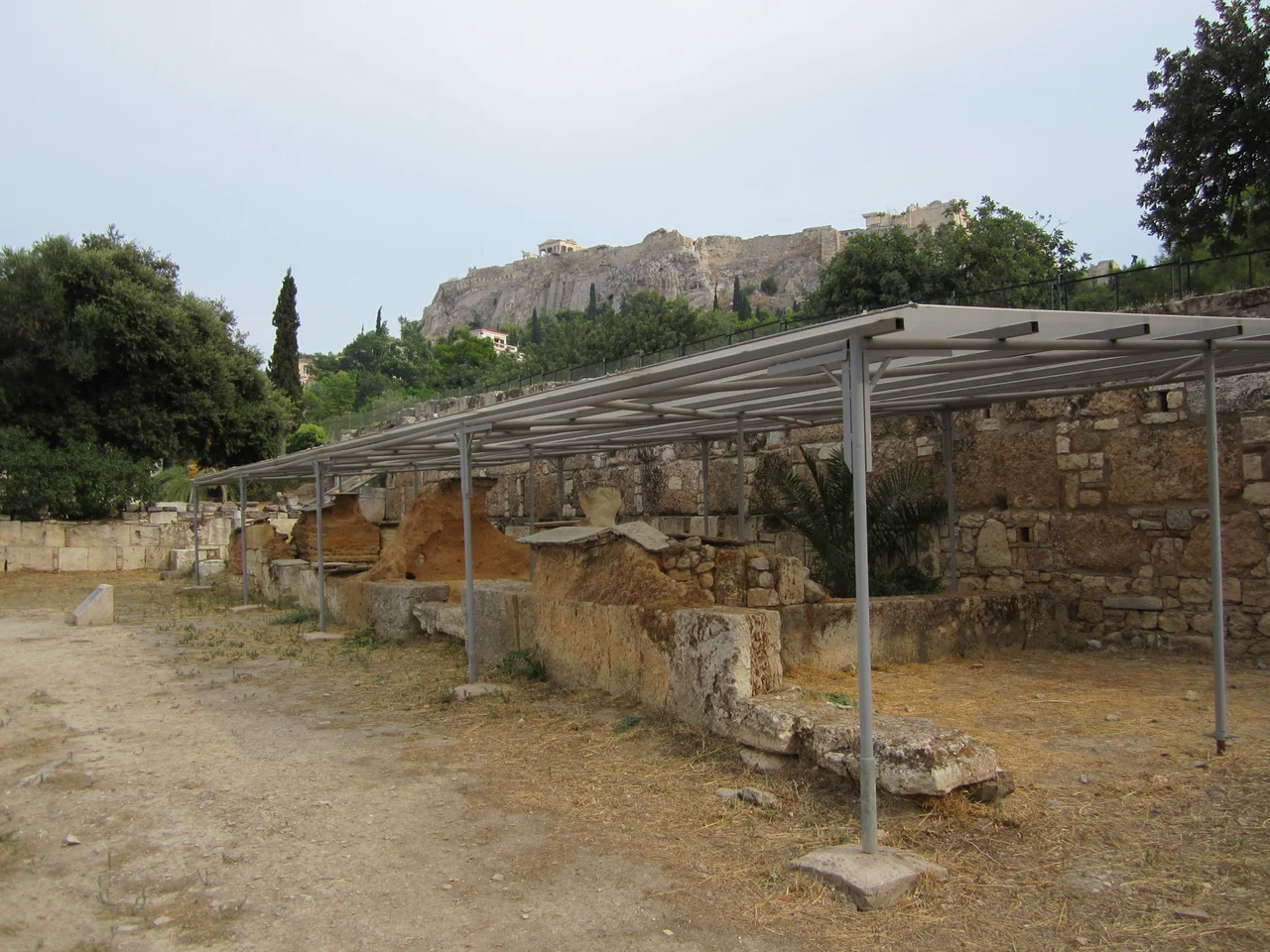

South Stoa I (Athens)
Some buildings survive because they were beautiful. South Stoa I survives because somebody dropped an inscription on its floor. Around 221 BC, the metronomoi - Athens' inspectors of weights and measures - recorded that they had handed over the city's official standards to next year's board. That stone, found embedded in the floor of one room, is the closest thing we have to a name tag for a long, plain building on the southern rim of the Agora. It was not grand. By the excavators' own description its construction was 'shoddy and makeshift.' But it was where Athens did its paperwork and ate its dinner.
The Earliest of Its Kind
Built at the end of the 5th century BC, South Stoa I stretched 80 meters along the Agora's southern edge, two aisles of columns facing north onto the public square, with fifteen rooms running behind. That layout - colonnade in front, row of rooms behind - became the standard template for Greek stoas. South Stoa I appears to be the earliest example of it. The foundations were soft poros limestone; the walls were mostly unbaked mudbrick, with only the rear wall built of stone to carry the load. The forty-five outer columns stood unusually close together, packed in perhaps because good stone for the lintels above them was scarce. None of it was marble. The poros columns were simply coated in white stucco to fake the look of the real thing.
Rooms Built for Dinner
Step into one of the back rooms and the clues stack up. Each is roughly square, about 4.9 meters a side, with the doorway deliberately set off-center. That offset is the giveaway: it left room to arrange dining couches around all four walls. Seven couches fit per room, so the whole stoa could seat about 105 diners reclining at once. Channels cut through the door thresholds drained the rooms after meals; ash deposits mark where braziers warmed the food and the guests. In two rooms, a wine jar turned upside down in the floor made a small hearth. Around 200 BC some rooms swapped their couches for low clay benches - seating, but no longer for the formal reclining banquet.
Where Officials Worked and Ate
Greek magistrates routinely conducted business in the open shelter of a stoa, and South Stoa I was their workplace and their mess hall. Many Athenian boards came in groups of six officials plus a secretary - exactly the number a seven-couch dining room would hold. The metronomoi inscription places that particular board here. A small inscribed base dedicated to an anonymous 'Hero' hints that one corner may also have served as a shrine. Scholars have guessed at grander identities for the building - the thesmotheterion of the city's junior magistrates, or the Alphitopolis, the Agora's flour market - but the latest authorities let those guesses rest. The building keeps its real secrets in its receipts, not its name.
Demolished by Its Own Successor
Between about 175 and 125 BC, Athens reorganized the south end of the Agora into a grand enclosed courtyard, the South Square. South Stoa I, by then around three centuries old, first became a builders' workshop during that project and was then torn down to clear ground for its replacement, South Stoa II. The new building obliterated the western half of the old one entirely. Only because it did not extend over the eastern end did those foundations survive better - the part archaeologists could later read. American excavators first found traces in 1936 under Eugene Vanderpool, with more work in the 1950s and 1960s. What they recovered was not a monument but something rarer: the everyday machinery of a democracy, mudbrick and dinner couches and the city's careful records of who weighed what.
From the Air
South Stoa I lies at about 37.974°N, 23.723°E along the southern edge of the Ancient Agora of Athens, directly below the north slope of the Acropolis. From the air the Agora reads as a green archaeological park threaded by the diagonal Panathenaic Way, with the reconstructed Stoa of Attalos as the most obvious landmark on its east side and the Temple of Hephaestus on the hill to the west. The Acropolis looms just to the southeast. Best viewed in clear daytime light. Nearest major airport is Athens International (LGAV), roughly 30 km east-southeast.
Nearby Stories
- Great Sand Beach 5 km away
- Battle of Delium 7.7 km away
- Tower of Aliartos 9 km away
- HMHS Britannic 10 km away
- Saronic Gulf 15 km away
- Sousaki Volcano 17 km away
- Sanctuary of Apollo Maleatas 24 km away
- Skyros 66 km away