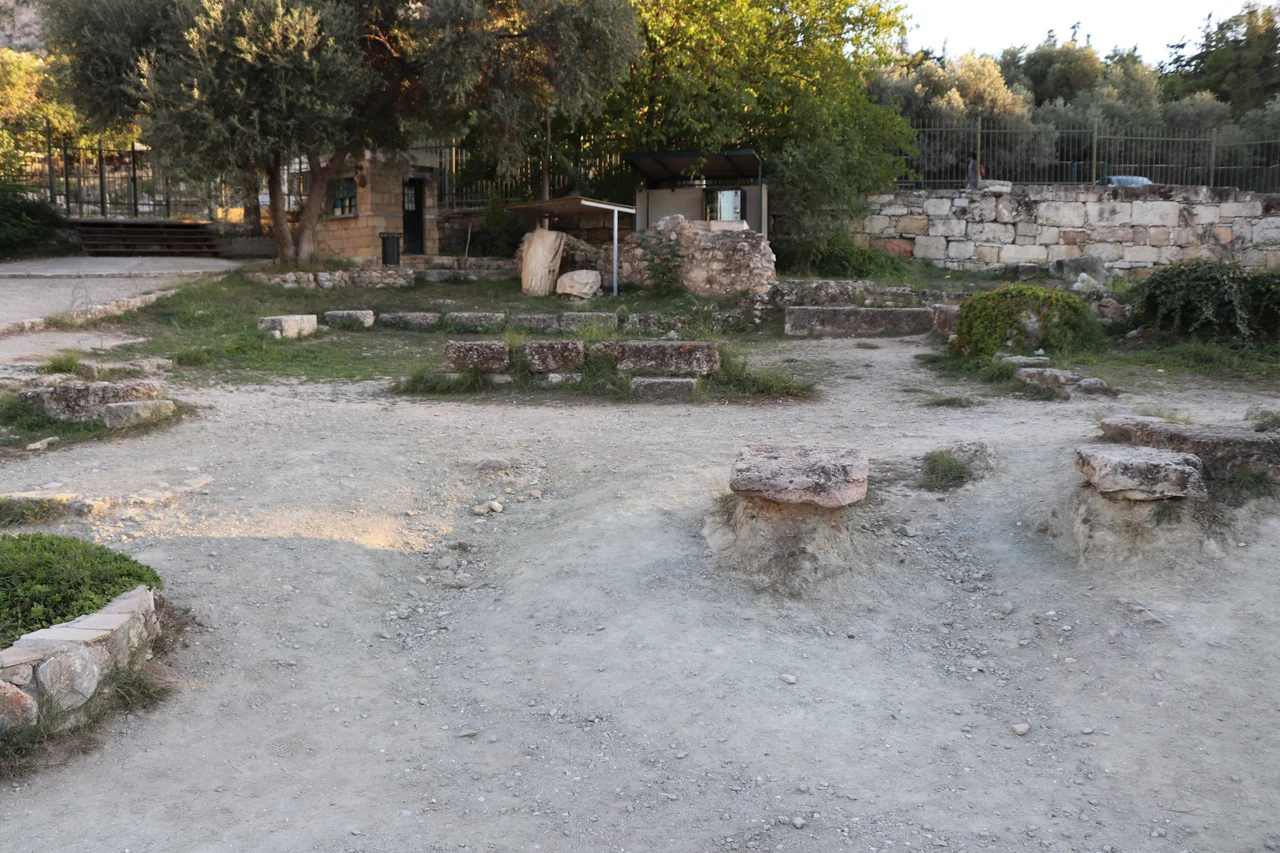

Southeast Temple
Look closely at the column drums of the Southeast Temple and you find letters cut into the stone - Γ, Θ, Λ, Ν, Π, Σ, Τ, Ω. They are mason's marks, an ancient assembly guide, telling the workmen which block went where. They needed the guide because these stones had been here before, somewhere else. The whole temple was built in the second century AD out of an older one, the Temple of Athena that had stood at Sounion on the windswept southern tip of Attica. Taken apart, hauled to Athens, and reassembled in the Agora's southeast corner, it was the last and most literal of the city's 'itinerant temples.'
Temples That Traveled
In the Roman Imperial period, Athens did something peculiar: it relocated old country temples into the heart of the city. Rural sanctuaries across Attica had fallen quiet - the Athena temple at Sounion likely went out of use after Philip V of Macedon's raids on the countryside shrines in 200 BC - and their dismantled stone became raw material for new construction in the Agora. The Southeast Temple was the last of these transplants. Built in the first half of the second century AD, it was an Ionic temple, octastyle and prostyle - eight columns ranged across the front porch and none down the sides. Strikingly, we no longer know which god or hero it honored once it was rebuilt. The address survives; the dedication does not.
Commanding the Sacred Road
Position was everything. The temple rose in the southeast corner of the Agora, at the foot of the Acropolis' north slope, on the west side of the Panathenaic Way just past the Library of Pantainos. The Panathenaic Way was the processional route that climbed from the Agora up to the Acropolis, and anyone walking it toward the sacred rock would have had the temple squarely in view - a deliberate piece of staging on the city's most ceremonial street. Its foundations were set after the Way was repaved in the early second century, and they cut down through earlier remains, planted partly over the corner of the old Classical mint. A nymphaeum, a monumental fountain, went up just to the west a little later; today the medieval Church of the Holy Apostles stands on that flank.
The Colossal Figure Inside
Inside the cella, a large pedestal of reused stone once carried the cult statue - and it was no modest image. Reconstruction points to a colossal female figure draped in a peplos, carved from fine Pentelic marble, standing nearly four meters tall. Only three battered fragments survive: the upper torso with sockets where a separate head and left arm attached, a stretch of drapery from the hips and thighs, and a single right foot found to the west. The statue's closest cousin is a piece in Rome's Capitoline Museum known as the 'Capitoline Demeter,' itself a Roman copy of a late-fifth-century BC original - though scholars cannot even agree whether it shows Demeter, Hera, or Aphrodite. The Athens statue may have been the model the Roman copyist worked from, or both may descend from a lost masterpiece.
Sacked, and Salvaged Once More
The temple's stones got no rest. In 267 AD the Heruli, a Germanic people raiding the eastern Roman world, sacked Athens and badly damaged the building. In the aftermath the city threw up a hasty defensive wall - the Post-Herulian fortification - and once again the temple was quarried for parts. The fragments that let archaeologists reconstruct its design were not found standing in place; they were dug out of that very wall, directly opposite where the temple had stood. American excavators uncovered the foundations between February and August of 1959, under Dorothy Burr Thompson, and recovered the superstructure piece by piece from the later wall. A building moved once in antiquity, dismembered again after disaster - its history is one long act of recycling, the same marble pressed into service across seven hundred years.
From the Air
The Southeast Temple's foundations lie at about 37.974°N, 23.724°E in the southeast corner of the Ancient Agora of Athens, at the foot of the Acropolis' north slope. From the air, trace the diagonal line of the Panathenaic Way as it climbs from the green Agora park toward the Acropolis - the temple site sits beside it near the Library of Pantainos and the small domed Church of the Holy Apostles. The Stoa of Attalos marks the Agora's east edge and the Acropolis dominates to the southeast. Best viewed in clear daytime light. Nearest major airport is Athens International (LGAV), about 30 km east-southeast.
Nearby Stories
- Great Sand Beach 5 km away
- Battle of Delium 7.7 km away
- Tower of Aliartos 9 km away
- HMHS Britannic 10 km away
- Saronic Gulf 15 km away
- Sousaki Volcano 17 km away
- Sanctuary of Apollo Maleatas 24 km away
- Skyros 66 km away