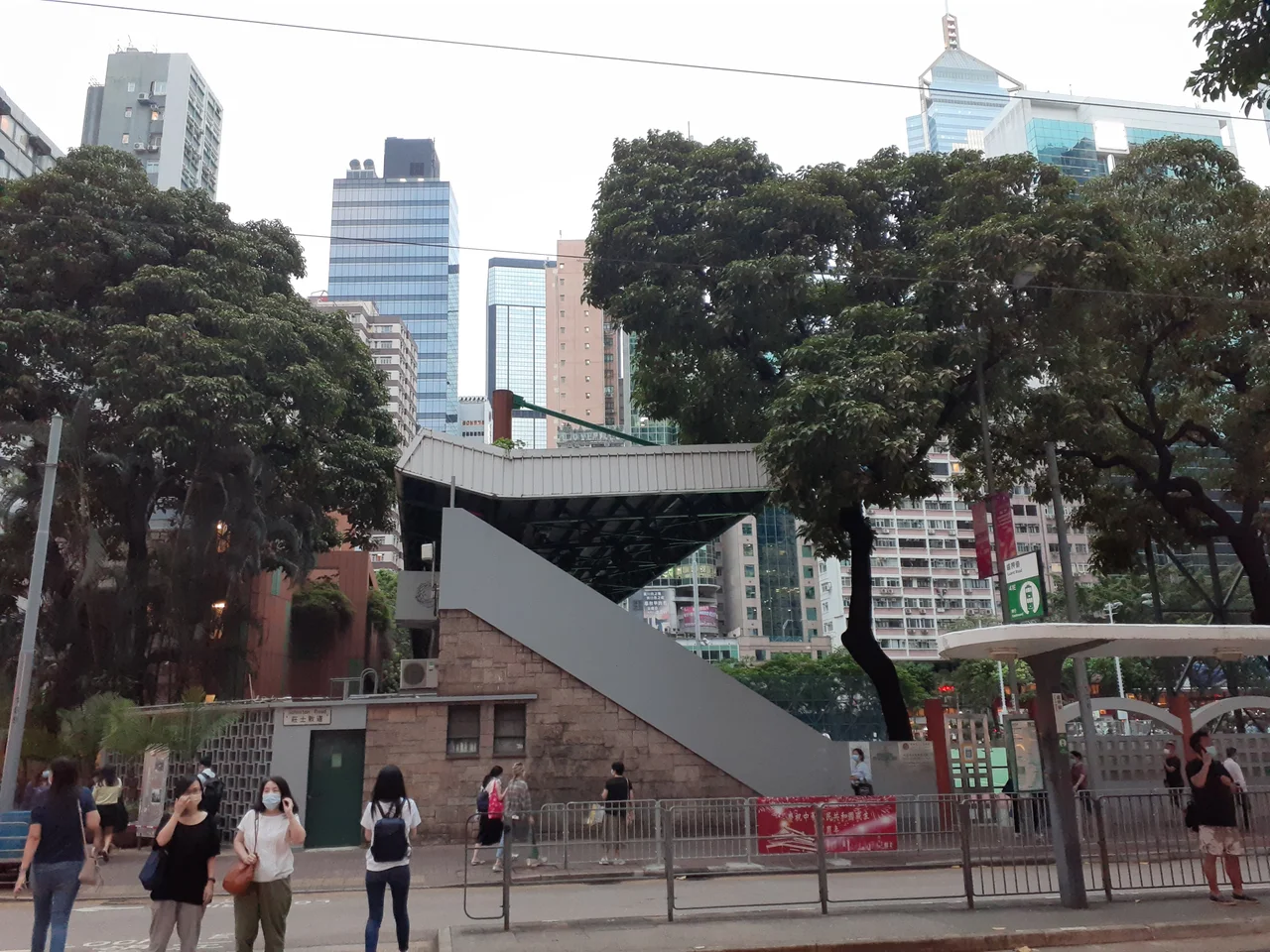

Southorn Playground
In the 1950s and 1960s, Southorn Playground had a morning shift. Day laborers — called coolies in the vernacular of the era — gathered at the ground each morning before dispersing to their work. By evening, the same space transformed: visitors came for Chinese magic shows, kung fu demonstrations, and street food. The playground was doing double duty as labor exchange and entertainment venue, the way urban public spaces often do when a neighborhood has no other common ground. That multi-use character has never left. Southorn Playground today still hosts senior citizens playing Chinese chess in one corner and young basketball players building reputations at one of the most storied courts in Hong Kong.
Land From the Harbour
The ground Southorn Playground stands on did not exist before the 1920s. It was reclaimed from Victoria Harbour as part of the Praya East Reclamation Scheme, one of the land-creation projects that have steadily pushed Hong Kong Island's shoreline southward over the past century. Once the land existed, a government Playing Fields Committee recommended in 1929 that it be set aside for recreation. Thomas Southorn — then Colonial Secretary, serving from 1925 to 1936 — argued that the strip between Johnston Road and Hennessy Road should remain a playground rather than be absorbed by development. The Rotary Club took stewardship of the Wanchai grounds; a formal opening ceremony was held on 11 July 1934. By that point, an April 1934 newspaper noted the facility already averaged 275 children per day. The playground had been in use before it was officially opened.
War Memorial and What Came After
After the Second World War, the Children's Playground Association constructed the War Memorial Centre in the eastern portion of the ground — a welfare and sports facility completed in 1950 that included a library and recreational space for children. A covered basketball court opened there in 1951. The centre coexisted for three decades with the Family Planning Association and the Violet Peel Clinic, both of which operated on the same block. Then came the MTR. When Hong Kong began constructing the Island line in the early 1980s, Urban Council chairman A. de O. Sales fought hard to keep the play areas intact. He partially succeeded: two peripheral sites were handed over — a kiosk location now housing a ventilation shaft, and the old O'Brien Road Public Toilet site. But the War Memorial Centre, the Violet Peel Clinic, and the Family Planning Association in the eastern section were all demolished to make way for the station that opened on 31 May 1985. They were relocated during construction and then rebuilt above the completed station as Southorn Stadium, Southorn Centre, and Southorn Garden.
Heatherwick's Proposal and the Answer It Got
In 2005, the Wan Chai District Council and the British Council invited English designer Thomas Heatherwick and urban renewal specialist Fred Manson to imagine a transformation of the playground. Their proposal centered on public art as infrastructure — turning the space itself into an artwork while upgrading its amenities. An unnamed developer offered to fund half the cost; the District Council sought approximately HK$100 million from the government to cover the rest. The Leisure and Cultural Services Department declined. Their reasoning, quoted directly in records, was that new towns like Tung Chung and Tin Shui Wai had greater urgency, and there was "less priority for a redevelopment proposal which aims at adding value to an existing well-used venue." The rejection was bureaucratically logical and aesthetically disappointing. The playground remained unremodeled, and Heatherwick's vision for Wan Chai went unrealized.
Protest, Chess, and Basketball
When the WTO Ministerial Conference of 2005 came to Hong Kong in December of that year, Southorn Playground was originally designated as one of the official protest zones. The government later reconsidered: the District Council pointed out that 0.4 kilometers from the Hong Kong Convention and Exhibition Centre was close enough to risk overflow crowds cramming Wan Chai. The playground was reassigned to cultural events, public forums, and bazaars instead. The annual Adidas Streetball Challenge, held at the courts, draws basketball devotees from across Hong Kong — a different kind of spectacle. Senior citizens claim their tables for xiangqi, the game of Chinese chess, in the mornings. The court's reputation for producing street-level talent is the kind of thing that gets passed down rather than documented, but it is real: street legends, as the Cantonese sports community calls them, have started here.
A Playground That Won't Stay Still
Southorn Playground has been proposed, studied, partially demolished, rebuilt above an MTR station, renovated (Southorn Stadium was refurbished in 2013), and connected to the redeveloped Lee Tung Street by a 100-metre pedestrian subway. A government study on underground space development in densely built areas has now identified it as a site worth investigating for subsurface use. The playground is, in short, never entirely finished. What stays constant is the use: people come here to move, to sit, to play, to compete, to rest. The reclaimed ground that Thomas Southorn suggested preserving in 1929 still functions exactly as he intended — as a place that belongs, against all the pressures of one of the world's most expensive cities, to the people who use it.
From the Air
Southorn Playground sits at 22.277°N, 114.172°E in the Wan Chai district of Hong Kong Island. From the air, look for the open green space bounded by Hennessy Road to the north and Johnston Road to the south — it stands out as one of the few unbuilt rectangles in the dense Wan Chai urban grid. Best observed from 1,500–3,000 feet over Victoria Harbour, where the relationship between the playground, the MTR station below, and the high-rise surroundings becomes clear. Hong Kong International Airport (VHHH) lies approximately 22 nautical miles to the west on Lantau Island.
Nearby Stories
- Lok Ma Chau Loop 2.3 km away
- Portas do Cerco 2.3 km away
- Kweilin Incident 17 km away
- Wanshan Archipelago Campaign 34 km away
- Nanxiong Formation 115 km away
- Battle of Nanpeng Island 148 km away
- Heyuan 169 km away
- Cape Maobitou 632 km away