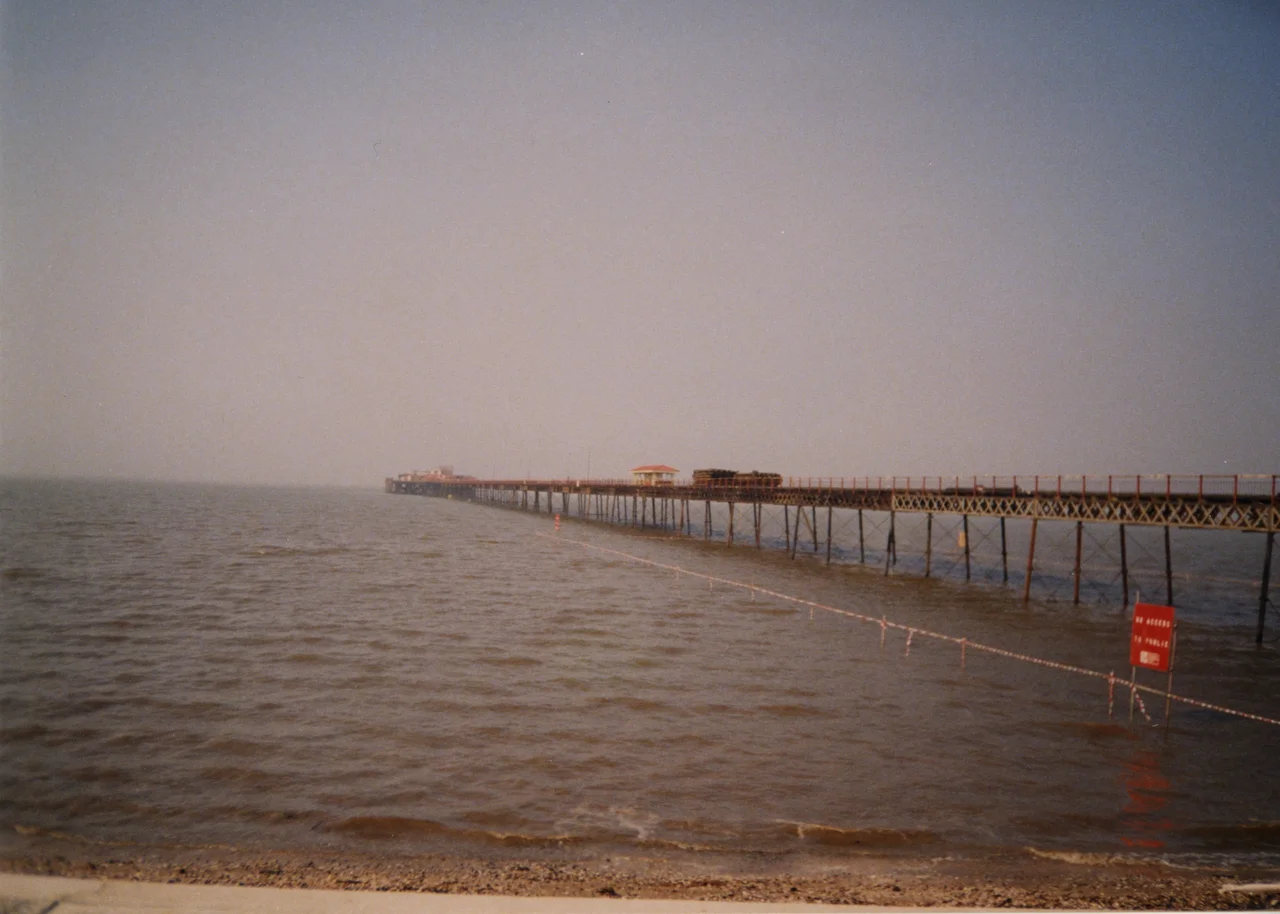

Southport Pier
In December 1990 the pier was about to be demolished. Sefton Council had run the numbers, looked at the maintenance bills, and concluded that the oldest iron pleasure pier in the country could not be saved. The vote went against demolition by one. One councillor in one room kept Southport Pier upright. That margin gets to the heart of this structure: it has been almost lost so many times that surviving has become its defining characteristic.
The First Pleasure Pier
Proposals for a Southport pier first appeared in 1844, tied to a possible railway connection from Manchester. A committee formed in 1852. The Southport Pier Company was registered in March 1859 with twelve thousand pounds of capital, and construction commenced that August. The cost ran to eight thousand seven hundred pounds. When the pier opened on 2 August 1860 with a grand procession, it was a deliberate departure from what piers had been until then. It was not meant to dock ships; it was meant for walking. That made it, by general agreement, the first pleasure pier in the country, and at thirty-six hundred feet it was also the second-longest. It was extended to four thousand three hundred and eighty feet in 1868. A cable-operated tramway carried passengers along its deck by 1865. For the price of admission, a Victorian visitor could walk further out over the Irish Sea than anywhere else in Britain except Southend.
Fire, Steamers, Charlie Chaplin
A fire in September 1897 destroyed the original pavilion. Its replacement opened in January 1902 with an auditorium and was considered grander than the first. From 1903, divers performed from the tea house roof several times daily; Professors Osbourne and Powsey were the most popular, with Powsey specialising in jumping off the pier on a bicycle. From 1906 the new pavilion hosted Charlie Chaplin and George Robey. After the First World War it was renamed the Casino and given over to dancing. The 1920s averaged a profit of six thousand seven hundred and fifty pounds a year. Then the channel silted. Steamers had been ferrying visitors to and from Lytham and Liverpool since the pier's opening, but by the early 1920s the sea had retreated too far. The steamer service ended entirely in 1929. A fire in July 1933 destroyed the pier head. The Southport Pier Company sold to Southport Corporation in June 1936 for thirty-four thousand seven hundred and forty-four pounds, and the corporation kept it through the Second World War as a searchlight platform watching for Luftwaffe aircraft on their way to Liverpool docks.
Reprieved by One Vote
A 1989 storm caused extensive damage to an already deteriorating structure. Sefton Council moved to demolish in December 1990 and lost the vote by a single ballot. In October 1998 the Heritage Lottery Fund awarded one point seven million pounds for restoration. Work began in 2000 and was completed in 2002, costing seven point two million pounds in total. A new tram ran along the centre of a widened deck, half-hourly in both directions, every day of the year except Christmas. The 2003 National Piers Society named it Pier of the Year. Hardwood slats let walkers see slivers of water below; name plaques along the deck recorded the local people who had funded the restoration by buying one each. The pier had become a community project.
Closures and Fires Again
The tram service was suspended in July 2013 after cracks were found in supporting columns. It stopped entirely in June 2015. The rails were taken up in 2023 and given to the West Lancashire Light Railway. In December 2022 the whole pier was closed to the public because the deck appeared to be rotting. Repair funding stalled. In May 2025 access remained blocked. Then, on 31 August 2025, a large fire, suspected to have been caused by an electrical fault, swept through part of the pier and spread to a cafe building on it. The pier closes in this story, and reopens in this story, on a rhythm that has now run for one hundred and sixty-five years. Land beneath part of the pier has been reclaimed; the structure now passes overland before reaching the beach, because the silt that drove away the steamers eventually gave Southport new ground. The sea moves. The pier stays.
From the Air
Southport Pier reaches west from the promenade at approximately 53.653 N, 3.017 W into Liverpool Bay. The pier head sits over what is now largely tidal sand and reclaimed land, the result of the same channel silting that closed the steamer service in 1929. Liverpool John Lennon (EGGP, LPL) lies about 18 nm to the south; Blackpool International (EGNH, BLK) is about 14 nm to the north. From altitude the pier is a slender line running west from the town grid past Marine Lake, beside which the Lakeside Miniature Railway operates. Lord Street's covered Victorian shopping canopy runs parallel to the seafront a few hundred metres inland. Royal Birkdale Golf Club is south along the beach in the dunes.
Nearby Stories
- Kingsway Tunnel 3.1 km away
- Helmshore Mills Textile Museum 8.3 km away
- Heysham Port 9 km away
- Tatton Park 13 km away
- Abergele Rail Disaster 18 km away
- Malham Cove 23 km away
- Llandudno 47 km away
- Egremont Castle 57 km away