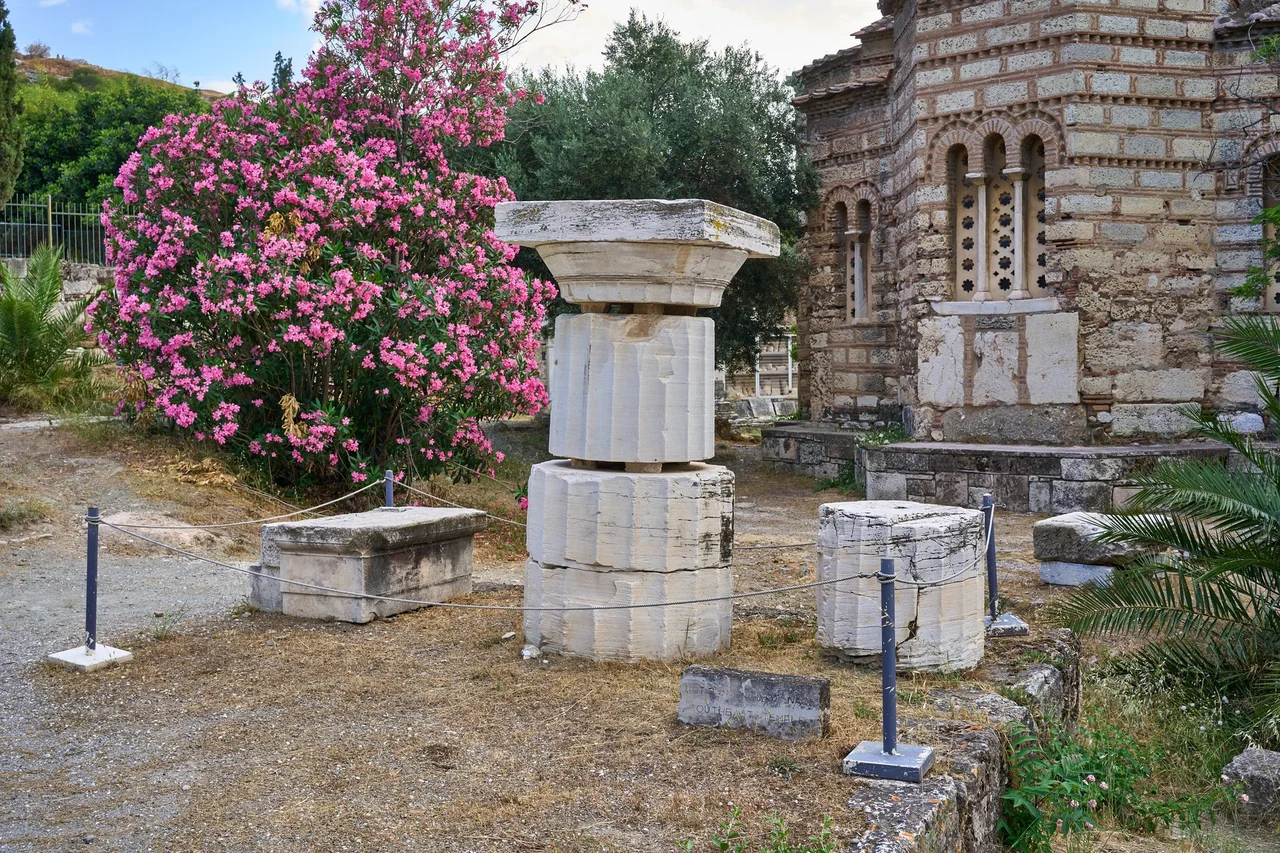

Southwest Temple
There is a temple in the southwest corner of the Athenian Agora that no longer stands, and that may never have been entirely original to begin with. We do not know which god it honored. We do not know its true name - "Southwest Temple" is simply where modern archaeologists found it. What we do know is stranger than any dedication: when Romans raised this Doric temple in the age of the emperor Augustus, around the dawn of the first century AD, they built almost none of it new. They built it from scavenged parts.
A Temple of Recycled Stone
The technical word is spolia - the reuse of older building material - and the Southwest Temple is a near-complete exercise in it. Its columns came from an unfinished double colonnade at Thorikos in southeastern Attica, built in the late fifth century BC, more than four centuries before they were re-erected here; only when the Romans moved them to the Agora were the vertical flutes finally carved into their surfaces. The wall blocks came from that same Thorikos structure. The decorative frieze derived from a second-century BC building, probably one wrecked when Sulla's army sacked Athens in 86 BC. The triglyphs - the grooved blocks of the frieze - were quarried, in effect, from at least four different earlier temples, ranging across centuries of Greek history, then recut to a common size to fit their new home. Assembling this temple was less construction than curation.
Reading the Mason's Marks
None of the temple's superstructure was found standing. Instead, archaeologists recovered its marble members from an unexpected place - a defensive wall thrown up centuries later. And on those scattered marble blocks they found something quietly remarkable: mason's marks, small carved letters cut to guide the builders in reassembling the pieces correctly, like the numbered parts of a kit. The letter forms date these marks to the first or second century AD, confirming the Roman reconstruction. From the surviving evidence, the architect William Dinsmoor Jr. reconstructed the building on paper: a front of four Doric columns, each just over a meter wide at the base and standing some 5.6 meters tall, with no columns along the back or sides. Behind the porch stretched the largest cella - the inner chamber - of any temple in the Agora.
Whose House Was It?
The temple's dedication remains an open question, and the guesses are educated rather than certain. One scholar, Homer Thompson, suggested it served the imperial cult, pointing to a statue base for Livia - the empress and mother of the emperor Tiberius - found nearby; but that base probably belonged to the council house instead. Dinsmoor proposed a link to a statue of Athena discovered close at hand, an idea now associated with the separate Temple of Ares. So the building keeps its secret. It faced west, toward the round council chamber called the Tholos, aligned with the civic offices and the Middle Stoa beside it - clearly meant to belong to the dignified heart of the city, even if its identity has slipped out of the record.
Pulled Apart, Again
The temple's afterlife rhymed with its origins. Just as it had been assembled from the bones of older buildings, it was eventually dismembered to build a newer one. In 267 AD a Germanic people called the Heruli sacked Athens, and in the aftermath the surviving Athenians scrambled to fortify themselves. They tore the Southwest Temple apart and packed its marble columns and frieze blocks into a hastily built defensive rampart, the post-Herulian wall - which is exactly where excavators would later find them, in their third life as rubble. The foundations in the Agora were uncovered by the American School of Classical Studies, glimpsed in the 1930s and properly dug in 1951 under the archaeologist Rebecca Wood. The marble members emerged from the old fortification wall across digs in 1939 and 1959. Today the site is a low scatter of stone - the last resting place of a temple that spent its whole existence being taken apart and put back together.
From the Air
The Southwest Temple lies in the southwestern part of the Ancient Agora of Athens at 37.975°N, 23.723°E, west of the site of the Odeon of Agrippa. From the air there is little to see - the temple survives only as poorly preserved foundations among the Agora's low ruins, below the Acropolis. The nearest airport is Athens International (LGAV), about 30 km to the east-southeast. Central Athens is controlled airspace; the Agora is best explored on foot.
Nearby Stories
- Great Sand Beach 5 km away
- Battle of Delium 7.7 km away
- Tower of Aliartos 9 km away
- HMHS Britannic 10 km away
- Saronic Gulf 15 km away
- Sousaki Volcano 17 km away
- Sanctuary of Apollo Maleatas 24 km away
- Skyros 66 km away