
Sparta, Laconia
Most cities accumulate — they layer century over century, each generation building on or over what came before. Sparti did not accumulate. It was decreed. In 1834, King Otto of Greece signed an order creating a new city on the site of ancient Sparta, and planners drew a grid where ruins and scattered stones had lain for centuries. The name carried more weight than the town. What came into existence was not a continuation of the ancient polis but something new: a small regional capital wearing one of the most storied names in Western civilization.
After the Ancients
The ancient city of Sparta did not simply disappear. It declined — gradually, over many centuries, its population shrinking and its significance fading. From the thirteenth century onward, the political and cultural center of Laconia shifted to Mystras, a Byzantine settlement perched on a spur of Mount Taygetos about four kilometers to the west. The Palaiologos family, the last imperial dynasty of Byzantium, made Mystras their Peloponnesian seat. The Despotate of the Morea, their domain, fell to the Ottoman forces of Mehmed II in 1460.
Through all of this, the settlement at ancient Sparta — known in the medieval period as Lacedaemonia — continued to exist in diminished form. A few thousand people lived among the old ruins, in the long shadow of Mystras. The Greek War of Independence in the early nineteenth century changed everything. Greece became an independent nation, and a new state required capitals, institutions, and cities appropriate to a modern country that was simultaneously rediscovering its ancient identity.
A City Decreed Into Being
The decision to establish a proper city at the site of ancient Sparta was made by King Otto in 1834, just one year after the Greek state achieved full independence. The choice was deliberate and symbolic: placing a new Greek capital on the ground where the most famous of ancient Greek city-states had stood sent a clear message about the new nation's sense of historical continuity.
Planners laid out a street grid suited to a European-style municipal capital. The municipality was formally constituted on 21 March 1835 and officially declared the Municipality of Sparta in 1845. The city hall was built in 1872 under Mayor Emmanuel Meletopoulos. One ancient monument was incorporated into the new plan: a limestone structure of the late fifth century BCE, probably a temple, which nineteenth-century residents named the Tomb of Leonidas — though the association is unverified. It was the only ancient structure marked on the original 1834 town plan.
Between Two Mountains
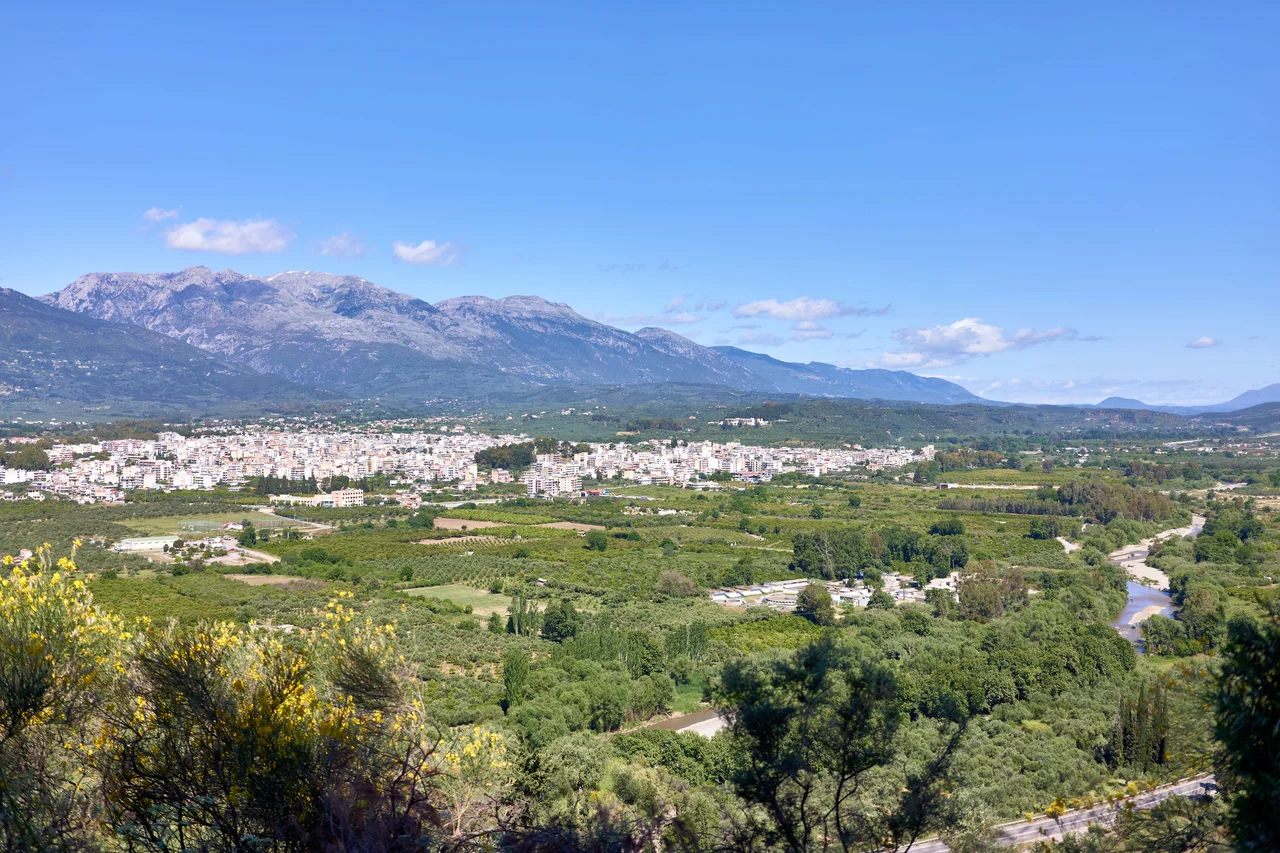
Modern Sparti sits in the Evrotas River valley, cradled between two mountain ranges. To the southwest stands Mount Taygetos, its highest peak reaching 2,407 meters — the same wall of rock that shielded ancient Sparta from attack from the west. To the east rise the forested ridges of the Parnon range, heavily wooded with Greek fir and other conifers. The Evrotas River, which the ancients called the Eurotas, still flows through the valley, its banks quiet now but once the setting for Spartan military training and religious rituals.
The setting is dramatic. The valley floor is flat and agricultural; the city's grid of streets sits on the eastern foothills of Taygetos, and the ancient acropolis stands just to the north of the modern city, largely unexcavated or in low ruins. On a clear day from the Menelaion — the hill to the southeast — the whole of the Sparti valley opens up in a panorama: the river, the plain, Taygetos rising steeply against the western sky.
Present-Day Sparti
The municipal area of Sparti, reformed in 2011 to include seven surrounding municipalities, has a total population of 32,786 as of 2021, of whom about 17,773 live in the city proper. Michalis Vakalopoulos was elected mayor in 2023 on the Sparta Together coalition. The city is the capital of the Laconia regional unit and serves as the administrative and commercial center of the southern Peloponnese.
The city holds several museums worth noting: the Archaeological Museum of Sparta, which preserves finds from the surrounding region including the sanctuary sites; the Museum of the Olive and Greek Olive Oil, reflecting an economy long based on olive cultivation; and the Archaeological Museum of Mystras. Every September since 1983, the Spartathlon — an ultramarathon running from Athens to Sparta, a distance of roughly 246 kilometers — finishes at the statue of Leonidas in the center of the city, drawing international competitors who are chasing a route that Pheidippides, according to Herodotus, ran in 490 BC to seek Spartan military aid before the Battle of Marathon. The modern city wears its name with a certain lightness: it knows what is expected of it, and chooses its own pace.
From the Air
Modern Sparti lies at approximately 37.074°N, 22.429°E in the center of the Evrotas Valley, southern Peloponnese. From the air the city's planned nineteenth-century grid is visible against the agricultural plain, with the Eurotas River threading the valley floor. Mount Taygetos (2,407 m) forms a sharp western horizon — one of the most striking features visible from altitude over the Peloponnese. Nearest major airport: Kalamata International (LGKL), approximately 60 km to the southwest, with straightforward approaches through the valley.
Nearby Stories
- Iklaina 6.6 km away
- Kalamakia Cave Site 7.8 km away
- Cleomenean War 9.7 km away
- Epidaurus Limera 16 km away
- Leonidio 18 km away
- Lepreum 20 km away
- Franchthi Cave 30 km away
- El-Kouf National Park 448 km away