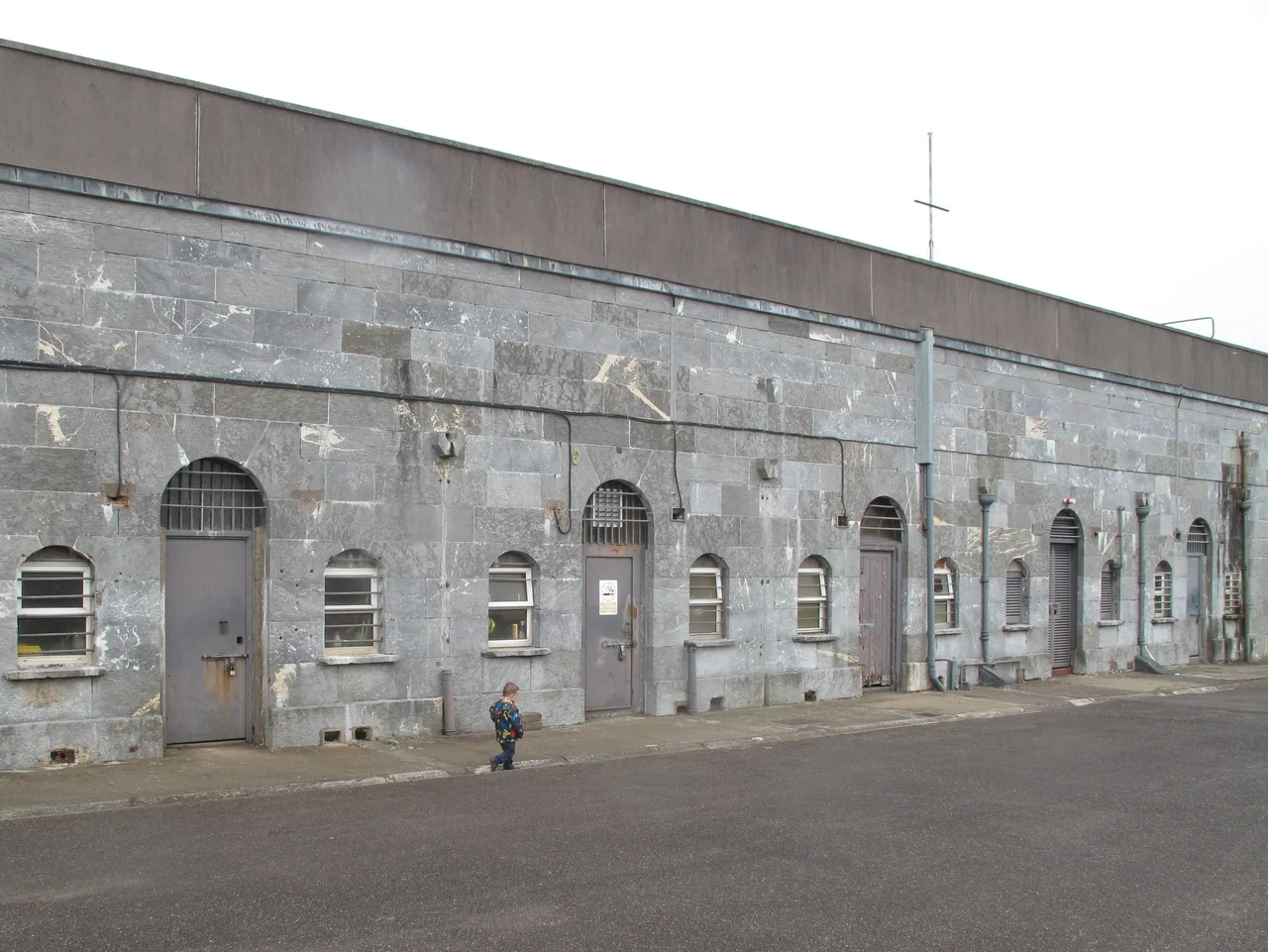

Spike Island
In 2017, the World Travel Awards named it Europe's Leading Tourist Attraction, beating out everything from the Acropolis to the Eiffel Tower. The island that won is barely a kilometre across, sitting in the middle of Cork Harbour, and for most of its modern history it was a place people were sent against their will. Spike Island has been a 7th-century monastery, a smuggler's hideout, a star-shaped fortress, a Famine-era convict depot, a British naval base held under the Anglo-Irish Treaty, an IRA internment camp, and a youth prison so brutal that the inmates burned down a wing in 1985. Now visitors pay to wander its cells.
From Monks to Marlborough
The earliest tradition places Saint Mochuda founding a monastery here in the 7th century, when the island was just a wooded hump in the harbour. By 1178 the Church of Saint Rusien on Spike was being granted to St Thomas's Abbey in Dublin, the same year Diarmid McCarthy, King of Desmond, surrendered his lands to the Normans. Ownership passed through the Pyke and Ronan and Roche and Galwey families across four centuries, then forfeited in the Irish Rebellion of 1641. In 1698 the island briefly belonged to Arnold Joost van Keppel, the Dutch favourite who had crossed to England with William of Orange. Around 1600 a map shows a small fortified tower, hinting at smugglers using the place. None of it prepared Spike for what the British Army had in mind.
The Star Fort
When France and Spain joined the American Revolution in 1778 and 1779, Cork Harbour became the assembly point for transatlantic convoys - at one point, more than 400 vessels rode at anchor here, loaded with supplies for British forces in the West Indies and North America. The harbour needed teeth. In 1779 the army built a temporary battery on Spike Island, eighteen 24-pounders dragged across from Cobh Fort. After the Treaty of Paris ended the war in 1783, that work was demolished. The permanent fortress came next. On 6 June 1804, General Sir Eyre Coote laid the foundation stone of the bastion fort that still dominates the island - a six-pointed star of brick-vaulted casemates, ramparts and magazines, designed to be bombproof and to hold the harbour mouth shut against any enemy fleet. The walls would later hold something else entirely.
Ireland's Alcatraz
By the Famine years, Spike's fortress had become a convict depot, the way-station for prisoners bound for transportation to Australia. The reputation as 'Ireland's Alcatraz' stuck, and it kept earning that reputation through the next century. John Mitchel, the nationalist journalist whose Jail Journal became a cornerstone of Irish republican literature, was held here before transportation. So was Richard Barrett and other IRA prisoners during the War of Independence; Barrett escaped during the 1921 truce. One unexpected story softens the rest: Ellen Organ - 'Little Nellie of Holy God' - lived on Spike with her soldier father in the early 1900s and received special permission to take First Communion before her death at age four. The Pope, hearing of her, lowered the universal age for Communion from twelve to seven.
Held by Britain, 1922 to 1938
When the Anglo-Irish Treaty was signed on 6 December 1921, it gave Ireland its Free State but kept three deepwater 'Treaty Ports' under British sovereignty. Spike Island was one of them. For sixteen years after Irish independence, the Royal Navy still flew the Union Jack above the fortress in the middle of Cork Harbour. The ports rankled. Eamon de Valera's Ireland was moving toward neutrality, and a British base on Irish soil contradicted the whole project. On 11 July 1938, under the Anglo-Irish Trade Agreement, Spike was finally ceded. De Valera and Frank Aiken attended the handover. The British fort was renamed Fort Mitchel, for the journalist who had once been a prisoner there. Within a year, Britain was at war and Churchill was raging in the Commons about the 'folly' of giving the ports back.
Riot, Ruin, Reinvention
The new Irish state used the island as a military base, then later as a youth correctional facility. On 1 September 1985 the young inmates rioted. A subsequent Dail committee reported that 'civilians, prison officers and the Gardai on the Island were virtual prisoners of the criminals' - one of the cell blocks, A Block, caught fire and is still known today as the Burnt Block. The prison closed for good in 2004. After more than a decade of planning and €5.5 million of investment by Cork County Council and Failte Ireland, Spike reopened in 2016 as a heritage attraction. Visitors tour the punishment block, the 1985 riot exhibition, the gun emplacements, the recreated transportation ship hull, and the Mitchel installation. In 2019, more than 81,000 people came. The island that for two centuries punished people has become a place people pay to visit.
From the Air
Spike Island sits at 51.835 degrees N, 8.285 degrees W in the middle of lower Cork Harbour, a roughly 4-hectare island clearly visible as a star-shaped fortress complex from cruising altitude. Best viewed from 3,000 to 6,000 feet on a Cork Harbour overflight, with Haulbowline naval base immediately to the northwest, Great Island and Cobh to the north, Fort Davis (Whitegate) on the east shore, and Camden Fort Meagher (Crosshaven) on the west. Cork Airport (EICK) lies about 14 km west; the harbour mouth and Roche's Point Lighthouse mark the seaward approach to the south.
Nearby Stories
- Walter Siepmann 6.3 km away
- Gaeltacht na nDéise 11 km away
- Fermoy 12 km away
- Canovee 14 km away
- Rathcoole Ambush 16 km away
- SS Folia (1907) 20 km away
- Cloghan Castle, Lough Hyne 35 km away
- SM U-27 91 km away