.jpg)
Square Peristyle
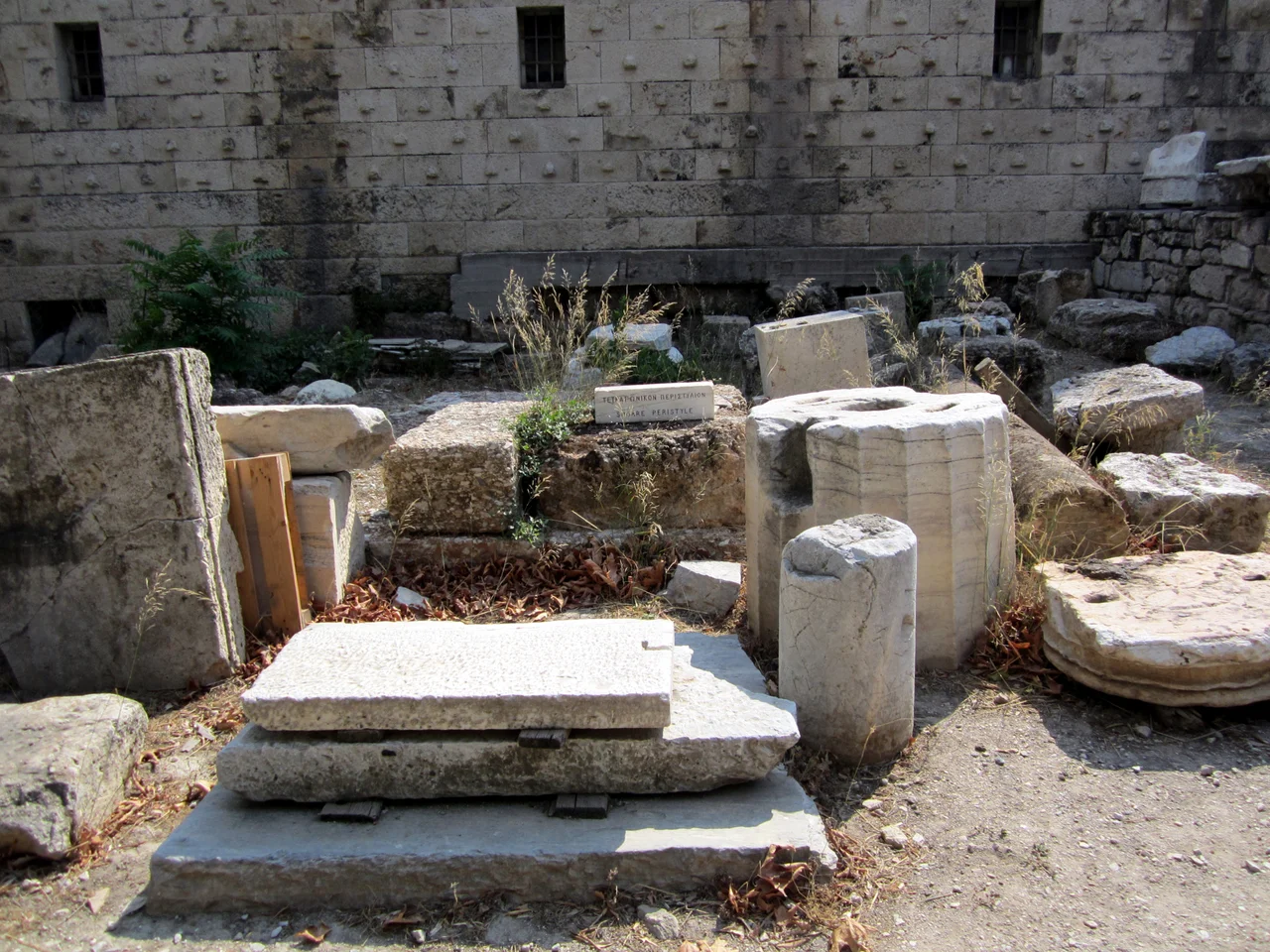
Around 300 BC, the Athenians began one of the most ambitious buildings their democracy ever attempted: a vast square enclosure, nearly 59 meters on each side, ringed by a Doric colonnade and built to hold the city's law courts. With its benches rearranged, it could have seated six thousand citizen jurors for the gravest trials. It was the largest of at least seven colonnaded buildings Athens raised in those years, and the second-largest such structure attempted anywhere in Greece up to that time. And then, within a generation, the Athenians simply stopped. They never finished it. Today you cannot see the Square Peristyle at all - the Stoa of Attalos sits squarely on top of its grave.
A Courthouse for the Democracy
The Square Peristyle was the latest in a line of law courts on the same patch of ground, replacing a cluster of older buildings where Athenians had administered justice for a century. We know they were courts because of what excavators found in them: bronze voting ballots used by jurors, and an open yard nearby that likely hosted the elaborate daily lottery that assigned jurors to their cases. Athenian justice was built to resist corruption through sheer randomness - citizens were sorted to courtrooms by chance each morning, never knowing in advance which trial they would judge. The Square Peristyle was conceived to give this dizzying machinery a permanent home. The plan placed a court in each corner of the colonnade, where five hundred jurors per case could sit on rows of benches; single Greek letters carved into the building's stone steps may have marked which seating bay corresponded to a juror's randomly drawn lot.
Built on a Budget
Athens was not the imperial power it had once been, and the building shows the strain in its materials. Rather than the marble of the city's prouder monuments, the outer walls were raised in cheap mudbrick. The columns and entablature were cut from limestone quarried at Kara, in the foothills of Mount Hymettus - a stone that resembled marble but was easier to work and lay closer to the city than the great marble quarries. Even so, the builders attempted something genuinely difficult. The spans between the columns were three meters wide, larger than any earlier Greek colonnade had dared, and the frieze above them used a clever cantilevering system to channel the roof's full weight directly down onto the columns. Ambition and thrift sat uneasily together in the same walls.
The Building That Stopped
It was never completed. The northern wing was finished; the southern wing's foundations were never even laid. A grand entrance gate planned for the west side and a smaller one for the east were simply left as gaps. Many blocks still bear the rough protective surfaces that masons meant to chisel smooth once the stones were set in place - and never did. The cause was almost certainly the turmoil of the age. These were the Wars of the Diadochi, the violent scramble among Alexander the Great's successors, and Athens lurched through financial and political crisis. By around 285 to 275 BC the foundation trench for the south wall was deliberately filled in with dirt, formally abandoning the plan. One archaeologist read the half-built ruin as a symbol in itself - of how the proud court system of the democracy was losing its central place in a changed Athenian world.
Demolished, Reused, Forgotten
An unfinished building is a quarry waiting to happen. In the early second century BC the Athenians systematically tore the Square Peristyle down, foundations and all, and carted most of its stones and timbers across the Agora to build South Stoa II - a new colonnade given the very same dimensions, as if the old design were finally being completed in a different place. Leftover blocks went into other structures scattered through the city. Only the north wall was spared, because it usefully served as a retaining wall. Then, around 150 BC, the gift of King Attalos II of Pergamon - the great two-storey Stoa of Attalos - rose directly over the buried foundations. When American archaeologists led by Homer Thompson finally traced the peristyle in the early 1950s, the timing was cruel: the Stoa above was being reconstructed at the very same moment. The dig had to race the rebuilding, and once the Stoa was finished in 1956, the law court vanished beneath it again. A short stretch of its north wall still survives, visible only in the Stoa's basement - the last sliver of a courthouse that history covered over twice.
From the Air
The Square Peristyle lies buried beneath the Stoa of Attalos on the east side of the Ancient Agora at 37.976°N, 23.724°E, beside the ancient Panathenaic Way. Nothing of it is visible from the air or the ground - look instead for the reconstructed Stoa of Attalos that stands over it, the one full-height building on the Agora site. The nearest airport is Athens International (LGAV), roughly 30 km to the east-southeast. Central Athens is controlled airspace; the Agora is best explored on foot.
Nearby Stories
- Great Sand Beach 5 km away
- Battle of Delium 7.7 km away
- Tower of Aliartos 9 km away
- HMHS Britannic 10 km away
- Saronic Gulf 15 km away
- Sousaki Volcano 17 km away
- Sanctuary of Apollo Maleatas 24 km away
- Skyros 66 km away