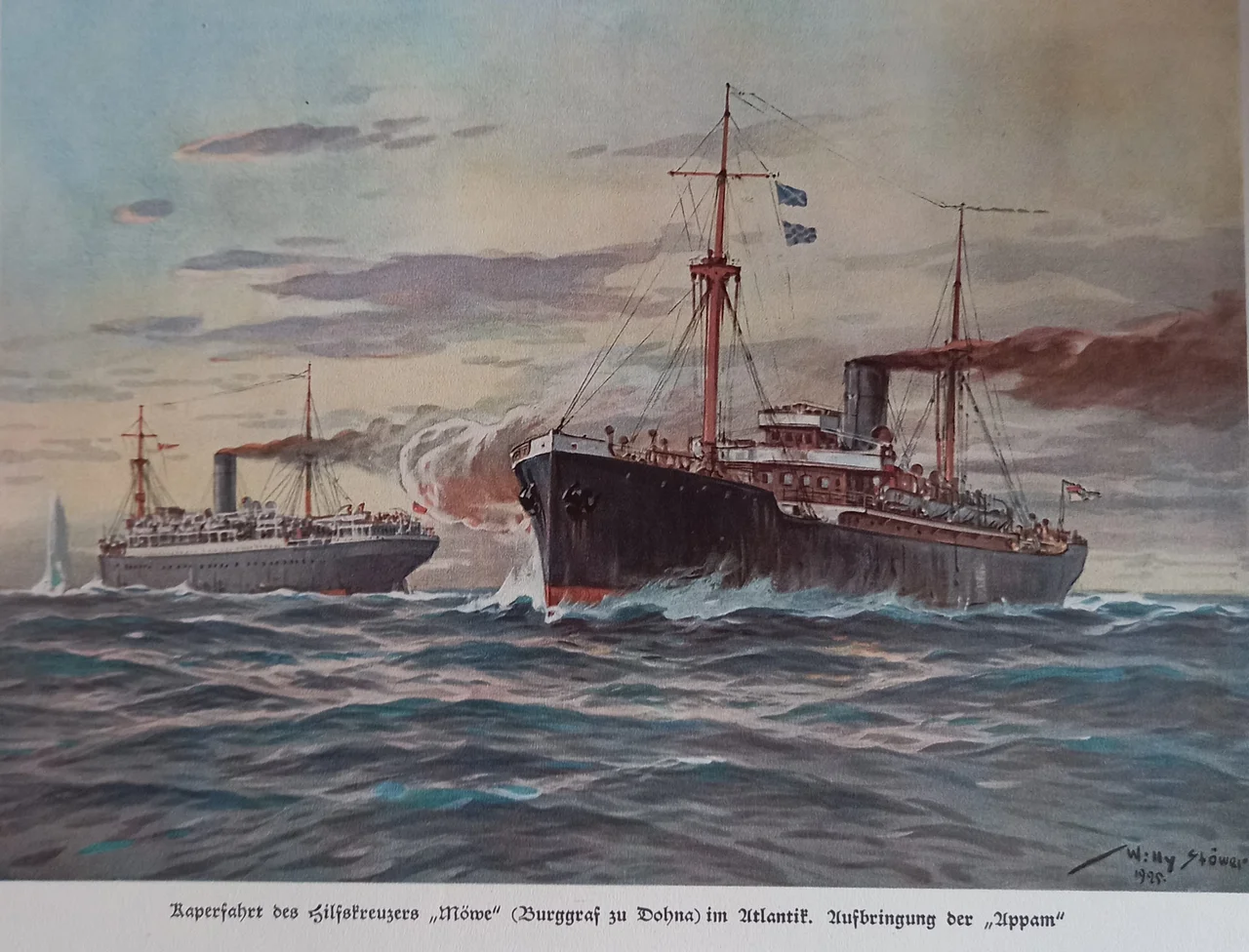
_im_Atlantik._Aufbringung_der_APPAM._auf.jpg)
SS Appam
Imagine you are a passenger on a British liner bound from West Africa for Plymouth in January 1916. The First World War is in its second winter. Somewhere off the Canary Islands a stranger flying the wrong flag closes with your ship, demands her surrender, puts a small German crew aboard, and then — instead of sinking you — sends your ship sailing across the Atlantic to a neutral American port. That was the strange fate of the SS Appam: a routine West African mail run that ended at Hampton Roads, Virginia, where the United States Supreme Court eventually had to work out who owned the ship her captors had so politely delivered.
Built in Belfast
The Appam was a 7,781-ton British steamship, 425 feet long with a 57-foot beam, built in 1913 by Harland & Wolff in Belfast — the same yard that had built the Titanic a year earlier. She belonged to the British & African Steam Navigation Company, a subsidiary of the Liverpool-based Elder Dempster Lines that worked the routes between Britain and West Africa. In peacetime she carried mail, cargo, and passengers between Liverpool and ports along the coasts of present-day Senegal, Ghana, and Nigeria. In wartime she kept doing exactly the same thing, because the empire could not function without the West African routes, and because the British government was confident enough in the Royal Navy to let merchant traffic continue.
Captured by the Möwe
That confidence was sometimes misplaced. On 15 January 1916, while Appam was on her way home from West Africa, she was intercepted by the SMS Möwe, an Imperial German Navy auxiliary cruiser disguised as a merchantman. The Möwe was on her first commerce-raiding cruise under Korvettenkapitän Nikolaus zu Dohna-Schlodien, and she would take or sink a long list of British and Allied ships before returning safely to Wilhelmshaven. The Appam was one of her larger prizes. Rather than sink the liner — which carried civilians, mail, and a significant amount of cargo — the Möwe put a small German prize crew aboard under Leutnant Hans Berg, with orders to sail the captured ship to a neutral port. On 17 January the two ships parted. The Möwe vanished back into commerce raiding. The Appam, with her British passengers, her Royal Navy refugees from earlier prizes, and her German prize crew of around twenty-two men, set course for the United States.
Arrival at Hampton Roads
She made Hampton Roads, Virginia on the last day of January 1916. America was still neutral; American newspapers covered the arrival as a sensation. Photographers swarmed the harbour. The German prize crew flew the Imperial naval ensign above the British red ensign, an unmistakable signal that one of the major Atlantic powers had pulled off something embarrassing in the middle of the ocean. Appam's British owners immediately filed suit in U.S. federal court to get her back. The Germans claimed her as a lawful prize of war and asked the United States to intern her under the rules of neutrality, which would have effectively given them the use of an American port as a free harbour for captured British shipping.
The Supreme Court Decides
On 29 July 1916, U.S. Federal Judge Edmund Waddill of Virginia ruled for the British owners: the Appam, her remaining cargo, and the proceeds of the perishable cargo already sold should be returned at once. The German Empire appealed all the way to the U.S. Supreme Court. The case — formally known as The Steamship Appam — was decided on 6 March 1917. The Court found unanimously for the British owners and laid down a principle that would matter again in the world wars to come: a belligerent nation may not bring its prizes of war into a neutral port and expect the neutral country to give them shelter. The decision came less than a month before the United States itself entered the war on 6 April 1917. On 28 March of that year, Appam was formally returned to her British owners.
After the War
She was renamed SS Mandingo for a brief period — a sensible piece of wartime caution — and then, when the war ended, reverted to her original name. She went back to the Liverpool–West Africa run she had been built for. The captain of the German prize crew, Hans Berg, was interned in America until the United States entered the war, then transferred to a regular prisoner-of-war camp. The Möwe survived two more commerce-raiding cruises before being trapped in port for the rest of the war; she was sunk by Allied bombing in 1945, by which time she had been a Norwegian and then a German merchant ship for nearly thirty years. The Appam herself was eventually sold for scrap. But the case — The Steamship Appam — is still cited in maritime law textbooks as the moment when an American court decided that a neutral port could not be a back room for someone else's war.
Flight Context
The coordinates associated with this article (53.43°N, 4.30°W) place it off the north coast of Anglesey, near the approach to Liverpool that Appam would have used on her regular voyages. The Appam herself was captured in mid-Atlantic, well southwest of the Canary Islands, but the story is bound to the British Atlantic ports — Liverpool, where her owners filed suit; Belfast, where Harland & Wolff built her — that frame the Irish Sea. From a low transit along the north Anglesey coast you can see the seaway through which she would have approached the Mersey. RAF Valley (ICAO EGOV) lies 30 km to the southwest; Liverpool John Lennon (EGGP) about 100 km east-southeast.
From the Air
Coordinates 53.433°N, 4.300°W (associated with Liverpool approach off north Anglesey). Recommended viewing altitude 2,000–5,000 ft AGL. Nearest airport RAF Valley (EGOV), 30 km southwest. The story itself spans the Atlantic — capture point in mid-ocean, prize voyage to Hampton Roads, Virginia — but the British ends are Liverpool (her port) and Belfast (her builder). Visible landmarks near the article's reference point: the north Anglesey coast, the Skerries lighthouse, and the open Irish Sea approach to the Mersey.
Nearby Stories
- Llandudno Lifeboat Station 3.8 km away
- Glynllifon 6.1 km away
- German submarine U-1024 9.4 km away
- Irish Sea Bridge 11 km away
- Ysbyty Ifan 12 km away
- Irish Sea 18 km away
- Celtic Array 18 km away
- Birkdale Palace Hotel 56 km away