.jpg)
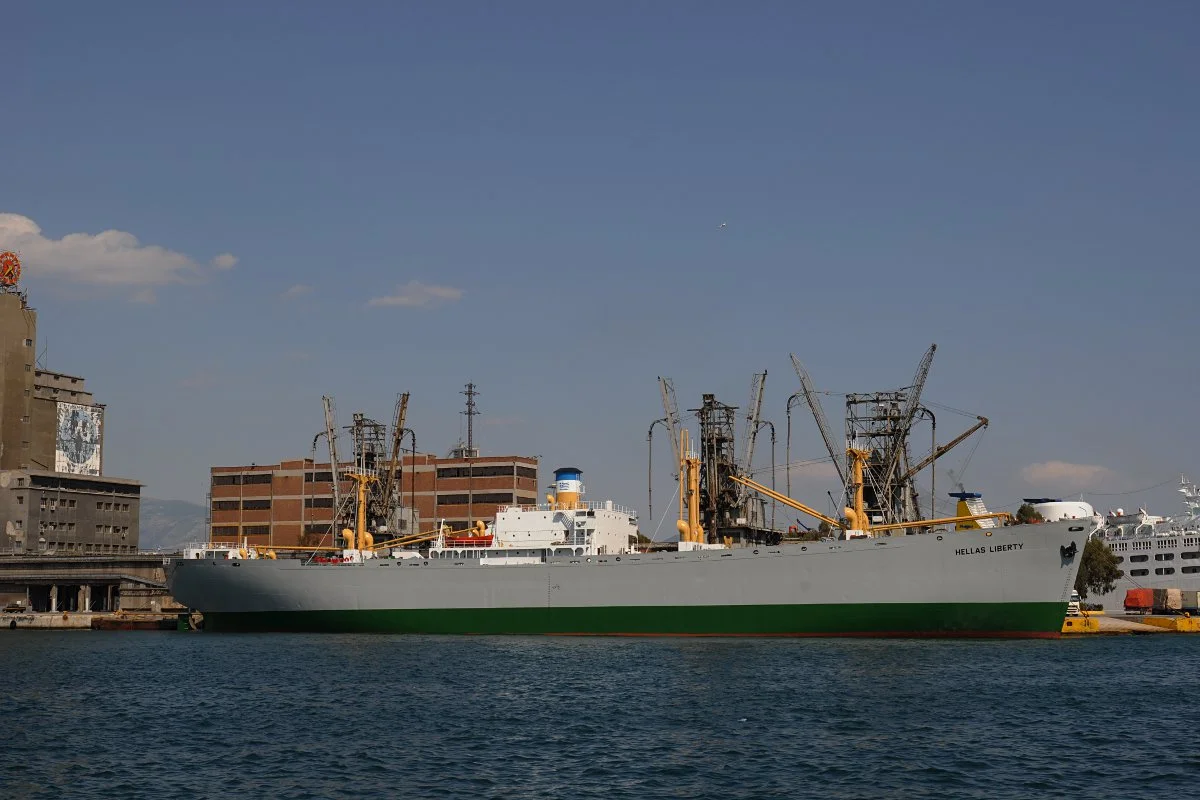
SS Arthur M. Huddell (Hellas Liberty)
She was laid down on October 25, 1943, at the St. Johns River Shipbuilding Company in Jacksonville, Florida, launched six weeks later on the anniversary of Pearl Harbor, and delivered to the War Shipping Administration before Christmas. Thousands of ships like her were built in American yards during World War II — cargo carriers pressed into the service of the Allied war effort, loaded with explosives, coal, pipe, and personnel, and sailed through submarine-infested waters to wherever the war needed them. Most were eventually scrapped or scuttled. This one, named for a union leader from Boston, ended up in a Greek harbor as a floating museum, one of only three surviving original Liberty ships of the Second World War still afloat.
Built for a War
Arthur M. Huddell — the man — had been president of the Boston Central Labor Union and president of the International Union of Operating Engineers, a figure prominent enough in American labor circles to have a wartime cargo ship named for him by his widow at the launching ceremony. The ship that bore his name loaded explosives in Jacksonville in February 1944 and sailed for London. She crossed the Atlantic in convoy, returned to Norfolk, then departed from Charleston with another cargo of explosives bound for Oran in Algeria. By the summer of 1944, the ship had been modified for a specific and secret purpose: holds 4 and 5 were converted to carry coiled pipe for Operation PLUTO — the pipeline-under-the-ocean project that would pump fuel under the English Channel to supply Allied forces after D-Day. She departed New York in September 1944, spent 84 days in London unloading pipe, and returned. It was her only PLUTO mission.
From War Surplus to Cold War Infrastructure
The war ended in 1945, and the Arthur M. Huddell was laid up in the James River Reserve Fleet in Virginia, needing $20,000 in repairs. After stints in reserve and a brief return to service, she emerged in 1956 in a remarkable second career: AT&T chartered her as a cable transport, deploying her to lay undersea telephone cables between the US mainland, Hawaii, and Alaska. Her modified holds, originally built for PLUTO pipe, proved ideal for the new purpose. Later she was transferred to the US Navy and reclassified as a barge to support the Sound Surveillance System (SOSUS) — the Cold War underwater listening network designed to track Soviet submarines. By 1983, she was back in reserve at the James River Fleet, stripped of her propeller, rudder, and most equipment.
The Blessed Ships
Greece's relationship with the Liberty ship is intimate and specific. Of the 1,272 ships operating under the Greek flag at the start of World War II, 914 were lost during the war — an astonishing proportion. When the conflict ended, Greece needed to rebuild its merchant fleet almost from nothing. The United States, through legislation passed in 1946, allowed the sale of surplus vessels to allied nations, and Greek shipowners moved quickly. Between December 1946 and April 1947, Greek buyers purchased 98 Liberty ships from the US government. They kept buying through the 1950s. By 1966, of 722 Liberty ships still in service worldwide, 603 were Greek-owned. Greeks controlled the world's largest commercial fleet by the early 1970s, and the Liberties were the foundation on which that empire was built. The Greek shipping community called them the eulogimena — the blessed ships.
Rescued from the Reef
By the late twentieth century, the Arthur M. Huddell was awaiting the fate of most surviving Liberties: to be scuttled with obsolete ammunition to create an artificial reef. The Greek shipping community had long dreamed of acquiring one of these ships as a floating monument, but the logistics were formidable. Shipowner Spyros M. Polemis coordinated an international effort involving US politicians of Greek heritage, including Rhode Island Senator Leonidas Raptakis and Connecticut congressman Dimitrios Yiannaros, who shepherded legislation through Congress allowing the transfer of ownership to Greece. On June 30, 2008, the formal agreement was signed between US Maritime Administrator Sean Connaughton and Greek Minister of Merchant Marine Georgios Voulgarakis. The ship left Norfolk on December 6, 2008, under tow by the Polish tug Posidon, and arrived in Piraeus on January 11, 2009.
Hellas Liberty
Restoration work took place at Perama and Salamis throughout 2009 and 2010. A new rudder was fabricated in Greece; the propeller — a spare Victory ship propeller donated by the US government, which happens to share the same diameter as a Liberty ship propeller — was fitted, even though it would never turn again. The hull color was changed from the grey of US government service to the more commercial colors of the postwar Greek merchant fleet, restoring the ship's appearance to match the blessed ships her owners had sailed. In June 2010, she was presented to the public in Piraeus Harbor as Hellas Liberty. She remains there — moored in the port that Themistocles built, in the harbor where so many Greek sailors set out across the Aegean and beyond, a rusting steel monument to the ships and the people who sailed them.
From the Air
The Hellas Liberty is moored in the Port of Piraeus at approximately 37.94°N, 23.63°E on the Saronic Gulf, about 10 km southwest of central Athens. At anchor, the ship is small relative to the enormous container cranes and cruise terminals that surround it, but it is identifiable by its distinctive profile and the Greek colors on its hull. Athens International Airport (LGAV / Eleftherios Venizelos) is approximately 35 km to the east-southeast of Piraeus. Pilots approaching Athens from the west pass over the harbor at low altitude; the blue water of the Saronic Gulf and the dense quay infrastructure of Piraeus are among the first recognizable features. The island of Salamis — where the ancient naval battle was fought — is visible across the water to the northwest of the port.
Nearby Stories
- Parnitha 3.4 km away
- Kea (island) 7.3 km away
- Sanctuary of Apollo Maleatas 11 km away
- Sousaki Volcano 12 km away
- Battle of Leuctra 14 km away
- Great Sand Beach 18 km away
- Agios Georgios (island) 23 km away
- Skyros 84 km away