
SS Great Britain
On 19 July 1843, Prince Albert took the Great Western Railway from London to Bristol - Isambard Kingdom Brunel himself drove the train - to christen a ship the like of which the world had not seen. The royal party walked down to the dry dock. The Princess Royal swung a bottle of champagne at the iron hull, but the tug Avon had already begun to tow the ship into the harbour. The bottle fell ten feet short and dropped unbroken into the water. A second bottle was rushed forward and the Prince Consort hurled it himself. It struck the iron and burst. The largest vessel in the world had a name: Great Britain.
A wooden ship that became an iron one
Brunel had not planned to build her in iron. The original design called for a wooden paddle steamer, sister to his Great Western of 1838. Then, in late 1838, an iron-hulled ship called Rainbow - a packet built by John Laird - put into Bristol on its way to Antwerp. Brunel sent two colleagues, Christopher Claxton and William Patterson, to ride her back. They returned converted. Iron, they argued, was getting cheaper while wood was getting dearer. Iron hulls didn't rot. They were lighter, thinner, and - critically - much stronger. The longest wooden hulls flexed sickeningly as waves passed beneath them. Iron could be built far longer. Brunel scrapped the wooden plans, talked the company into the new material, and with each successive draft the ship grew larger, until she was bigger than anything afloat.
And a paddle ship that became a propeller one
Then, in early 1840, came a second piece of luck. A small ship called Archimedes arrived in Bristol - the first vessel driven by a screw propeller, built by Francis Pettit Smith. Brunel had been worrying about how to improve his paddlewheels. He persuaded Smith to lend him Archimedes for months of trials, testing different propeller designs. The screw, Brunel concluded, was the future. Its machinery weighed less and sat low in the hull, which lowered the centre of gravity. It freed up space. It eliminated paddleboxes - those great clumsy sponsons that made every paddle steamer manoeuvre like a barge. It stayed submerged when waves rolled. In December 1840, with half the paddlewheel engines already built, the company agreed to scrap them and start again. The decision delayed the ship by nine months.
The maiden voyage and the wreck at Dundrum
On 26 July 1845, seven years after construction began and five years overdue, Great Britain sailed from Liverpool to New York under Captain James Hosken with forty-five passengers. She made the crossing in 14 days and 21 hours, slower than the prevailing record but a triumph of new technology. The next year, on 22 September 1846, on her third Atlantic crossing of the season, Hosken made a navigational error - by one recent account, mistaking the St John's Point light for the Chicken Rock light on the Isle of Man - and drove her hard aground in Dundrum Bay on the north-east coast of Ireland. She lay there for almost a year. Brunel himself organised her protection with timber breakwaters. She was finally refloated on 25 August 1847, but the rescue had cost £34,000 and ruined the Great Western Steamship Company. They sold her in 1852 to Gibbs, Bright & Co. for a mere £25,000.
The Australian years
Her new owners refitted her for the Australia trade. From 1852, Great Britain carried thousands of emigrants from Liverpool to Melbourne - settlers, gold-rush hopefuls, families chasing land and second chances. She made the long passage round the Cape again and again for nearly thirty years. In 1881 she was converted to all-sail. Three years after that, retired at last, she was towed to the Falkland Islands, where she became, in succession, a warehouse, a quarantine ship, and a floating coal hulk - a piece of Victorian engineering reduced to storage in the South Atlantic. In 1937, ninety-eight years after she had been laid down in Bristol, she was scuttled in Sparrow Cove on East Falkland and left to settle in the mud.
The return
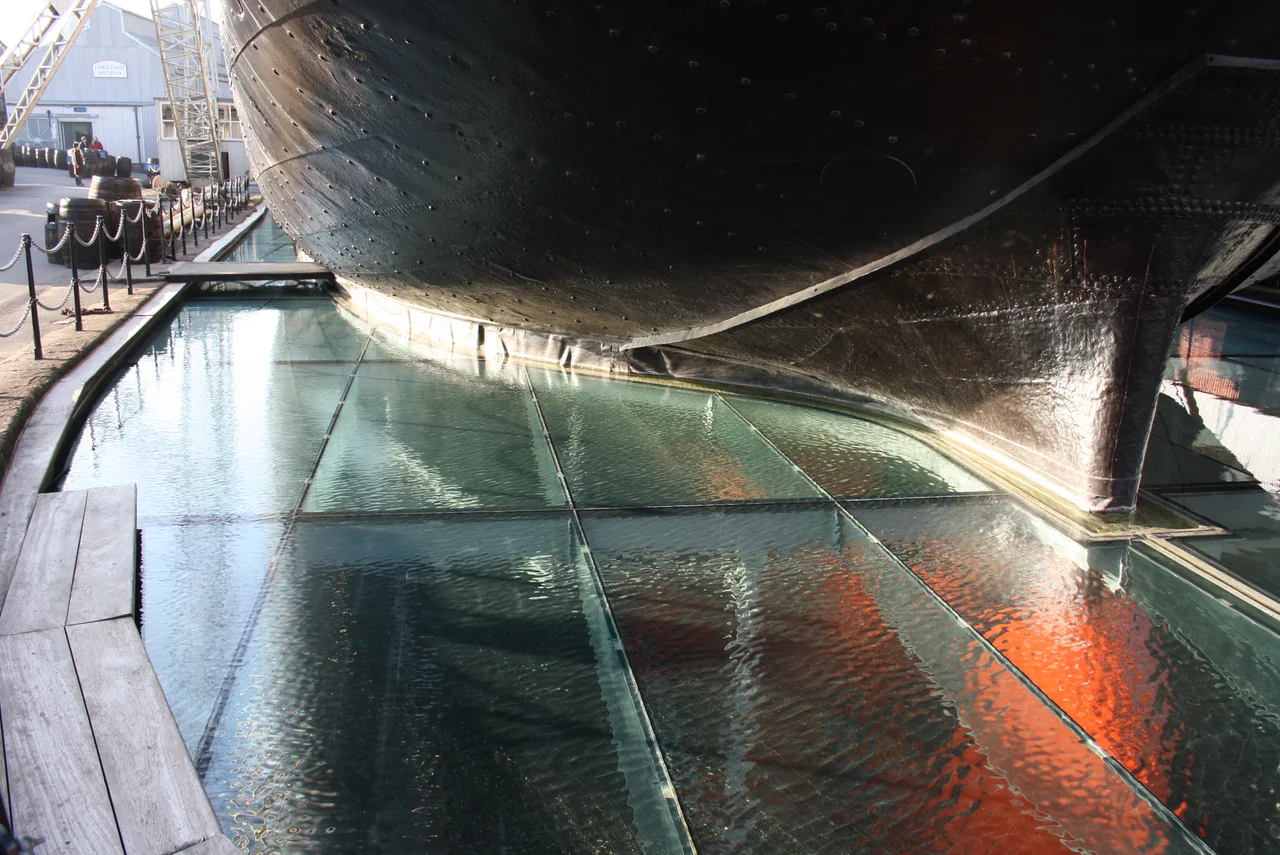
She lay there for thirty-three years. In 1970, Sir Jack Hayward - a businessman, philanthropist and owner of the football club Wolverhampton Wanderers - paid for her to be raised, patched, and towed north across the Atlantic on a pontoon. The journey took weeks. She was brought back into Bristol harbour and into the very dry dock where she had been built 127 years earlier. The crowds along the bank were enormous. The dock is now glassed over at water level so that visitors can walk beneath her hull as if on the seabed, looking up at the iron plates Brunel and his team rivetted together by hand. She is part of the National Historic Fleet, draws between 150,000 and 200,000 visitors a year, and remains what she was always meant to be: a Bristol ship, in Bristol water, telling a Bristol story.
From the Air
SS Great Britain at 51.4492 N, 2.6084 W, berthed in the Great Western Dock on Bristol's Floating Harbour. Best viewed from low altitude (1,500-3,000 ft) over the Floating Harbour. Visual landmarks: the M Shed museum to the east, the Cumberland Basin and locks to the west, the Clifton Suspension Bridge upriver. Nearest airports: Bristol (EGGD) approximately 6 nm south-west, Filton aerodrome to the north.
Nearby Stories
- Cosmeston Medieval Village 1.4 km away
- Glastonbury Festival 3.5 km away
- Tintern Abbey 3.6 km away
- Quantock Hills 4.8 km away
- Ebbw Vale Steelworks 10 km away
- New Wardour Castle 12 km away
- Windmill Hill, Avebury 16 km away
- Cotswolds 18 km away