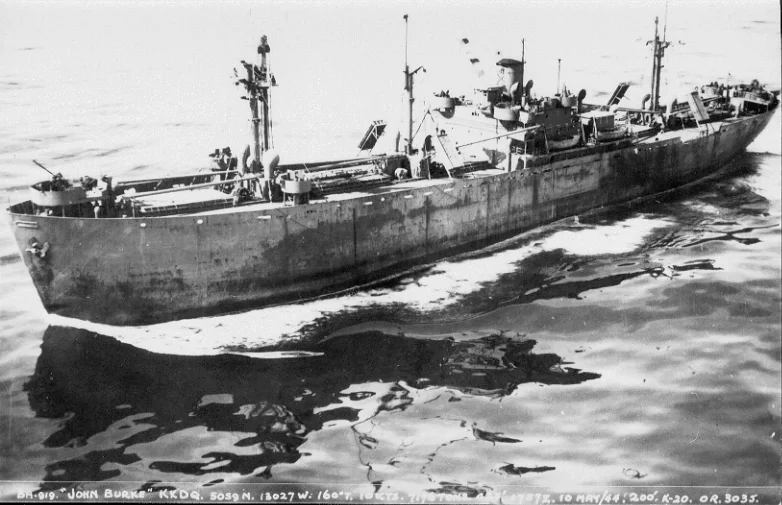

SS John Burke
For several seconds after the impact, the SS John Burke simply disappeared. Where a 441-foot Liberty ship loaded with ammunition had been steaming moments before, there was now a mushroom cloud of smoke, fire, and debris rising from the strait between Negros, Siquijor, and Mindanao. Ships nearby were damaged by the blast and flying wreckage. When the cloud cleared, the John Burke was gone -- broken apart so completely that its fragments now lie 1,500 feet below the surface. Every person aboard died. The ship had existed for just over two years, built as one of 2,710 mass-produced Liberty ships meant to last five years at most. It lasted twenty-five months.
Built for Speed, Not for Posterity
The John Burke was launched from Kaiser Shipbuilding Company's Oregon Shipbuilding yard in Portland, Oregon, her keel laid on November 20, 1942. She was named for John Burke, the 10th Governor of North Dakota, who had served from 1907 to 1913. Like her 2,709 sister ships, she was an EC2-S-C1 type: 441 feet long, powered by two oil-fired boilers and a single 2,500-horsepower triple-expansion steam engine that turned a single propeller at 76 rpm, achieving a top speed of about 11 knots. Liberty ships were not designed to be elegant or fast. They were designed to be numerous -- an expedient solution to the catastrophic merchant shipping losses inflicted by German U-boats. Large hatches above five cargo holds allowed steam winches to load and unload rapidly. The bridge, radio room, and captain's quarters sat atop a three-deck structure amidships. Gun tubs at the bow, stern, and above the bridge held a mix of weaponry that could include 5-inch, 4-inch, 3-inch, 40mm, 20mm, and .50-caliber guns.
Uncle Plus Thirteen
In late December 1944, the John Burke joined the 100-ship convoy designated "Uncle Plus 13," bound for Leyte in the Philippines to deliver supplies for the ongoing campaign to liberate the islands. The convoy arrived at Leyte on the night of December 27. Japanese forces learned of its presence shortly before daybreak on December 28, and a flight of kamikaze fighter-bombers was dispatched from Cebu Island. The crews aboard the convoy's ships went to general quarters after the dawn weather report confirmed that air cover would not launch until the poor weather cleared. They waited, knowing the Japanese would come before their own planes could protect them.
Eighty-One Seconds
At about 08:15, the first kamikaze appeared on radar, and the convoy began evasive maneuvers. Through breaks in the cloud cover, Japanese pilots spotted the American ships steaming south of Cebu and Bohol. Three A6M Zero fighters from the 201st Air Group, led by Lieutenant Masami Hoshino, had taken off from Cebu at 09:50, each carrying a 250-kilogram bomb. One pilot dove through the anti-aircraft fire, his aircraft already damaged, and crashed between the John Burke's number two and number three cargo holds. What happened next was not a fire or a slow sinking. The ammunition in the holds detonated in a catastrophic explosion that obliterated the ship almost instantaneously. The blast damaged several nearby vessels. All merchant crew and armed guards aboard -- the exact number uncertain -- died without any opportunity to abandon ship.
Fifteen Hundred Feet Down
The kamikaze attack that destroyed the John Burke that morning was only the beginning. Over the next two days, Japanese aircraft continued to attack the convoy, sinking more ships and killing hundreds. The surviving vessels reached their destination at 06:48 on December 30, delivering materials for the Mindoro invasion. Today, the fragmented remains of the SS John Burke lie on the seabed approximately 1,500 feet below the surface, in the strait between Negros, Siquijor, and Dapitan, Zamboanga del Norte. She was one of three Liberty ships and one of forty-seven ships sunk by kamikaze attack during World War II. Two of her sister ships -- the SS John W. Brown and the SS Jeremiah O'Brien -- survived the war and more than seventy years beyond it, and now serve as museum ships open to the public. The John Burke, by contrast, left nothing on the surface. Only the record of her loss, and the men who went down with her, remain.
From the Air
The wreck site of SS John Burke lies at approximately 9.02N, 123.45E in the strait between Negros Island, Siquijor Island, and Dapitan on the Mindanao coast. The nearest airports are Dumaguete-Sibulan Airport (RPVD) on Negros, approximately 30 km to the northeast, and Dipolog Airport (RPMG) on Mindanao, approximately 50 km to the south. From the air at medium altitude (5,000-10,000 ft), the strait is visible between the larger islands. The wreck lies at 1,500 ft depth and leaves no surface trace. The waters here were part of the convoy route during the Battle of Leyte Gulf operations in late 1944.
Nearby Stories
- Pamplona Massacre 10 km away
- Jose Rizal Memorial Protected Landscape 22 km away
- Boljoon Church 36 km away
- Japanese Cruiser Abukuma 64 km away
- 1995 Ipil Massacre 123 km away
- November 2023 Mindanao Earthquake 371 km away
- Balut Island 430 km away
- Sinking of MV Sewol 2777 km away