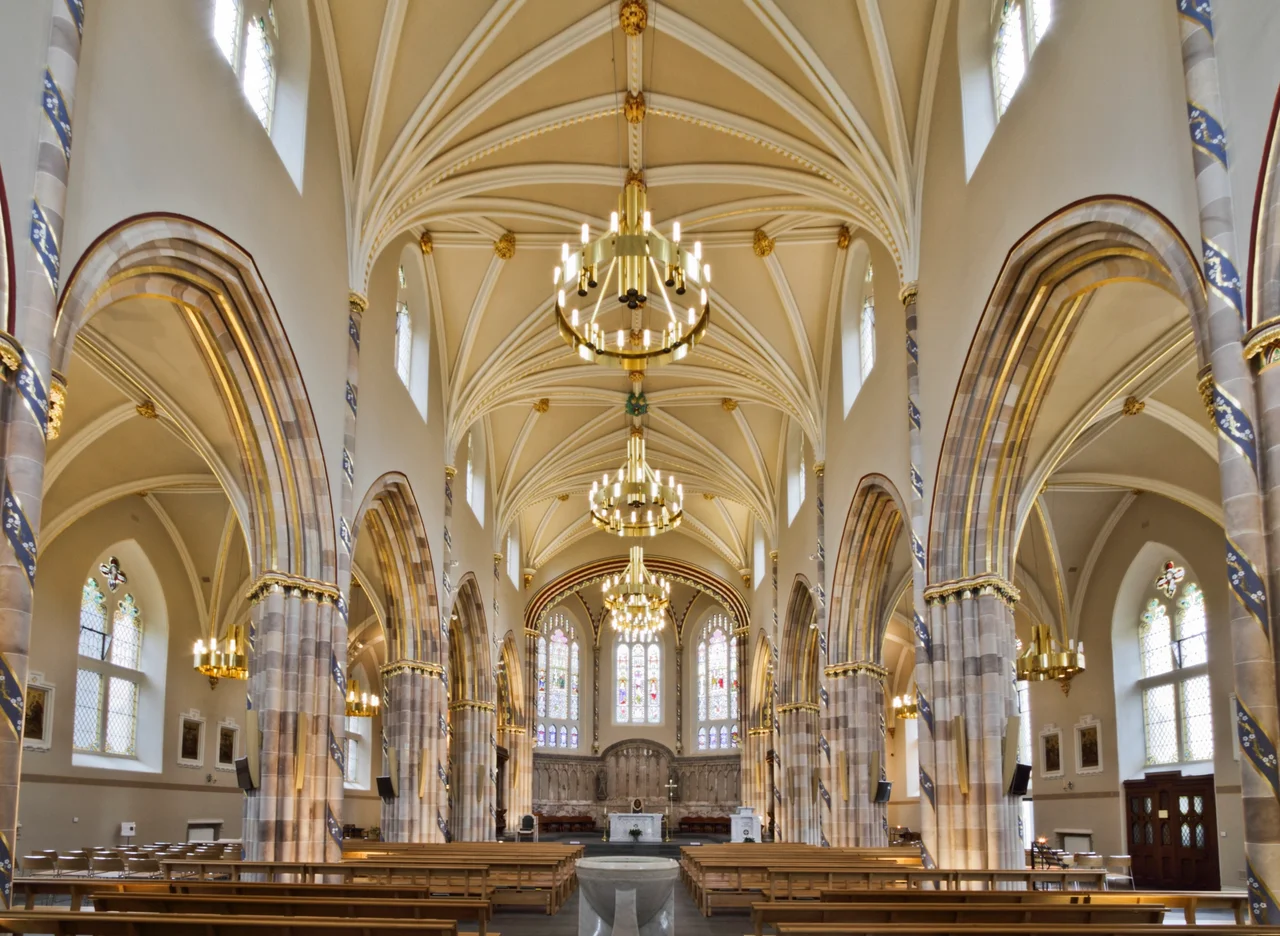

St Andrew's Cathedral, Glasgow
Saboteurs came at night. Throughout 1814 and 1815, while Andrew Scott and his small Catholic congregation in Glasgow were trying to build their first proper church since the Reformation, workmen returning each morning found that the previous day's labour had been pulled down again in the dark. The Roman Catholic Relief Act 1791 had restored limited civil rights and freedom of worship to British Catholics, but anti-Catholic feeling in Glasgow was not erased by an Act of Parliament. Guards eventually had to be posted at the building site. And here is what makes the story interesting: other Christian denominations in the city - Presbyterians and Episcopalians, the dominant traditions - donated money to help finish the work. The Metropolitan Cathedral Church of Saint Andrew, completed in 1816 on Clyde Street, is therefore a slightly improbable building. It was built in defiance of mob violence and in cooperation with rival Christian congregations who decided, in the end, that a church should rise.
Two and a Half Centuries of Hiding
From the Scottish Reformation of 1560 until the Roman Catholic Relief Act 1791, Catholics in Glasgow had to worship covertly. That is 231 years of meeting in private houses, of priests travelling under assumed names, of sacraments celebrated in rooms that could not be marked as churches. By 1805 there were approximately 450 Catholics in the city. By 1814 there were 3,000, a sixfold increase in nine years. The reason was the early Industrial Revolution and, in particular, the arrival of Irish Catholic immigrants drawn by work in Glasgow's mills, shipyards, and growing port. Father Andrew Scott - a Scottish-born priest with congregational responsibility for this growing community - made the decision in 1814 to build a real church for them. The site was on Clyde Street, on the north bank of the river, and it would be the first formal Catholic church built in Glasgow since the Reformation.
The Tobacco Merchants' Land
The land on which St Andrew's was built had previously belonged to the firm of Bogle and Scott, a Glasgow trading house deeply involved in the city's tobacco and sugar trade with America and the West Indies. The Bogles and Scotts - Presbyterian and Episcopalian by religion, not Catholic - were prominent Glasgow families whose wealth came from the same Atlantic trading system that defined the Merchant City. George Bogle of Daldowie served as Lord Rector of the University of Glasgow. These were merchant princes whose fortunes were built on goods produced by enslaved labour on Caribbean and American plantations - a history that should not be elided when telling the story of who owned this land before a Catholic congregation bought it. There is a quiet historical irony in a Catholic cathedral - serving a largely Irish immigrant working-class community - rising on ground previously held by some of the wealthiest figures of Glasgow's slave-economy trade.
Gillespie Graham's Modest Cathedral
James Gillespie Graham, the Edinburgh-born architect who later collaborated with A.W.N. Pugin on their joint competition entry for the Palace of Westminster, designed St Andrew's in 1814 in the Neo-Gothic style. The building is deliberately modest. There is no steeple, no bell tower. This was not aesthetic restraint but legal necessity. The Roman Catholic Relief Act 1791 had restored worship rights but maintained restrictions on the prominence of Catholic places of worship - those restrictions were not fully repealed until the Roman Catholic Relief Act 1829. Father Scott's congregation could build a church, but not a triumphant one. They built what they were allowed. The first Mass in the new church was celebrated on 22 December 1816. Pugin and Pugin - the family practice continuing Augustus Pugin's Gothic Revival work - significantly renovated the interior in 1884, when the church was raised to the status of pro-cathedral following Pope Leo XIII's restoration of the Scottish Catholic hierarchy in 1878. In 1947 it became a metropolitan cathedral, recovering for Glasgow a status it had lost at the Reformation.
Recent Renovations and a Howson Canvas
A major restoration project began on 14 August 2009. The work included new heating and lighting, redecoration, gold leaf restoration, newly commissioned bronze doors, and the dismantling of the cathedral's pipe organ - originally built in 1903 by Henry Willis and Sons for the Elgin Place Congregational Church and reinstalled at St Andrew's in 1981 - which is held in storage pending restoration funds. An Allen Protégé electronic organ stands in for it. The most striking new element was a canvas commissioned from Glasgow artist Peter Howson, depicting the martyrdom of Saint John Ogilvie - the Scottish Jesuit who was executed in 1615 during a period of intense persecution of Catholic clergy. The cathedral re-opened officially on 11 April 2011, and the cathedra - the bishop's chair from which the building takes its name - returned from temporary placement at Saint Mary's, Calton. The current Archbishop of Glasgow, William Nolan, leads liturgies here. Shoppers, students, workers, and passers-by drop in for quiet prayer, Mass, or the Sacrament of Reconciliation throughout the week.
From the Air
Located at 55.8557 degrees N, 4.2528 degrees W in central Glasgow on the north bank of the River Clyde, on Clyde Street. Best viewed from 1,200-2,500 feet. The cathedral is relatively modest in profile - no steeple or tower - so identification is best made by its position on Clyde Street between the Merchant City to the north and the river to the south. Nearest ICAO airports: Glasgow International (EGPF) about 7 nm west and Glasgow Prestwick (EGPK) about 25 nm southwest. The much larger Glasgow Central Station and the Clyde river are the primary local landmarks.
Nearby Stories
- Mauchline 3.6 km away
- Shotts 4.2 km away
- HMS Ulysses (1917) 7.7 km away
- Rothesay Castle 8.8 km away
- Inchcailloch 10 km away
- Strachur 14 km away
- Battle of Dollar 16 km away
- Crawford Castle 16 km away