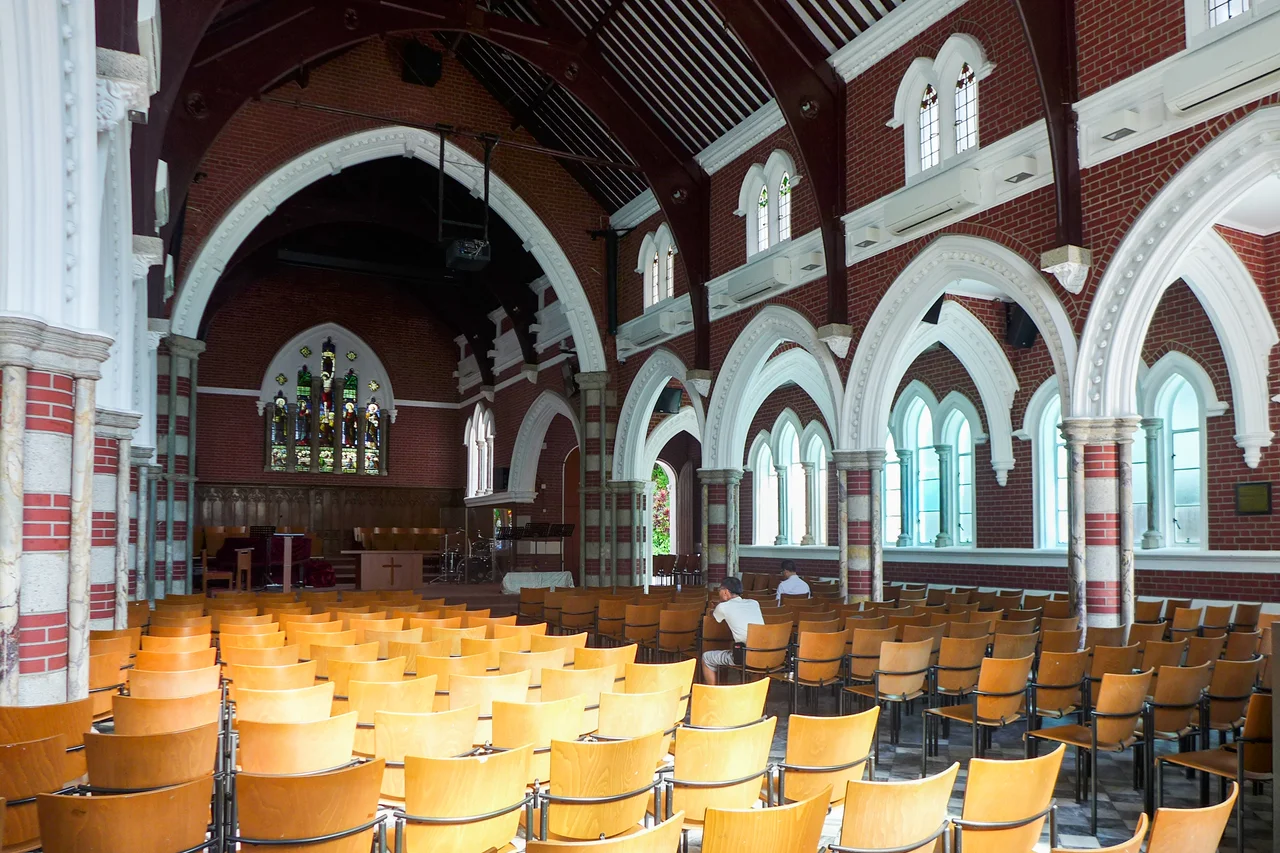

St Andrew's Church, Kowloon
Early in 1945, as the Japanese occupation of Hong Kong entered its final months, the main building of St Andrew's Church on Nathan Road was converted into a Shinto shrine. The congregation had already scattered — many of its members were military personnel who had left for the front in 1914, and those who remained during the Pacific War found their church used for very different purposes. When the congregation of All Saints Mong Kok sheltered at St Andrew's from 1942 to 1944 while their own building served as a rice store, they eventually retrieved much of the furniture before the shrine conversion in 1945 — an act that, inadvertently, saved the contents from destruction. That history of adaptation and survival runs through everything at St Andrew's, a building consecrated in 1906 that still gathers roughly 2,000 people on a Sunday.
Paul Chater's Church
The idea of building an Anglican church in Kowloon was first floated in 1897, but for seven years nothing happened. Progress arrived in 1904 in the form of Sir Catchick Paul Chater, the Hong Kong merchant and property developer who financed the construction. Chater's land holdings in Kowloon were substantial; the site he made available for the church sat between what was then Robinson Road (now Nathan Road) and Austin Road, next to a large garden Chater owned. Alfred Bryer of the architectural firm Leigh & Orange designed the building. Work began in November 1904 and the church was consecrated on 6 October 1906. The stained glass installed in the altar and baptismal windows that year came from William Morris & Co of Westminster, London. Those windows are still there.
Victorian Gothic on Nathan Road
The architectural style Leigh & Orange chose was Victorian Gothic — red brick and granite laid on rammed earth foundations, exterior bricks exposed and pointed with lime-based mortar, interior walls rendered with raised mortar joints painted to suggest the brick beneath. The effect is solid and deliberate, a statement of permanence on a busy commercial street. The original carillon of eight bronze tubular bells from Harrington's of Coventry was installed in 1906 and is still in use. The bell tower once carried a tall spire, but typhoon damage forced its removal. More contemporary Art Nouveau glass was added later in the west window and upper nave windows. To mark the centenary in 2006, two pictorial stained glass windows went into the transepts. The Old Vicarage, completed in 1909, the Amahs' Quarters, and the Verger's Cottage — all in matching red brick with granite detailing — round out a heritage complex; the main church building holds Grade I historic building status, while the ancillary structures are classified Grade II.
Through Two World Wars and a Handover
The years from 1914 to 1918 nearly broke the congregation financially; so many members were stationed at Kowloon's military bases that when they departed for active duty, the church barely sustained itself. The Pacific War brought a different kind of disruption. The Shinto conversion in 1945 was a deliberate erasure — a colonial church made to serve an occupying empire's religion. Liberation came on 9 September 1945, when the first service following the Royal Navy's arrival was held at St John's Cathedral across the harbour; St Andrew's resumed its own rhythm shortly after. In 1947, the first Sunday school was organized. In 1954, a Lych Gate and steps were added to commemorate the 50th anniversary of the foundation stone's laying. Four decades later, in 1997, the church held special services on the Sunday before Hong Kong's handover to China. The morning service, titled "Our Transition and Hope," was broadcast on the BBC World Service.
UNESCO Recognition and a New Building
The centenary refurbishment of 2006 was recognized with an Award of Merit from the UNESCO Asia-Pacific Awards for Cultural Heritage Conservation. The citation praised the project for a "thorough conservation approach which sought to fully understand the building's significance and deterioration process before proposing solutions" — a commendation for taking the building seriously rather than simply freshening its appearance. Three years later, in 2009, the church launched its 2020Vision planning process, which resulted in the Life Centre: a new building at the foot of the hill facing Nathan Road, completed in 2015. It houses a large auditorium and multi-purpose rooms with a landscaped garden on top. The design won a Merit Award from the American Institute of Architects Hong Kong Chapter in 2011, making St Andrew's one of the rare institutions in Hong Kong that has received architectural recognition for both its century-old building and its contemporary addition.
Opposite the Park, Open to the World
St Andrew's stands directly across Nathan Road from Kowloon Park, which means it sits at one of Tsim Sha Tsui's busiest pedestrian junctions. Foot traffic runs through the precinct constantly. The church began as a congregation for the expatriate community; today, 90% of those attending consider Hong Kong home, and services run in English and Putonghua, with Holy Communion at the early Sunday service and on the second and fourth Sundays otherwise. Around 2,000 people pass through the doors each week. The archive now holds over 3,000 sermons available for free streaming. In 2021, a funeral service for TVB actor Liu Kai Chi was held here. The second rector, Rev Hubert Octavius Spink, founded the first scout troop in Hong Kong. The church that nearly didn't survive 1918 has, over a century later, become one of the most active congregations in the city.
From the Air
St Andrew's Church, Kowloon sits at 22.302°N, 114.172°E on Nathan Road in Tsim Sha Tsui, directly opposite Kowloon Park. From the air, the red-brick church and its heritage compound are identifiable within the dense Tsim Sha Tsui urban fabric. Victoria Harbour is less than a kilometer to the south, and the church's position relative to the park provides a useful visual anchor. Best viewed from 1,500–3,000 feet on approach from the south over the harbour. Hong Kong International Airport (VHHH) is approximately 19 nautical miles to the west on Lantau Island.
Nearby Stories
- Lok Ma Chau Loop 2.3 km away
- Portas do Cerco 2.3 km away
- Kweilin Incident 17 km away
- Wanshan Archipelago Campaign 34 km away
- Nanxiong Formation 115 km away
- Battle of Nanpeng Island 148 km away
- Heyuan 169 km away
- Cape Maobitou 632 km away